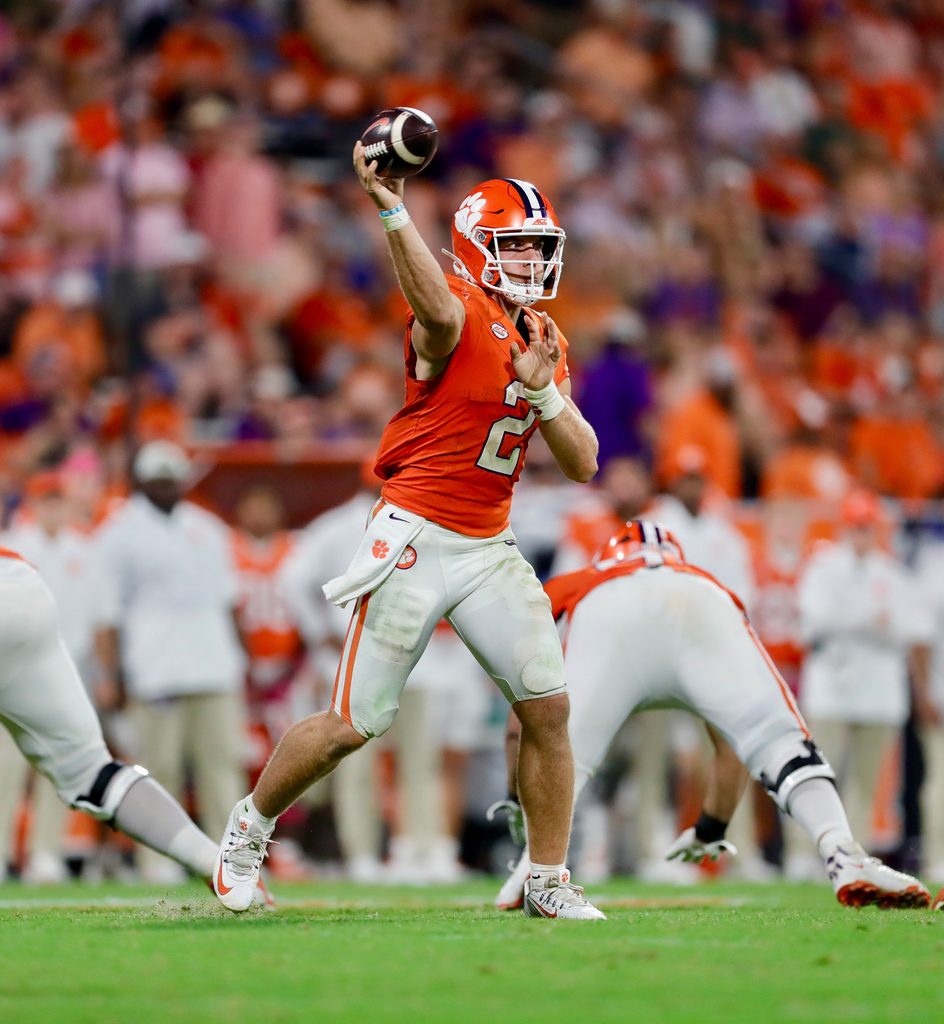
There are games that tell you more about a quarterback in defeat than some victories ever could, and Saturday night against Miami may eventually be remembered that way for Tait Reynolds. Clemson lost 41-13 to one of the most talented teams in the country, and the scoreboard will understandably dominate the immediate conversation, but there was another story unfolding inside the game. Reynolds, making only his third collegiate start, spent much of the night under siege, absorbed a level of punishment that would rattle many young quarterbacks, and continued to compete with the same intensity long after the circumstances had turned against him.
Miami came after Reynolds relentlessly. Clemson’s offensive line struggled to keep the pocket clean, allowing six sacks while the Hurricanes generated roughly 20 pressures over the course of the game. That meant Reynolds rarely had the luxury of operating from a comfortable platform or calmly working through his progressions. Instead, he was forced to speed up his clock, move off his spot, scramble to extend plays and make decisions with defenders closing from multiple directions. For a quarterback with only two previous college starts, it was about as difficult an assignment as Clemson could have handed him, especially against a Miami defense with elite speed and the ability to create pressure without sacrificing coverage integrity.
What stood out was not that Reynolds played a perfect game, because he did not. There were missed opportunities, throws he will want back and a late interception returned for a touchdown that made the final score even more lopsided. The significance of the night was in how he handled the constant stress. Reynolds completed 29 of 44 passes for 295 yards, and while those numbers did not translate into enough points, they reflected a quarterback who kept functioning despite being hit repeatedly and forced to improvise far more often than Clemson would have wanted.
The physical side of that performance was impossible to ignore. Reynolds took hard shots, was driven into the turf, was forced to escape collapsing pockets and repeatedly had to turn broken protection into something salvageable with his legs. What made the performance noteworthy was the absence of visible hesitation afterward. He did not begin playing scared. He did not retreat into checkdowns simply to avoid contact. He continued to stand in when he could, escape when he had to and attack downfield when opportunities appeared.
That matters because toughness at quarterback is more than the ability to survive contact. It is the ability to continue processing the game correctly after the contact starts affecting everything around you. Young quarterbacks often begin to speed up too much when protection breaks down. Their eyes drop toward the rush, their footwork deteriorates and plays that are structurally sound begin to look chaotic because the quarterback is anticipating pressure before it actually arrives. Reynolds had moments where Miami affected him, as any defense producing that level of pressure would, but he never looked overwhelmed by the moment itself.
That distinction is important for Clemson as it evaluates what Reynolds can become. This was not a veteran quarterback operating behind a seasoned offensive line in a controlled environment. This was a player in his third college start facing a top-five opponent with a defensive front capable of wrecking protections and compressing the pocket almost instantly. The situation demanded poise, competitiveness and a willingness to keep attacking despite repeated punishment, and Reynolds showed all three.
There is also an edge to the way Reynolds plays that Clemson should embrace. He carries himself with the kind of competitive intensity that can become contagious inside an offense. The phrase “chip on his shoulder” gets used too casually in football, but with Reynolds it fits because his style reflects it. He does not play like someone waiting for the game to come to him. He plays like someone who wants to challenge the defense, extend plays, prove he belongs and keep pushing even when the circumstances are against him.
That mentality showed up several times against Miami when protection broke down and Reynolds refused to concede the play. Rather than simply eating the sack or throwing the ball away at the first sign of trouble, he used his athleticism to move outside the pocket and give receivers additional time to uncover. Some of those plays ended positively and some did not, but the underlying trait was consistent. Reynolds kept trying to create offense even when the original design had failed.
Clemson desperately needs that type of personality at quarterback because this offense is still searching for consistency around him. The protection has to improve, the running game has to become more dependable and Clemson cannot expect Reynolds to survive week after week while facing the kind of pressure Miami created. No quarterback, regardless of toughness, can operate efficiently if he is constantly forced to create outside the structure of the offense. The responsibility for improvement extends well beyond Reynolds.
At the same time, there are some qualities coaches cannot manufacture, and Reynolds appears to possess several of them naturally. Competitiveness, resilience and the willingness to stand in under pressure are not traits that suddenly appear because they are written on a practice script. They reveal themselves when the game becomes uncomfortable, when the quarterback has already been hit several times, when the scoreboard is moving in the wrong direction and when the easiest response would be to become cautious.
Reynolds never became cautious.
That does not mean Clemson should celebrate a 28-point loss or confuse toughness with success. The Tigers need touchdowns, cleaner protection, better situational execution and a far more complete offensive performance if they expect to compete with teams at Miami’s level. Reynolds himself must continue developing his timing, pocket awareness and decision-making, particularly when pressure forces him to abandon the structure of the play. Those are normal developmental issues for a young quarterback, and nights like Saturday are often where those lessons become permanent.
The encouraging part for Clemson is that Reynolds seems wired to absorb those lessons rather than retreat from them. There is a difference between a quarterback who survives a difficult night and one who grows because of it. Reynolds looked like the latter. Every sack, every hurried throw and every scramble became part of an education that cannot be recreated in practice.
It is easy to develop confidence when protection is clean, receivers are open and the offense is playing with a lead. It is much harder to develop conviction when a defense is attacking from every direction and the quarterback is being asked to solve problems in real time. Reynolds experienced that version of football against Miami, and although the result was painful, he came out of it having shown Clemson something meaningful.
He showed that he is willing to compete when the game becomes difficult.
He showed that contact does not change his personality.
He showed that pressure does not erase his aggressiveness.
Most importantly, he showed Clemson that there may be something worth building around.
The Tigers have a long way to go offensively, and Reynolds remains very early in his development, but quarterback growth is rarely linear. Sometimes it happens during comfortable wins, and sometimes it happens while a player is getting knocked down by one of the best defenses in the country and deciding, snap after snap, that he is going to get back up and keep playing.
Saturday night looked like the latter.
For Tait Reynolds, that may ultimately matter far more than the final score.