There are certain matchups NFL scouts circle long before kickoff because they provide an opportunity to answer questions that ordinary Saturdays simply cannot answer. Clemson cornerback Ashton Hampton walked into one of those matchups Saturday night against Miami, and when it was over, he had done about as much as a defensive back can do to strengthen his professional résumé in a losing effort.
Across from Hampton was Malachi Toney, one of the most explosive receivers in college football and one of the most recognizable offensive players in the country. Toney entered Death Valley as a player capable of taking over a game from almost anywhere on the field, and Miami had spent the first month of the season demonstrating just how difficult its passing attack could be to contain. Clemson ultimately lost 41-13, but anyone evaluating Hampton individually should come away from the night with an entirely different conclusion.
Toney was targeted nine times and finished with only five receptions for 40 yards, an average of eight yards per reception. He never produced the explosive receiving performance that has become expected of him, and Clemson’s coverage repeatedly forced Miami quarterback Darian Mensah to look elsewhere. Hampton finished with three tackles and two pass breakups, including a critical breakup on fourth down early in the second half when Mensah attempted to find Toney.
That is exactly the type of performance NFL evaluators want to see from a player who is trying to move from “very good college cornerback” into the first-round conversation.
Hampton did not build his reputation Saturday night, because that reputation was already growing rapidly. What he did against Miami was provide another significant piece of evidence that his ceiling may be considerably higher than many believed entering the season.
The Assignment Could Not Have Been Much Tougher
Cornerback is one of the few positions in football where success often results in a player disappearing from the television screen. Quarterbacks stop looking in his direction. Offensive coordinators alter formations to create more favorable matchups. Receivers begin seeing bracket coverage, safety help or releases designed specifically to avoid allowing a cornerback to dictate the matchup.
Against Miami, Clemson’s secondary succeeded in preventing one of the country’s most dangerous passing attacks from routinely creating explosive plays on the perimeter. Mensah completed 18 of 27 passes for 227 yards, but his nine incompletions were actually his most in a game this season. Clemson also held Miami’s two leading receiving threats, Toney and Cooper Barkate, to 10 combined receptions. Barkate produced a 61-yard touchdown on Miami’s opening possession, but after that explosive play Clemson largely kept the Hurricanes’ primary receiving weapons in front of them.
Toney’s line is particularly revealing because this was not a situation in which Miami simply forgot about him. Nine targets demonstrate that the Hurricanes repeatedly attempted to involve their star receiver. Five completions for 40 yards demonstrate how little damage those opportunities ultimately produced.
For a cornerback, that difference matters.
The question NFL teams ask is not simply whether a player can cover an average college receiver. They want to know whether he can line up against somebody with NFL-caliber acceleration, change of direction, ball skills and route-running ability and survive without requiring the defense to redesign itself around the matchup.
Saturday night provided Hampton with exactly that examination.
He passed it.
Hampton’s 2026 Season Has Been Building Toward This
The Miami performance should not be treated as an isolated night. Hampton has been building momentum since Clemson opened the season at LSU.
Against LSU, the 6-foot-2, 205-pound junior recorded two tackles, half a tackle for loss and an interception. He followed that with three tackles and a career-high three pass breakups against Georgia Southern, then added four tackles and another breakup against North Carolina. At California, Hampton produced four tackles and matched his career high with three additional pass breakups. Clemson’s official records credited him with three tackles and two more breakups against Miami.
Add those first five games together and Hampton has produced 16 tackles, an interception and nine pass breakups during the opening stretch of the 2026 season.
Those nine breakups are especially significant. Clemson noted after the Miami game that Hampton became the first Tiger in at least 30 years to record multiple passes defended in three of the first five games of a season, according to the school’s game-stat records.
Those are not empty statistics accumulated against inferior competition, either. Clemson opened at No. 11 LSU and has already asked Hampton to handle difficult assignments against multiple Power Four opponents before Saturday’s meeting with fourth-ranked Miami.
The competition level makes the production more meaningful.
This Did Not Start in 2026
Hampton’s emergence should not surprise anyone who has followed his Clemson career closely.
He showed flashes almost immediately as a freshman in 2024, finishing the season with 27 tackles, five passes defended and two interceptions, including a 53-yard interception return for a touchdown. His performance earned Freshman All-America recognition and established him as one of Clemson’s next major defensive prospects.
His responsibilities increased dramatically in 2025. Hampton became a full-time starter and produced 47 tackles, three tackles for loss, a sack, an interception and 11 pass breakups according to Clemson’s official biography. Perhaps even more impressive for a cornerback, Clemson’s feature on Hampton noted that he did not surrender a touchdown while in primary coverage during the 2025 season.
That progression is exactly what NFL scouts want to see. Hampton was talented as a freshman, became dependable as a sophomore and now appears to be developing into a legitimate shutdown option as a junior.
The physical characteristics have always been obvious. At approximately 6-foot-2 and 205 pounds, Hampton possesses the size NFL teams increasingly value on the outside. He has the length to disrupt receivers at the line of scrimmage, enough recovery speed to survive vertically and the frame to compete against bigger receivers at the catch point. His background as a high school safety also helps explain why he appears comfortable playing with physicality rather than simply functioning as a finesse cover corner. Clemson’s own profile notes that Hampton finished his prep career with 192 tackles and six interceptions on defense, evidence of the instincts and willingness to tackle that existed before he ever arrived on campus.
What appears to be changing now is the consistency.
He is no longer merely flashing NFL traits. He is beginning to stack NFL-level performances.
The Miami Tape Will Matter in Draft Rooms
This is where Saturday night becomes especially important.
Mock drafts in September and October are obviously projections, and nobody should pretend the 2027 NFL Draft order is settled months before the season ends. Hampton, however, had already entered legitimate first-round discussions before facing Miami.
Todd McShay recently projected Hampton to the Detroit Lions with the 25th selection and graded him highly enough to place him among the better prospects in the class. Another current consensus board tracked Hampton around the top 30 overall, with individual mock projections ranging considerably higher.
Even more telling, one NFL-focused preview published before the Miami game identified Hampton as one of the premier prospects scouts should watch that weekend specifically because of his matchup with Toney. The article described Toney as a Heisman contender and pointed to Hampton’s coverage performance as one of the major evaluation points of the game.
That is important because draft stock is not built solely from statistics. It is built from tape against comparable talent.
Scouts want answers to specific questions. Can the cornerback survive against elite speed? Can he stay attached through the route? Can he recover when the receiver gains leverage? Can he locate the ball without panicking? Can he tackle after the catch? Can he play confidently when the opposing offense knows exactly who is covering its best receiver?
Toney provided Hampton with an NFL-style examination.
Five catches for 40 yards is a strong answer.
Is Hampton the No. 1 Cornerback in the Draft?
Calling anyone the unquestioned No. 1 cornerback in October would be premature, because the evaluation process still has months remaining and several highly regarded defensive backs will be competing for that distinction.
But Hampton has unquestionably earned his way into that conversation.
There is a difference.
Before the season, Hampton could reasonably be described as an intriguing NFL prospect with first-round tools. After five games, including a showcase performance against one of the country’s premier receivers, there is now a legitimate argument that he belongs among the first cornerbacks discussed when teams begin constructing their 2027 boards.
His combination of size, length, experience and production is difficult to ignore. The interception at LSU demonstrated ball skills. The repeated pass breakups demonstrate that he can contest throws even when quarterbacks challenge him. The absence of touchdown receptions in his primary coverage during 2025 demonstrated consistency over an entire season. The Toney matchup demonstrated that those traits can translate when the level of competition increases dramatically.
There will be additional tests, and Hampton will undoubtedly have snaps he wants back during the remainder of the season. That is the nature of playing cornerback, particularly against Power Four receivers. The position almost guarantees that eventually someone is going to make a play against you.
The best corners respond by winning the next snap.
Hampton increasingly looks like one of those players.
Clemson Lost the Game, But Hampton Won His Matchup
The difficulty in evaluating individual players after a 41-13 loss is separating the scoreboard from the actual performance. Miami clearly won the football game and deserved to win it, but that does not mean every matchup on the field belonged to the Hurricanes.
The Hampton-Toney matchup certainly did not.
Miami arrived with one of college football’s most dangerous receiving weapons. Clemson countered with one of college football’s fastest-rising cornerbacks. For four quarters, Hampton and the Tigers’ coverage kept Toney from becoming the player who decided the game.
Miami eventually found production elsewhere. Barkate delivered the early explosive touchdown. The Hurricanes ran the football effectively in the second half, controlled possession and allowed their defense to overwhelm Clemson’s offense. Toney, however, never took over the game.
For Hampton, that matters beyond one Saturday night.
Every NFL scout evaluating him now has another piece of tape to study, and this particular piece comes with a label that carries weight: Clemson versus Miami, primetime, Death Valley, elite receiver across the formation.
That is the environment in which future first-round cornerbacks are supposed to distinguish themselves.
Ashton Hampton did exactly that.
His draft stock was already climbing before Miami arrived in Clemson. After holding Malachi Toney to five receptions for 40 yards while adding two more pass breakups to what has become an outstanding start to the season, Hampton has strengthened his argument to be viewed not simply as one of the better corners in college football, but as one of the premier defensive prospects available in the 2027 NFL Draft.
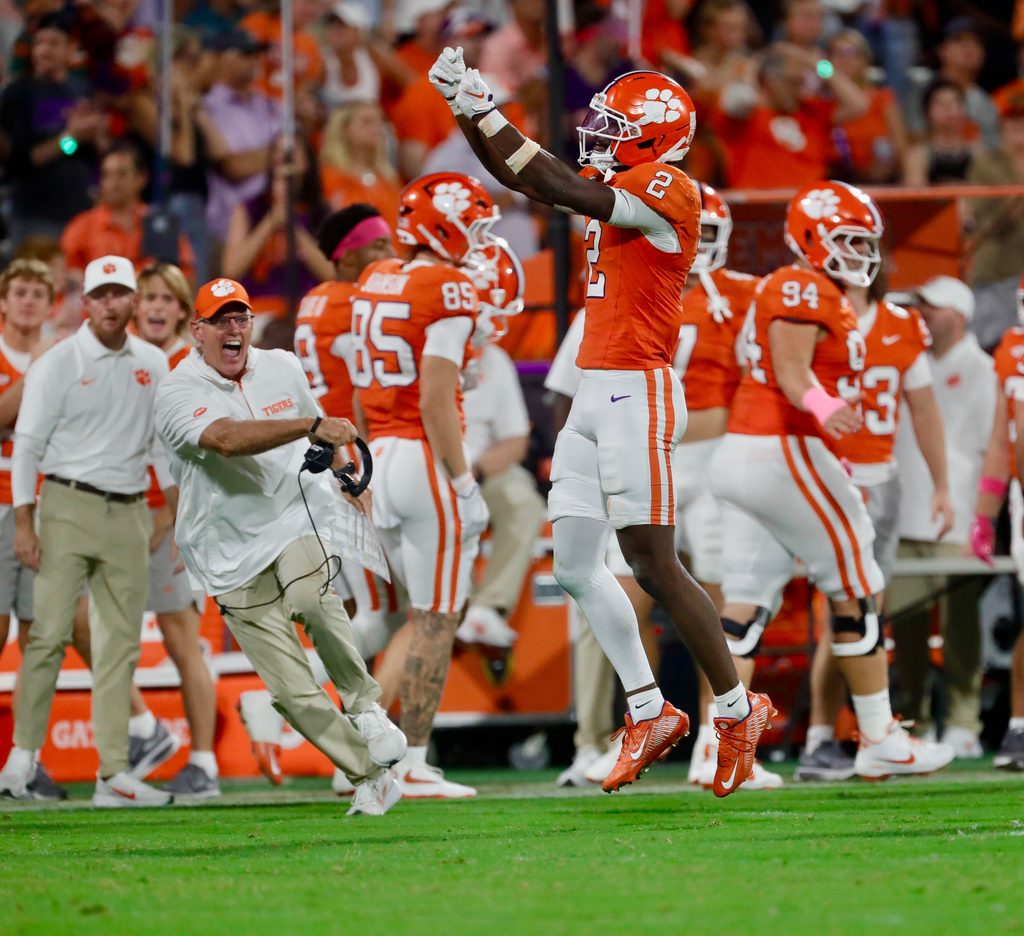
Clemson may have walked away from Saturday night disappointed in the result, but the NFL evaluation of No. 2 is heading in the opposite direction.
Ashton Hampton’s stock is going up.