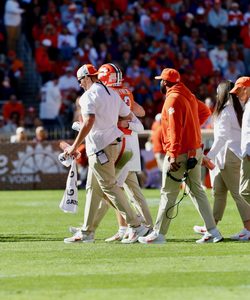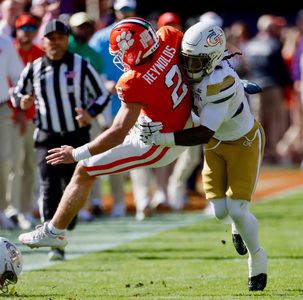
With Tait Reynolds sidelined, Trent Pearman taking over at quarterback, and injuries mounting across the roster, Clemson faces one of its toughest challenges of the season against a dangerous Duke team.
By Clemson Sports News | November 20, 2026
DURHAM, N.C. — What was supposed to be another opportunity for Clemson to build momentum heading into its annual rivalry showdown with South Carolina has instead become a Friday night survival test.
The Tigers travel to Durham to face the Duke Blue Devils on Friday, November 20, at 7:30 p.m. on ESPN, and the circumstances surrounding this matchup could hardly be more troubling for Dabo Swinney and his football program.
Clemson enters the contest at 6-4 overall and 4-3 in Atlantic Coast Conference play, coming off an embarrassing 20-6 home loss to Georgia Tech. Duke, meanwhile, stands at 7-3 overall and 4-3 in conference play under head coach Manny Diaz, with a productive offense, an outstanding rushing defense and one of the most dangerous running backs in college football.
But Clemson’s problems go considerably deeper than one disappointing performance.
The Tigers have lost their starting quarterback, are preparing to start their third option at the position, and are dealing with a growing injury list that threatens to affect nearly every phase of Friday night’s game.
And perhaps most concerning of all, Clemson’s struggling offense must find a way to move the football against a Duke defense that has made stopping opposing rushing attacks one of its greatest strengths.
For a Clemson team that has struggled to establish offensive consistency throughout the season, the matchup could not come at a worse time.
From Reynolds to Pearman: Clemson’s Quarterback Situation Reaches a Critical Point
The biggest storyline entering Friday night’s game is unquestionably Clemson’s quarterback situation.
Starting quarterback Tait Reynolds suffered a knee injury on the third offensive play against Georgia Tech, an injury that required surgery to repair a torn meniscus in his left knee and ended his season.
Reynolds had thrown for 1,449 yards and rushed for another 334 yards this season. While his passing numbers were hardly spectacular, his mobility provided Clemson with an additional offensive dimension.
That dimension is now gone.
Backup Christopher Vizzina is also unavailable after suffering a concussion against Georgia Tech, leaving Clemson with little choice but to turn to Trent Pearman as its starting quarterback against Duke.
Freshman Brock Bradley is expected to serve as Pearman’s backup, while Chris Denson has returned to the quarterback room to provide additional depth.
For Pearman, the assignment is enormous.
He isn’t simply being asked to manage a football game. He is being asked to direct an offense that has struggled for much of the season, behind an offensive line that has had difficulty consistently protecting its quarterbacks and creating running lanes.
And now he must do it on the road, in a nationally televised conference matchup, against a defensive-minded head coach who will undoubtedly look to exploit Clemson’s limitations.
Pearman completed just two of six passes for six yards in relief against Georgia Tech. For the season, he has thrown for 86 yards with two interceptions.
Those numbers hardly inspire confidence heading into a matchup against one of the ACC’s better defensive units.
Expect Duke to crowd the line of scrimmage, challenge Clemson’s receivers in coverage and force Pearman to prove he can consistently beat the Blue Devils through the air.
If Clemson cannot establish the running game, Pearman could find himself facing an almost impossible situation.
Clemson’s Injury Report: The Problems Extend Well Beyond Quarterback
Clemson’s injury situation has become a major storyline, and Thursday’s updated ACC availability report delivered even more bad news.
In addition to Reynolds and Vizzina, the Tigers will be without several important contributors, including wide receiver Tyler Brown, linebacker Jeremiah Alexander, defensive tackle Champ Thompson and offensive guard Easton Ware.
Starting cornerback Elliot Washington II remains questionable, leaving another significant question surrounding Clemson’s defensive personnel.
Other players listed as out include defensive backs Donovan Starr, Corian Gipson, Polo Anderson and Shavar Young Jr., defensive tackle Vic Burley, wide receiver Cole Turner, running back David Eziomume and offensive linemen Mason Wade and Braden Wilmes.
Running back Gideon Davidson and offensive lineman Harris Sewell are listed as probable.
The absence of Brown is particularly damaging considering Clemson’s quarterback situation.
The Tigers need every experienced receiver available to help Pearman settle into the offense, and losing another target makes an already difficult assignment even harder.
Ware’s absence creates another problem along an offensive line that has struggled throughout the season.
Defensively, the losses of Alexander and Thompson threaten Clemson’s ability to defend the run, precisely where Duke is most dangerous.
And then there’s Washington.
Washington has been one of Clemson’s most productive defensive playmakers, leading the Tigers with five interceptions. His ability to make plays on the football has been a significant part of Clemson’s defensive success.
With several other defensive backs already unavailable, losing Washington would further weaken a secondary that has frequently helped keep Clemson competitive despite the offense’s shortcomings.
The Tigers are simply running out of healthy, experienced bodies at critical positions.
By the Numbers: Duke Holds a Significant Statistical Advantage
A look at the season statistics entering Friday night’s matchup reveals just how difficult this assignment could be for Clemson.
OFFENSIVE STATISTICS
- Points per game: Clemson 21.0 | Duke 32.2
- Total offense: Clemson 327.0 | Duke 416.7
- Passing yards per game: Clemson 180.6 | Duke 232.2
- Rushing yards per game: Clemson 146.4 | Duke 184.5
- Third-down conversions: Clemson 29.8% | Duke 42.0%
DEFENSIVE STATISTICS
- Points allowed per game: Clemson 20.6 | Duke 15.3
- Total yards allowed per game: Clemson 342.1 | Duke 307.1
- Rushing yards allowed per game: Clemson 137.0 | Duke 101.0
- Passing yards allowed per game: Clemson 205.1 | Duke 206.1
- Opponent third-down conversion rate: Clemson 30.9% | Duke 28.9%
The numbers paint a troubling picture for Clemson.
Duke generates nearly 90 more yards of offense per game and scores approximately 11 more points than the Tigers.
Defensively, the Blue Devils surrender considerably fewer points and are particularly effective against the run.
But perhaps the most alarming statistical comparison involves third downs.
Clemson converts just 29.8% of its third-down opportunities, ranking near the bottom of the FBS, while Duke’s defense allows opponents to convert only 28.9% of the time.
That is a potentially devastating matchup for an offense already struggling to sustain possessions.
If Clemson finds itself repeatedly facing third-and-seven, third-and-eight or longer, the Tigers could spend much of Friday night punting the football away.
Duke’s Rushing Defense Could Be Clemson’s Biggest Nightmare
Of all the statistical mismatches entering Friday night’s contest, none appears more significant than Clemson’s running game against Duke’s rushing defense.
The Blue Devils are allowing just 101 rushing yards per game, a figure that places them among the nation’s better run defenses.
For Clemson, the challenge is obvious.
With Pearman making the start, the Tigers desperately need to establish a productive rushing attack. They cannot reasonably expect an inexperienced quarterback to throw 35 or 40 times against this defense and consistently move the football.
But running the ball has been an ongoing problem.
The Tigers average 146.4 rushing yards per game, and that figure doesn’t tell the entire story of their offensive struggles. Clemson has too frequently been unable to generate consistent movement up front when facing quality defensive fronts.
Gideon Davidson, who has rushed for 528 yards and five touchdowns on 105 carries, is expected to return after dealing with an ankle injury. Jarvis Green has contributed another 249 rushing yards.
Their availability gives Clemson options, but the offensive line must create opportunities for them.
Duke will likely load the box, challenge Clemson to run between the tackles and force Pearman into uncomfortable passing situations.
If the Blue Devils can shut down Clemson’s rushing attack without sacrificing coverage downfield, they could control the entire game defensively.
And that brings us to another major concern: Clemson’s inability to finish drives.
Against Georgia Tech, the Tigers managed only two field goals. Against Duke, even moving the football between the 20-yard lines may prove difficult.
Duke’s Nate Sheppard: A Major Problem for Clemson’s Defense
While Clemson is searching for offensive answers, Duke already has one of the nation’s most productive offensive weapons.
Sophomore running back Nate Sheppard has emerged as the centerpiece of the Blue Devils’ attack.
Sheppard enters Friday night’s game with 1,320 rushing yards, a Duke single-season record, and has become a legitimate national award contender.
His performance against Miami last weekend was particularly impressive.
Against the Hurricanes, Sheppard rushed for 131 yards on 16 carries while adding 12 receptions for 93 yards.
That’s 224 yards from scrimmage against one of the country’s better football teams.
Sheppard is more than a traditional running back. His combination of vision, acceleration, receiving ability and explosiveness makes him dangerous in several different ways.
He can run between the tackles, bounce outside, catch passes in space and turn an ordinary play into a significant gain.
For Clemson’s defense, containing Sheppard must be the first priority.
But with Alexander and Thompson unavailable, the Tigers face an uphill battle controlling the line of scrimmage.
Duke’s offensive staff will almost certainly test Clemson’s depleted defensive front early and often.
If Sheppard begins finding running lanes, the Blue Devils can control possession, wear down Clemson’s defense and limit the opportunities available to Pearman and the Tigers’ offense.
And considering Clemson’s inability to sustain drives, that could become a major factor as the game progresses.
Duke’s Passing Attack Adds Another Dimension
Although Sheppard commands much of the attention, Duke is not simply a one-dimensional running team.
Quarterback Walker Eget enters the matchup with more than 2,000 passing yards, giving the Blue Devils a capable passing attack to complement their ground game.
Wide receiver Jonah Burton leads Duke with more than 400 receiving yards.
Eget’s ability to distribute the football creates additional concerns for Clemson.
If the Tigers commit extra defenders to slowing Sheppard, Duke can look for opportunities downfield or attack favorable matchups against Clemson’s injury-depleted secondary.
The availability of Washington could become especially important in those situations.
Clemson has been reasonably effective defensively this season, allowing approximately 205 passing yards per game while generating 15 takeaways.
Safety Corey Myrick leads the Tigers with 77 tackles, while linebacker Sammy Brown has recorded 70 tackles. Defensive end Will Heldt has seven sacks.
Those are legitimate defensive strengths.
The question is whether Clemson can produce enough stops to overcome what figures to be another difficult offensive performance.
Clemson’s Defense May Have to Carry the Entire Load
There is one area where Clemson still has a realistic opportunity to make this game competitive: defense.
Despite the disappointing season, the Tigers have shown the ability to pressure quarterbacks, create turnovers and prevent opponents from consistently scoring touchdowns.
Against Georgia Tech, Clemson surrendered 20 points. That wasn’t an ideal performance, but it should have been manageable for an offense capable of producing even a modest scoring output.
Instead, Clemson managed six points.
That has become the recurring problem.
The defense can play well enough to give Clemson a chance, but the offense has struggled to take advantage.
Friday night could follow the same pattern.
Clemson might force Duke into several punts, generate a turnover or two and keep the game within reach deep into the second half.
But unless the Tigers can produce sustained offensive drives, the defense will eventually begin to wear down.
And against a back as dangerous as Sheppard, fatigue can quickly become a major factor.
Five Keys That Will Decide Friday Night
1. Can Clemson establish any running game?
If Davidson and Green cannot generate positive yardage on early downs, Pearman will face a long evening. Duke’s rushing defense is simply too good to allow Clemson to become one-dimensional.
2. Can Pearman avoid costly turnovers?
Clemson cannot afford to give Duke short fields. A conservative game plan may be necessary, but the Tigers still need to take occasional chances to prevent the Blue Devils from crowding the line of scrimmage.
3. Can Clemson contain Nate Sheppard?
Holding Sheppard below his season production would give the Tigers a fighting chance. Allowing him to control the game could make Duke extremely difficult to beat.
4. Can Clemson’s depleted secondary hold up?
Washington’s status is critical, particularly with other defensive backs already unavailable. Duke has enough balance offensively to exploit favorable matchups.
5. Can the Tigers finish drives?
Clemson cannot continue settling for field goals or coming away empty-handed when opportunities arise. Against Duke’s defense, those opportunities may be limited.
CSN Preview and Prediction: Duke’s Defense and Running Game Prove Too Much
Clemson has demonstrated throughout the season that it can compete defensively against quality opponents.
Unfortunately, the Tigers have also demonstrated that they cannot consistently generate enough offense to capitalize on those defensive performances.
Friday night’s matchup presents almost every offensive problem Clemson has experienced this season, magnified by injuries and a difficult opponent.
The loss of Reynolds removes Clemson’s starting quarterback. The absence of Vizzina eliminates its primary backup. Pearman must now step into an extraordinarily difficult situation against a Duke defense allowing barely 100 rushing yards per game.
And without a reliable running game, Clemson’s offense could become painfully predictable.
Expect the Tigers to lean heavily on short passes, conservative play-calling and an effort to avoid turnovers. Clemson’s defense should keep Duke from completely running away with the game, particularly early.
But Sheppard’s ability to produce explosive plays, combined with Duke’s defensive advantage, should gradually tilt the game in the Blue Devils’ favor.
Look for Duke to establish a 10-3 or 14-3 halftime advantage while Clemson struggles to sustain possessions.
In the second half, Clemson’s defense may create an opportunity or two, but the Tigers’ offensive limitations will continue to prevent them from mounting a meaningful comeback.
Nolan Hauser could once again account for virtually all of Clemson’s scoring, with three field goals providing the Tigers’ only points.
Duke, meanwhile, should be able to generate three touchdowns through its balanced offensive attack, with Sheppard playing a major role.
The Blue Devils won’t necessarily dominate every statistical category, but they should control the areas that matter most: rushing production, field position, third-down efficiency and offensive execution.
FINAL PREDICTION: DUKE 21, CLEMSON 9
For Clemson, the result would represent another frustrating chapter in a season that has fallen far short of expectations.
A loss would drop the Tigers to 6-5 heading into their regular-season finale against archrival South Carolina, with the possibility of a losing regular-season record suddenly becoming very real.
For Duke, a victory would deliver an eighth win and another significant accomplishment for Manny Diaz’s program.
Clemson has enough defensive talent to make Friday night interesting.
But with its quarterback situation in disarray, its offensive line struggling, and its roster depleted by injuries, asking the Tigers to generate enough offense to defeat this Duke team may simply be asking too much.
The Tigers’ defense can keep them in the fight. The offense, unfortunately, may not have enough left to win it.
Clemson Sports News Prediction: Duke 21, Clemson 9.