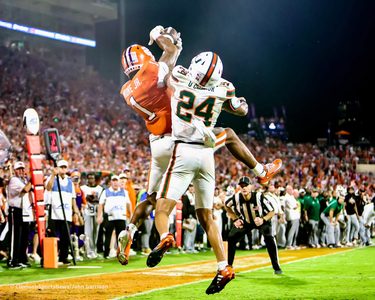
Clemson’s secondary has spent the last two weeks quietly changing the story around its pass defense. On Friday night, there will be nothing quiet about the test waiting for it. California quarterback Jaron-Keawe Sagapolutele — JKS — has the arm, confidence and production of a future NFL prospect, and he gives Clemson’s reconstructed back seven an opportunity to show just how far it has come
There are matchups within every football game, but occasionally one stands above the rest.
For Clemson’s first trip to Berkeley, this is it.
Forget for a moment about Clemson’s freshman quarterback situation, the late 10:30 p.m. Eastern kickoff, the cross-country travel and all the other storylines surrounding Friday night’s ACC matchup at California Memorial Stadium. When Cal has the football, the game becomes a fascinating examination of two units seemingly moving toward one another from opposite directions.
On one side is a Clemson secondary and back seven that was exposed badly in Baton Rouge but has improved statistically in virtually every important passing category in the two games since.
On the other is Jaron-Keawe Sagapolutele, the 6-foot-3, 225-pound sophomore left-hander everybody simply calls JKS, one of the most talented young quarterbacks in college football.
Dabo Swinney did not undersell him this week, calling Sagapolutele an “100% NFL quarterback” and praising his elite arm talent. NFL projections remain premature for a sophomore who is not yet draft eligible, but the long-term trajectory is obvious enough that evaluators are already tracking him closely.
And that makes Friday night perhaps the cleanest measuring stick Clemson’s defensive backs have received in 2026.
JKS Is More Than a Three-Game Hot Streak
Sagapolutele’s emergence didn’t begin against Wagner last weekend.
As a true freshman in 2025, he started all 13 games for California and completed 316 of 492 passes for 3,454 yards and 18 touchdowns. His passing yardage, completions, attempts and touchdowns were all second in Cal freshman history only to Jared Goff, and he opened his career with 13 consecutive 200-yard passing performances.
That was the introduction.
Year Two appears to be the acceleration.
Through three games in 2026, JKS has completed 72 of 108 passes — 66.7 percent — for 866 yards, seven touchdowns and two interceptions, producing a 151.7 NCAA passer rating and averaging 8.0 yards per attempt. His 866 passing yards rank fourth in the ACC entering Clemson week.
The progression inside those three games is worth noticing.
Against UCLA, Sagapolutele completed 24 of 41 for 271 yards with two touchdowns and two interceptions. Against Syracuse, he became more efficient: 21 of 34 for 182 yards, two touchdowns and no picks.
Then came Wagner.
Twenty-seven completions.
Thirty-three attempts.
413 yards. Three touchdowns. Zero interceptions.
That is an 81.8-percent completion rate and 12.5 yards per attempt, and he did most of his damage in roughly two and a half quarters before Cal emptied the bench in a 49-7 victory.
Yes, Wagner is Wagner.
Clemson is not Wagner.
But arm talent travels, accuracy travels, and confidence travels from one Saturday to the next. Clemson isn’t preparing for a quarterback hoping to discover his game Friday night. It is facing one who arrives believing he already has it.
Clemson’s Numbers Are Moving in Exactly the Opposite Direction
This is what makes the matchup so compelling.
Clemson’s first defensive performance of 2026 provided very little encouragement. LSU accumulated 644 total yards and 335 through the air in a 51-10 demolition in Baton Rouge. Clemson’s defense looked stretched horizontally, vulnerable vertically and unable to consistently get off the field.
But isolate the passing numbers over the first three weeks and there is a clear progression.
Against LSU, opposing quarterbacks combined to complete 22 of 36 passes for 335 yards, a 61.1-percent completion rate and a staggering 9.3 yards per attempt.
Against Georgia Southern, Clemson reduced that to 27 of 48 for 244 yards — 56.3 percent and only 5.1 yards per attempt.
Then North Carolina’s Billy Edwards Jr. finished 13 of 30 for 135 yards, one touchdown and one interception. That’s 43.3 percent completions and 4.5 yards per attempt.
Look at that progression again:
9.3 yards per attempt.
5.1.
4.5.
The opponent completion rate has similarly moved from 61.1 percent to 56.3 to 43.3.
Through all three games, Clemson opponents have completed only 54.4 percent of their passes, tied for third-best in the ACC, and the Tigers have allowed a 115.07 opposing passer-efficiency rating. Over only the last two games, the numbers are even stronger: opponents are completing 51.3 percent while averaging only 4.9 yards per attempt.
Those aren’t cosmetic improvements.
Something is beginning to happen in Clemson’s coverage.
Friday night will tell us a lot more about whether it is sustainable.
Ashton Hampton Has Become the Corner Clemson Needed
The centerpiece is Ashton Hampton.
When Avieon Terrell departed early for the NFL after becoming a second-round selection, Clemson needed somebody to become the stabilizer on the outside. Hampton entered 2026 with 1,150 career defensive snaps, 17 pass breakups and three interceptions, making him easily the most experienced returning piece of Clemson’s cornerback room.
So far, he has responded.
Hampton intercepted LSU on the second play of the season. Against Georgia Southern, he recorded a career-high three pass breakups. Against North Carolina, he added another breakup.
That matters against JKS because Clemson cannot survive Friday by simply sitting in passive coverage and surrendering easy throws underneath.
Cal wants Sagapolutele comfortable.
Clemson has to make him uncomfortable without becoming reckless.
That means Hampton and the other Clemson corners — including veteran transfer Elliot Washington II, Branden Strozier and others in the rotation — have to hold up when Tom Allen chooses to add bodies to the pressure package.
Washington already provided one of Clemson’s biggest defensive plays of the young season. With North Carolina attempting one final drive last Saturday, Washington intercepted Edwards with 37 seconds remaining to finish the 28-20 victory.
The significance extends beyond the turnover.
Clemson’s defensive backs are beginning to make plays on the football, rather than merely making tackles after catches.
That distinction will be enormous in Berkeley.
Clemson Rebuilt the Safety Room for a Game Exactly Like This
Remember what Clemson did during the offseason.
The Tigers didn’t simply shuffle players around at safety. They attacked the position.
Jerome Carter III arrived from Old Dominion after intercepting six passes in 2025, tied for second nationally. Corey Myrick brought experience from Marshall and Southern Miss. Ronan Hanafin returned after transitioning from receiver to safety and finishing third on Clemson’s 2025 team with 72 tackles.
Those additions were made because Clemson knew its pass defense needed to change.
And Myrick has quickly become an important part of it.
He had 10 tackles against LSU, six against Georgia Southern and then a team-high 11 against North Carolina. Carter recorded 11 against LSU, five against Georgia Southern and six against UNC.
That is a lot of activity from the safeties.
Against JKS, however, Clemson would prefer some of those tackles occur before an underneath completion becomes a 20-yard gain.
That’s where eyes and angles become critical.
Sagapolutele can make every portion of the field available. At 6-foot-3 with a powerful left-handed delivery, he doesn’t need an exaggerated throwing window to attack between zones. If Clemson’s safeties become overly aggressive toward run action or allow their eyes to be manipulated, JKS has enough arm to make them pay before they can recover.
Conversely, if Myrick, Carter and Hanafin can keep the ball in front of them and Clemson can rally to underneath throws, Sagapolutele may be forced to repeatedly drive the field rather than generating explosives.
That’s a very different football game.
Sammy Brown Is Part of the Pass Defense, Too
Calling this merely “Clemson’s defensive backs versus JKS” doesn’t quite cover it.
This is Clemson’s back seven versus JKS.
And that brings Sammy Brown directly into the conversation.
Brown’s development has reached the point where his role goes far beyond running downhill and destroying ball carriers. He has spoken openly about learning not only his assignment but the entire structure of Clemson’s defense — what the defense is showing, how the disguise works and what coverage Clemson is attempting to create.
That is particularly valuable against a quarterback like Sagapolutele.
The easiest quarterbacking happens when the picture before the snap remains the picture after the snap.
Clemson doesn’t want to give JKS that luxury.
Brown, Jeremiah Alexander and Clemson’s safeties give Tom Allen pieces he can move around before the snap. Clemson can threaten pressure and retreat. It can present a two-high structure and rotate late. It can walk a linebacker into a gap and force Sagapolutele to account for him before dropping that defender underneath an anticipated throwing lane.
The objective isn’t to produce exotic defense for the sake of being exotic.
It’s to make a sophomore quarterback spend an additional half-second identifying what he is seeing.
Because that half-second might be all Will Heldt needs.
Coverage and Pass Rush Have Finally Started Working Together
Here’s another trend that cannot be ignored.
Heldt has produced two sacks in consecutive games, giving him four over Clemson’s last two contests. Clemson sacked Georgia Southern three times and North Carolina three times.
That isn’t separate from the secondary’s improvement.
It’s connected to it.
Great pass rush helps coverage.
Good coverage buys time for a pass rush.
And Clemson has begun to produce more examples of the two working together instead of independently.
Cal has protected Sagapolutele reasonably well. He has been sacked only four times through 108 attempts this season.
So Clemson cannot assume Heldt and the front four will simply wreck Cal’s protection.
The back end may have to create those opportunities.
If Hampton and Washington can disrupt the outside release, if the safeties eliminate the first vertical window and if Brown can close an interior passing lane, the clock inside Sagapolutele’s head changes.
Three seconds becomes four.
Four becomes movement inside the pocket.
Movement becomes Heldt getting home.
That is where Clemson can change the game without sending six defenders every snap.
Cal Can Make Clemson Defend Every Blade of Grass
Sagapolutele isn’t working alone.
Cal has gradually surrounded him with enough variety to make defensive coordinators defend the entire field.
Chase Hendricks caught nine passes for 98 yards against Wagner. Kyion Grayes also totaled 98 receiving yards in that game, including an 80-yard touchdown. Running back Adam Mohammed added a 65-yard touchdown reception and finished with 78 receiving yards while also rushing for 91 yards. Eleven different Bears caught at least one pass.
That’s the issue.
Double one receiver and JKS doesn’t necessarily have to force him the football.
Play too soft outside and Cal can take underneath completions.
Become too aggressive underneath and Sagapolutele possesses enough arm to attack over the top.
Commit too much attention to the receivers and Mohammed becomes another matchup problem coming out of the backfield.
Cal’s overall offensive numbers illustrate where its identity sits. The Bears are averaging 321.7 passing yards per game as a team compared with only 106.7 rushing yards, and 40 of their 68 first downs have come through the air.
This is not difficult to decipher.
Clemson is going to be challenged through the air.
Repeatedly.
The Most Important Number May Be the Explosive Pass
Clemson does not necessarily have to hold Sagapolutele to 135 yards the way it did Billy Edwards.
Expecting that would ignore what JKS and this Cal passing game can do.
A more realistic defensive objective is to make those yards expensive.
Make Cal snap it again.
And again.
And again.
If Sagapolutele completes a five-yard throw on first down, Clemson can live with it.
What Clemson cannot live with are 45-, 65- and 80-yard explosives created by one blown leverage assignment, one safety with bad eyes or one missed tackle.
That was one of the largest differences between Baton Rouge and the last two weeks. LSU averaged 9.3 yards every time it attempted a pass against Clemson. Georgia Southern and North Carolina combined were below five.
That is an enormous swing.
It reflects not merely fewer completions, but fewer devastating ones.
Thomas Allen’s Role Bears Watching
Another piece of this defensive evolution shouldn’t be overlooked.
Clemson promoted Thomas Allen to defensive pass game coordinator before the 2026 season after his role with the secondary expanded late in 2025. Dabo Swinney specifically said Allen would work with Clemson’s “back five,” oversee installations and make sure the unit was synchronized.
That synchronization may be Clemson’s biggest challenge Friday.
Sagapolutele is talented enough to expose one defender being wrong.
Not five defenders.
One.
If the corner thinks he has inside help and the safety rotates outside, JKS can find it.
If a linebacker carries a route expecting a safety to replace him and the safety bites on something underneath, JKS can find it.
If Clemson disguises pressure but one defender reveals the coverage too early, JKS can adjust.
This is a game where communication has to travel from one side of the field to the other — in a hostile stadium, after a cross-country trip, late at night Eastern time — against a quarterback specifically equipped to exploit hesitation.
That is the test.
The Chess Match: Can Clemson Make JKS Play Patient Football?
This may ultimately become the question that defines the matchup.
Sagapolutele owns a big arm. Everybody knows it.
So Clemson’s temptation cannot be to prove it can take every throw away.
No defense can.
The objective should be to dictate which throws are available.
Force the checkdown.
Force the five-yard out.
Force the running back underneath.
Then tackle.
Make an offense accustomed to explosive possibilities execute 11 or 12 correct decisions to reach the end zone.
And once Cal gets behind the chains, that’s when Clemson can allow Brown, Alexander, Heldt and the rest of the pressure package to become aggressive.
Second-and-10 matters.
Third-and-7 matters even more.
Those are the situations in which Allen can change pictures and make JKS determine whether the linebacker showing pressure is actually coming, whether the safety is rotating, whether the corner is playing man or trap coverage and whether his first option will still exist after the snap.
That’s where a sophomore quarterback — even an extraordinarily talented one — can be made to work.
Friday Night Will Tell Us What Clemson’s Secondary Really Is
The LSU game created one picture of Clemson’s defense.
The last two weeks have created another.
Now comes the test that may tell us which picture is closer to reality.
Ashton Hampton appears to be settling into the role of Clemson’s No. 1 corner. Elliot Washington has already made a game-closing play. Corey Myrick and Jerome Carter have brought experience and physicality to a safety room that needed both. Sammy Brown’s understanding of the defense continues to expand beyond simply chasing the football. And Clemson’s pass rush has begun arriving more frequently as the coverage behind it has tightened.
The numbers are unquestionably trending in the right direction.
But Jaron-Keawe Sagapolutele represents a different level of examination.
He has already thrown for more than 4,300 yards in his first 16 college games. He’s completing two-thirds of his passes this season. He’s averaging nearly 289 passing yards per game. He’s coming off the first 400-yard performance of his career. And Clemson’s own head coach has already identified the arm talent and future professional potential.
So when Clemson and California kick off under the lights in Berkeley Friday night, keep an eye away from the football immediately after the snap.
Watch Hampton at the boundary.
Watch the safeties rotate.
Watch Brown underneath.
Watch whether JKS is getting the ball out on his first read or holding it.
And then watch Will Heldt coming around the corner.
Because Clemson’s defensive front versus Cal’s offensive line matters.
Clemson’s offense versus Cal’s defense matters.
Special teams will matter.
But when Cal possesses the football, this is the matchup inside the matchup:
JKS versus Clemson’s back seven.
A gifted young quarterback whose trajectory is pointing sharply upward against a Clemson secondary whose numbers are doing exactly the same.
By late Friday night in Berkeley, we should know a whole lot more about both.