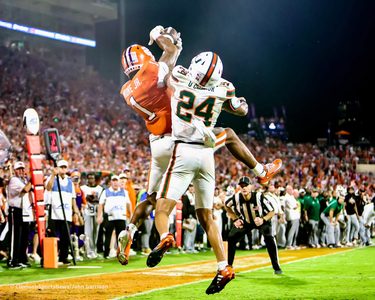
Tigers and Golden Bears Meet Under the Friday-Night Lights in Berkeley
Clemson’s first ACC trip to Berkeley arrives at an interesting point for both programs.
The Tigers enter Friday night at 2-1 overall and 1-0 in the ACC, fresh off a 28-20 comeback victory over North Carolina in which true freshman quarterback Tait Reynolds made his first career start. California is also 2-1 and 1-0 in league play, and the Golden Bears come in after exploding for 626 yards of offense in a 49-7 rout of Wagner. Kickoff is scheduled for 10:30 p.m. Eastern/7:30 p.m. Pacific at California Memorial Stadium on ESPN. ESPN.com
This will be only the second meeting ever between Clemson and Cal. The previous matchup came in the Citrus Bowl following the 1991 season, when Cal won 37-13. The Clemson Insider
But history has little to do with this one.
Friday night’s game presents a fascinating collection of contrasts: Clemson’s emerging freshman quarterback against a Cal secondary already producing turnovers at a remarkable rate; one of the country’s more accomplished young passers in Jaron-Keawe Sagapolutele facing Clemson’s aggressive defensive front; two coaching staffs that have undergone substantial change; and a Clemson team traveling across the country for a conference road game unlike almost anything in the program’s history.
There are matchups everywhere.
Clemson Offense vs. California Defense
The biggest storyline surrounding Clemson’s offense is no longer simply whether it can produce.
It is becoming what the offense looks like with Tait Reynolds running it.
Reynolds took over after Christopher Vizzina was injured against Georgia Southern and threw for 178 yards in relief. Against North Carolina, Dabo Swinney and offensive coordinator Chad Morris gave the freshman his first start. ESPN.com
The beginning was rough.
Reynolds started the UNC game just 5-of-9 for 17 yards, and Clemson found itself trailing 17-3. But from that point forward, something changed. Reynolds finished 20-of-29 for 215 yards and a touchdown, guiding an offense that ultimately accumulated 401 total yards, including 186 rushing. University of North Carolina Athletics
Perhaps more important than the numbers was how the freshman handled the game as it developed.
He stayed in the pocket. He worked through progressions. He became increasingly comfortable pushing the football vertically and attacking the intermediate middle of the field. His 27-yard touchdown strike to tight end Christian Bentancur capped a 92-yard drive and represented arguably Clemson’s most important offensive possession of the young season. Clemson University Athletics
Friday night represents Reynolds’ next test — and a very different one.
Reynolds vs. Cal’s Ball-Hawking Secondary
California has made interceptions a central part of its defensive identity early in 2026.
Through its first two games, Cal ranked first in the ACC with four interceptions, and defensive back Kingston Lopa had all four of them. Lopa intercepted three passes against Syracuse alone, including a pick-six, and was named ACC Defensive Back of the Week as well as receiving national defensive honors. California Golden Bears Athletics
Then against Wagner, he added another interception, bringing his total to five through three games. San Francisco Chronicle
That makes Reynolds’ decision-making especially important.
Cal wants quarterbacks to become impatient. The Bears disguise coverage, move safeties after the snap and create opportunities for defensive backs to attack throws rather than simply cover receivers.
Reynolds cannot allow Friday night’s environment — road stadium, late kickoff, second career start — to speed him up.
Clemson does not need him attempting to create a highlight on every snap.
It needs him doing exactly what worked during the second half against UNC: identify leverage, move defenders with his eyes, trust his protection and deliver the ball where the structure of the offense takes him.
Clemson’s Running Game May Be the Key
For the first two weeks of the season, Clemson’s inability to establish a consistent running game placed enormous pressure on its quarterbacks.
Against North Carolina, that began to change.
Gideon Davidson delivered his first 100-yard game of the season with 105 rushing yards and a touchdown, and the offensive line steadily began controlling the line of scrimmage after struggling early. Clemson University Athletics
The fourth quarter provided the clearest evidence.
With Clemson trailing 20-15 after the lengthy weather delay, the Tigers drove 68 yards in only four plays, with Davidson scoring from eight yards out.
Later, wide receiver Tyler Brown finished another drive with a 34-yard touchdown run.
That rushing element matters enormously against Cal.
If Clemson can force the Golden Bears to commit additional defenders to the box, Morris can begin building play-action opportunities for Bryant Wesco Jr., T.J. Moore, Tyler Brown and the Clemson tight ends.
Clemson’s current offensive depth chart includes Wesco, Moore and Brown as the primary receiver group, with Davidson atop the running back rotation and Bentancur leading the tight ends. Ourlads
Wesco remains particularly important.
His ability to stretch defenses vertically changes the geometry of the field. Even when he isn’t catching deep balls, safeties must account for him.
Against an opportunistic Cal secondary, Clemson would much rather dictate those safety decisions through the running game than ask Reynolds to throw repeatedly into obvious passing downs.
The Clemson offensive objective
Stay ahead of the chains.
Second-and-5 is an entirely different offense than second-and-11.
If Clemson can repeatedly create manageable downs, Reynolds gets access to the entire Morris playbook — RPOs, quarterback movement, play action, screens, quick game and vertical shots.
If Clemson spends Friday night in third-and-8 situations, Cal can disguise pressure and coverage and make life considerably more difficult for a freshman quarterback.
Clemson’s Offensive Line Faces Another Test
Clemson’s offensive line may quietly be the matchup that determines how much of Morris’ offense can actually be used.
The Tigers currently feature Brayden Jacobs, Elyjah Thurmon, Harris Sewell, Ronan O’Connell and Easton Ware among the primary offensive-line group. Ourlads
Against North Carolina, the line struggled early before becoming increasingly effective as the game progressed.
That improvement has to continue.
Cal entered the Wagner game ranked fourth in the ACC in sacks. Against Syracuse, the Bears produced three sacks along with three quarterback hurries. Jayden Wayne, Daniel Harris, Jericho Johnson, Nate Burrell and AJ Tuitele have all contributed to that pressure package. California Golden Bears Athletics
The battle is not simply about sacks.
It is about preventing Reynolds from feeling pressure immediately.
There is a massive difference between a freshman quarterback who can hitch once and make a throw and one who spends the game retreating from collapsing pockets.
California Offense vs. Clemson Defense
This is probably the matchup that will attract the most attention from NFL scouts and neutral observers.
California quarterback Jaron-Keawe Sagapolutele — commonly called JKS — is the centerpiece of the Golden Bears’ offense.
And Clemson’s defense represents a major test.
Sagapolutele entered 2026 after establishing himself as one of the ACC’s most accomplished young passers. Against Syracuse, he completed 21 of 34 passes for 182 yards and two touchdowns without an interception. That game ended a streak of 14 consecutive 200-yard passing performances to begin his career, which had tied an NCAA record. California Golden Bears Athletics
Then came Wagner.
JKS erupted for a career-high 413 yards and three touchdowns, completing 27 of 33 passes as Cal rolled up 626 yards. ESPN.com
That’s what Clemson is walking into.
JKS: The Quarterback Clemson Must Disrupt
Sagapolutele is dangerous because Cal does not require him to live entirely on difficult throws.
He distributes the football.
Before the Wagner game, he had already completed passes to 10 different receivers. Against Wagner, 11 Bears caught passes. California Golden Bears Athletics
That distribution can make traditional defensive game-planning difficult.
Take away one receiver?
He goes elsewhere.
Play soft coverage?
He works underneath.
Become overly aggressive?
He possesses enough arm talent to attack the vacated area.
Cal’s primary receiving weapons include Ian Strong, Chase Hendricks, Jordan King, Mason Mini, Cooper Perry, Kyion Grayes and Cole Boscia, along with the backs. Hendricks was particularly productive against Wagner, catching nine passes for 98 yards. California Golden Bears Athletics
For Clemson defensive coordinator Tom Allen, therefore, the objective is unlikely to be simply “stop JKS.”
It is to alter his clock.
Clemson’s Pass Rush Has to Matter
This is where Will Heldt enters the conversation.
Heldt has become one of the most important pieces of Clemson’s defense early in the season.
Against North Carolina, he recorded two sacks, giving him consecutive two-sack performances. He subsequently earned ACC Co-Defensive Lineman of the Week honors. Clemson University Athletics
That pass rush becomes essential Friday.
Sagapolutele is too talented to allow him to repeatedly stand in a comfortable pocket and work through his progression.
But Clemson also cannot simply blitz recklessly.
That is the chess match for Tom Allen.
Pressure without sacrificing coverage.
The Tigers will attempt to generate disruption with their defensive front while allowing their secondary to play combination coverages behind it.
Allen has extensive experience building exactly that type of defense. Before arriving at Clemson, his 2024 Penn State defense finished seventh nationally in total defense at 294.8 yards per game and eighth in scoring defense at 16.5 points per game. He is now in his second season coordinating Clemson’s defense. Clemson University Athletics
Friday could provide a particularly clear look at the philosophy.
Clemson’s Secondary vs. Cal’s Receivers
Clemson’s back end has gradually settled down after an uneven beginning to the season.
Against North Carolina, Clemson limited quarterback Billy Edwards Jr. to just 135 passing yards on 13-of-30 passing, and Elliot Washington II ended UNC’s final possession with an interception. University of North Carolina Athletics
Safety Corey Myrick led Clemson with 11 tackles.
That group now faces a completely different style of passing game.
Cal will spread the football around, attack matchups and use Sagapolutele’s timing and arm talent to stress defenders horizontally before searching vertically.
Clemson must tackle after the catch.
That may sound simplistic, but it is critical against this offense.
Five-yard completions cannot repeatedly become 14-yard gains.
The Other Cal Weapon: Adam Mohammed
Concentrating exclusively on Sagapolutele would be a mistake.
Running back Adam Mohammed gives Cal offensive coordinator Jordan Somerville something every quarterback benefits from: a legitimate rushing threat.
Through Cal’s first two games, Mohammed had 194 rushing yards on 47 carries, averaging 97 yards per game. He rushed 28 times for 120 yards against UCLA in his Cal debut. California Golden Bears Athletics
Against Wagner, he produced 169 all-purpose yards and three touchdowns, including two rushing scores and a 65-yard touchdown reception. San Francisco Chronicle
That receiving ability makes him particularly dangerous.
If Clemson’s linebackers become overly aggressive against the run or pressure Sagapolutele, Mohammed can slip into space underneath.
The Tigers will need disciplined eyes at linebacker and safety.
Clemson allowed North Carolina to run for 214 yards, including 130 from Benjamin Hall. University of North Carolina Athletics
That number will certainly have Tom Allen’s attention.
Cal is perfectly capable of making Clemson pay if the Tigers become so concerned about JKS that they neglect the box.
Coaching Matchup
There is a fascinating contrast on the sidelines.
Clemson: Dabo Swinney
Dabo Swinney brings the stability of one of college football’s longest-tenured head coaches, but the staff surrounding him looks considerably different in 2026.
Most notable is the return of Chad Morris as offensive coordinator.
Morris originally coordinated Clemson’s offense from 2011 through the 2014 regular season. During that period, Clemson averaged 468.5 yards and 36.3 points per game, and the Tigers went 41-11. He returned to Clemson in January for his second stint running the offense. Clemson University Athletics
The challenge now is very different.
Instead of Tajh Boyd, Sammy Watkins and DeAndre Hopkins, Morris is developing a young quarterback in Reynolds while attempting to establish an offensive identity around Davidson, Wesco and Clemson’s current skill group.
Clemson also has former star quarterback Tajh Boyd serving as quarterbacks coach, while Matt Luke is assistant head coach/co-offensive coordinator and offensive-line coach, and C.J. Spiller oversees the running backs and run game. Clemson University Athletics
Defensively, Swinney has Tom Allen coordinating the unit, with Nick Eason, Mike Reed, Chris Rumph, Ben Boulware, Nolan Turner and others filling out a staff loaded with Clemson connections and defensive experience. Clemson University Athletics
And special teams have undergone a major change with longtime NFL coach Rich Bisaccia now coordinating the unit. Clemson University Athletics
California: Tosh Lupoi
Across the field stands one of the more intriguing new head coaches in college football.
Tosh Lupoi took over Cal after building a reputation as an elite recruiter and defensive coach at multiple major programs.
His résumé includes championship experience at Alabama and time at Oregon before returning to Berkeley, where he previously played and coached. Cal credits Lupoi with being part of two Alabama national championship staffs and five conference championship teams across Alabama and Oregon. California Golden Bears Athletics
Lupoi has surrounded himself with an interesting staff.
Jordan Somerville, previously an assistant quarterbacks coach with the Tampa Bay Buccaneers, is Cal’s offensive coordinator. Nick Rolovich serves as associate head coach and quarterbacks coach. Michael Hutchings runs the defense, Da’Von Brown is co-defensive coordinator and defensive backs coach, while Zach Tinker handles special teams. California Golden Bears Athletics
That staff reflects the type of program Lupoi appears to be building: aggressive recruiting, defensive athleticism and an offense centered around maximizing Sagapolutele.
Clemson Special Teams vs. Cal Special Teams
Special teams could become particularly important because neither offense wants to spend the evening repeatedly driving 80-plus yards.
Clemson has an established weapon in Nolan Hauser.
Against North Carolina, Hauser connected on field goals from 49, 21 and 22 yards, keeping Clemson within reach while the offense struggled to finish drives. He was subsequently named the ACC Specialist of the Week. University of North Carolina Athletics
That is significant.
When a team trusts its kicker from distance, the definition of “scoring territory” changes.
Clemson’s special-teams depth chart also features Jack Smith at punter, Hauser at placekicker, Robert Gunn III handling kickoffs, Bryant Wesco Jr. as a primary punt-return option and Chris Johnson Jr. among the kickoff returners. Ourlads
With Bisaccia coordinating the group, Clemson has placed considerable emphasis on the hidden-yardage portion of games.
Cal’s Special Teams
Cal entered 2026 with Angus Davies as its punter and Chase Meyer and Towns McGough as placekicking options.
Davies arrived from Tulsa after posting a 41.5-yard net punting average in 2025, while Cal also added return ability through Chase Hendricks, who averaged 18 yards per punt return at Ohio last season. Mohammed has previous experience returning kickoffs as well. Write For California
Zach Tinker coordinates the unit after working with Lupoi at Oregon and previously spending the 2023 season at Cal. California Golden Bears Athletics
The field-position game will matter.
California Memorial Stadium can create unusual sight lines for specialists, and a Friday-night game of this nature can turn quickly on a blocked kick, long return or poorly placed punt.
Five Matchups That Define the Game
1. Tait Reynolds vs. Kingston Lopa and Cal’s secondary
This may be the most obvious matchup. Reynolds has shown impressive composure, but Lopa enters with five interceptions. Clemson must create defined reads for its freshman and avoid turning the game into a series of obvious passing situations. San Francisco Chronicle
2. Clemson’s defensive front vs. Jaron-Keawe Sagapolutele
Sagapolutele just threw for 413 yards. Allow him time and Cal can spread Clemson from sideline to sideline. Heldt and the Clemson front have to create pressure while maintaining rush-lane integrity. ESPN.com
3. Clemson’s offensive line vs. Cal’s pressure packages
The Tigers’ line improved significantly as the UNC game progressed. Cal’s defense has shown it can generate sacks and turnovers. Clemson’s ability to establish Davidson could dramatically reduce the burden on Reynolds.
4. Adam Mohammed vs. Clemson’s run defense
After surrendering 214 rushing yards to North Carolina, Clemson cannot simply sell out against Sagapolutele. Mohammed is capable of hurting Clemson both as a runner and receiver. University of North Carolina Athletics
5. Field position and finishing drives
Hauser has already shown Clemson can come away with points when drives stall. Cal has enough offensive firepower that Clemson cannot continually leave scoring opportunities empty. Conversely, Clemson’s defense needs to force Cal into longer field-goal decisions rather than touchdowns.
Clemson’s Offensive Formula
Clemson’s clearest path offensively is not complicated:
Run the football effectively enough to protect Reynolds.
Get Davidson involved early.
Use Wesco to stretch coverage.
Allow Reynolds to operate with manageable down-and-distance situations.
Use play action after Cal begins committing defenders to the box.
And, perhaps most importantly, remain patient.
The Tigers discovered something against North Carolina.
They did not score an offensive touchdown until the third quarter, yet they continued grinding away until the game eventually opened.
That patience could again become valuable Friday night.
Clemson’s Defensive Formula
Defensively, Clemson faces a more complicated puzzle.
Sagapolutele can punish conservative coverage.
Blitz him constantly and he can punish vacated areas.
Sit back and allow him time and he can work through his progressions.
That means Clemson needs disruption from four-man pressures.
Heldt, the interior defensive line and Clemson’s edge players can change the game without Tom Allen constantly committing extra rushers.
If the Tigers can do that, Allen can devote numbers to Cal’s receivers while still accounting for Mohammed underneath.
That’s the ideal scenario.
What Cal Will Try to Do
Expect Somerville and Lupoi to test Clemson horizontally early.
Quick completions.
Running-back outlets.
Tight ends between levels.
Screens.
Motion.
Anything that forces Clemson’s linebackers and safeties to communicate.
Once Clemson begins tightening those areas, Sagapolutele has the arm to attack vertically.
On defense, Cal should test Reynolds’ patience.
The Bears know this is only his second collegiate start.
Expect changing pre-snap pictures, simulated pressure, disguised safety rotations and attempts to force the freshman into deciding where the football should go before the snap — only to alter that picture afterward.
What Clemson Will Try to Do
Morris will almost certainly want to remove some of that burden from Reynolds.
Clemson can do it by running the football.
Expect motion, RPO concepts, quick throws and opportunities to move the pocket.
Reynolds is athletic enough that Clemson does not need to leave him stationary all night.
And if Davidson establishes himself between the tackles, the playbook expands considerably.
Defensively, expect Clemson to challenge Sagapolutele physically.
The Tigers cannot allow Cal’s receivers completely free releases and clean timing routes all night.
Disrupt the timing.
Compress the pocket.
Tackle immediately.
Make Cal repeatedly execute long drives.
The Quarterback Spotlight
Ultimately, the quarterback contrast makes this game particularly compelling.
On one side is Jaron-Keawe Sagapolutele, already an established ACC quarterback with a substantial body of work, 14 consecutive 200-yard games to begin his career, a Cal record of 210 consecutive passes without an interception, and a 413-yard performance coming into Friday night. California Golden Bears Athletics
On the other is Tait Reynolds, a true freshman making start No. 2 after responding to a miserable beginning in start No. 1 by helping Clemson erase a 14-point deficit and win its conference opener.
One quarterback enters the game with experience and proven production.
The other enters with rapidly developing confidence.
Both will face defenses specifically constructed to make quarterbacks uncomfortable.
Final Preview
This Clemson-Cal matchup is much more than another ACC game dropped into an unusual television window.
It is a test of where two evolving programs currently stand.
For Clemson, the questions revolve around whether the offensive improvement seen during the second half against North Carolina was the beginning of something sustainable. Reynolds gets another opportunity to grow. Davidson gets another opportunity to establish the running game. Clemson’s offensive line gets another opportunity to prove its late-game performance against UNC represented genuine progress.
Defensively, Clemson now faces the most accomplished passing quarterback it has seen during this young season.
Cal presents the opposite question.
The Golden Bears just produced 626 yards against Wagner, but Clemson represents a substantial escalation in defensive speed, size and depth. Sagapolutele will have considerably smaller windows. Mohammed will find fewer uncontested running lanes. And Cal’s offensive line will face a Clemson front beginning to generate substantially more pressure.
Then there are the circumstances.
Friday night. Berkeley. 7:30 locally. 10:30 back in South Carolina. Two 2-1 teams. Two 1-0 ACC teams. Clemson making its first ACC trip to the Pacific coast. A freshman quarterback making his second start opposite one of the conference’s established passing talents.
No prediction is necessary to understand why the matchup is compelling.
This one is about Clemson discovering whether the fourth quarter against North Carolina represented a turning point — and Cal discovering how its new-look program responds when Clemson’s size, speed and defensive pressure arrive in Strawberry Canyon.
By the time Friday night is over, both teams should know considerably more about themselves than they do going in.