Clemson and North Carolina arrive at Saturday’s ACC opener from almost opposite directions.
North Carolina comes to Death Valley at 2-0, having opened the season with a 15-10 victory over TCU in Dublin before handling East Tennessee State 35-3 in Chapel Hill. Clemson is 1-1 after absorbing a stunning 51-10 loss at LSU and then returning home to grind out a 22-7 win over Georgia Southern.
Yet the records only begin to tell the story.
North Carolina has been considerably more efficient statistically through two games, particularly defensively. Clemson, meanwhile, is still searching for an offensive identity and will now hand the offense to freshman quarterback Tait Reynolds for his first collegiate start.
At the same time, the Tar Heels will arrive in Clemson carrying something the Tigers do not have to deal with this week: a growing collection of off-field headlines involving coaching departures, an internal university investigation and player discipline.
That combination makes Saturday’s noon kickoff at Memorial Stadium one of the more intriguing early-season games in the ACC.
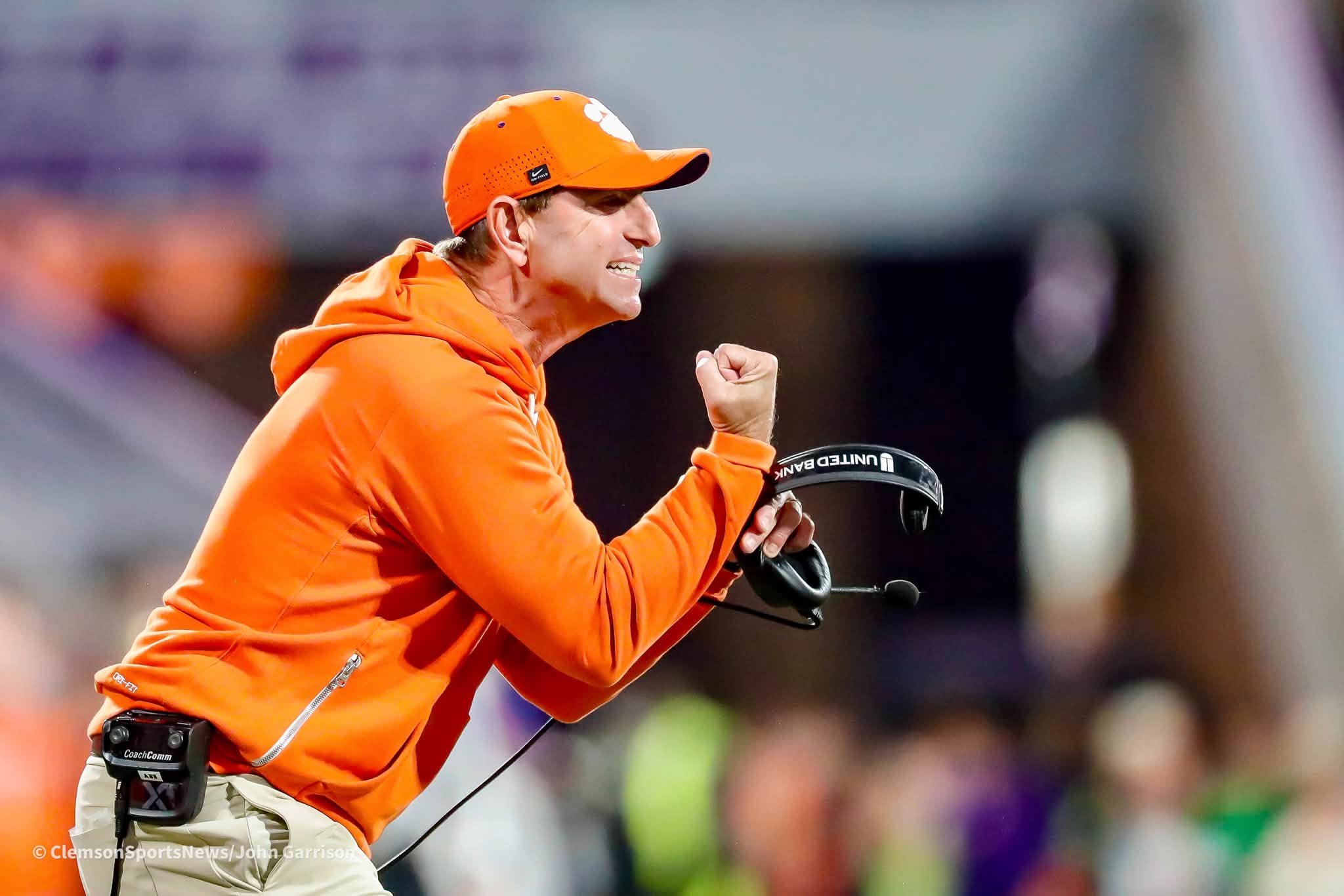
It is Clemson versus North Carolina, Dabo Swinney versus Bill Belichick and, perhaps most importantly, a game that should tell us considerably more about both football teams than their first two games have.
Saturday’s game kicks off at noon on ESPN and serves as the ACC opener for both programs.
THE NUMBERS: NORTH CAROLINA HOLDS THE EARLY EDGE
Through two games, the statistical comparison favors North Carolina almost across the board.
The Tar Heels are averaging 25 points and 374.5 yards per game while Clemson is averaging 16 points and 246 yards. UNC is producing 249 passing yards and 125.5 rushing yards per game, compared with Clemson’s 151 passing and 95 rushing.
The difference becomes even larger when efficiency is considered.
North Carolina is averaging 6.8 yards per offensive play. Clemson is averaging just 4.0.
UNC has converted 40 percent of its third downs. Clemson is an alarming 3-of-27, or 11.1 percent.
North Carolina has punted only five times. Clemson has punted 17.
UNC has scored touchdowns on four of its seven red-zone opportunities. Clemson has reached the end zone on only two of six.
Those numbers explain a great deal about Clemson’s first two games. The Tigers have moved the football in stretches but have been unable to consistently sustain possessions, create manageable third downs or finish drives with touchdowns.
North Carolina hasn’t exactly been an offensive juggernaut, but the Tar Heels have been considerably more efficient.
CLEMSON OFFENSE: CAN TAIT REYNOLDS PROVIDE THE SPARK?
Everything begins here.
Clemson entered the season needing Christopher Vizzina or Reynolds to establish himself at quarterback following the departure of Cade Klubnik. Two games into the season, Reynolds has earned his opportunity.
Against Georgia Southern, Vizzina completed four of seven passes for 19 yards, a touchdown and an interception before suffering an injury to his non-throwing arm.
Reynolds took over and completed 16 of 27 passes for 178 yards while adding 38 rushing yards on 14 attempts. He did not throw a touchdown, but his mobility immediately added another dimension to the offense.
For the season, Reynolds has completed 20 of 33 passes — 60.6 percent — for 200 yards without throwing an interception. He has yet to throw his first collegiate touchdown pass.
Swinney announced that Reynolds would receive the first-team practice repetitions and make his first career start against North Carolina. Vizzina has been dealing with the elbow injury, although Swinney said earlier in the week that he expected him to be available in a backup role.
That makes Chad Morris’ approach fascinating.
Does Clemson simplify the game plan for a freshman making his first start, or does Morris use Reynolds’ athletic ability to expand it?
The answer probably needs to be somewhere in between.
Moving the pocket, using quarterback movement, incorporating RPO concepts and creating defined reads could help Reynolds while also forcing North Carolina’s defensive front to account for another runner.
Clemson cannot continue living in obvious passing situations.
The Tigers’ 3-of-27 performance on third down is among the most concerning numbers surrounding this football team. Against Georgia Southern alone, Clemson converted only two of 14 third downs.
Improving first-down efficiency may therefore be even more important than improving third down.
Clemson needs four, five and six yards on early downs rather than constantly asking an inexperienced quarterback to convert third-and-eight or third-and-nine.
CLEMSON’S RUNNING GAME SHOWED LIFE — BUT NOW IT MUST BECOME CONSISTENT
The run game was virtually nonexistent against LSU.
It looked considerably better against Georgia Southern.
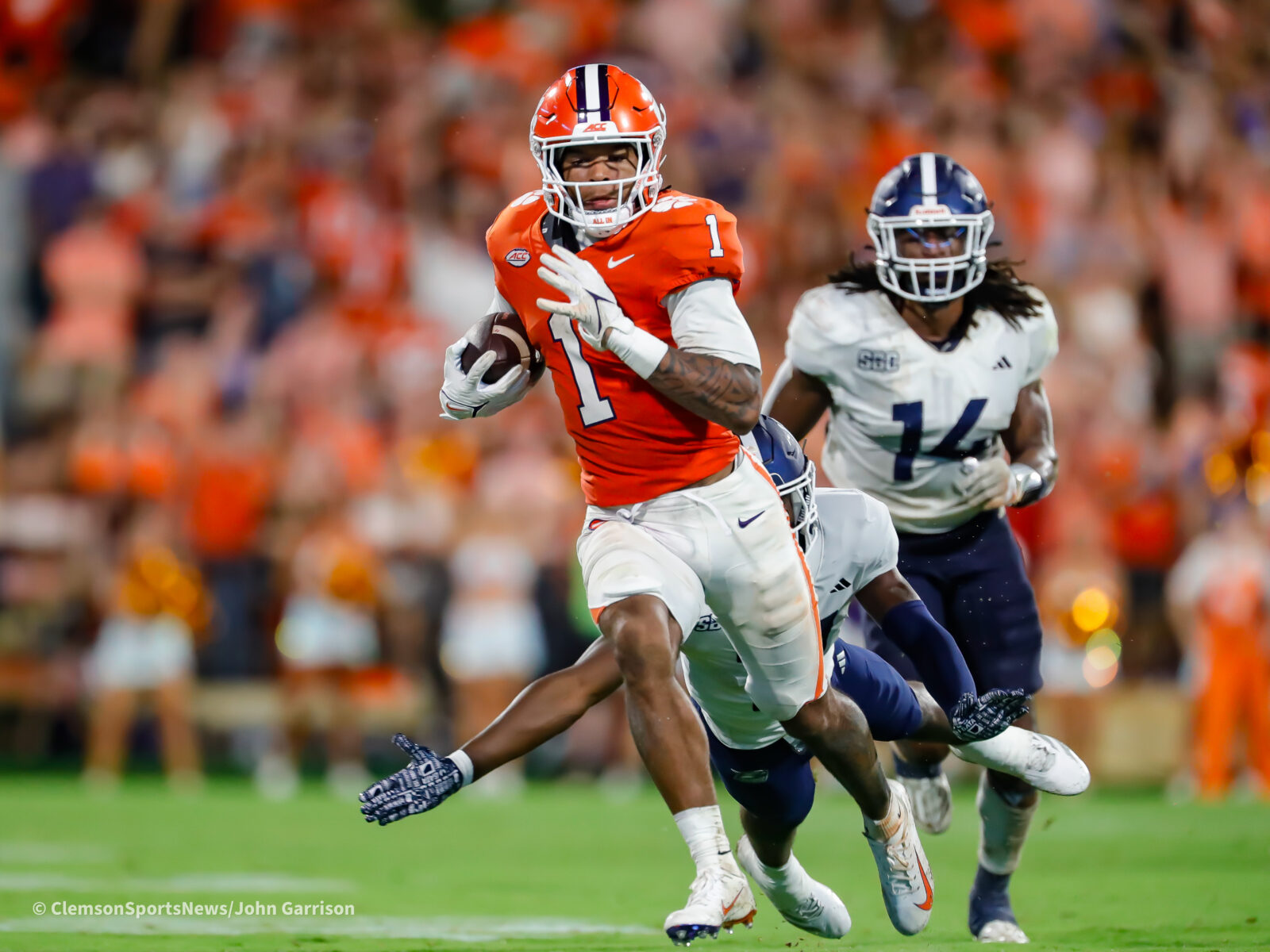
Clemson rushed for 150 yards against the Eagles. Gideon Davidson carried 14 times for 62 yards, Chris Johnson Jr. produced 53 yards on seven carries and Reynolds added another 38.
Those are not overwhelming numbers, but they represented progress.
The biggest issue remains consistency along the offensive line. Clemson has already surrendered six sacks this season and has struggled with penetration, missed assignments and negative plays.
North Carolina is not the opponent Clemson wants to face if those problems continue.
The Tar Heels have already produced seven sacks through two games.
That means Clemson’s offensive line may ultimately decide this football game.
If the Tigers can run the ball, Morris can keep Reynolds out of predictable passing situations, use play action and make UNC defend the entire offense.
If Clemson cannot run it, North Carolina can attack a freshman quarterback behind an offensive line that has already shown protection problems.
T.J. MOORE HAS EMERGED AS CLEMSON’S MOST RELIABLE OFFENSIVE WEAPON
If Reynolds needs someone he can trust Saturday, T.J. Moore is the obvious answer.
Moore caught seven passes for 103 yards against Georgia Southern and scored Clemson’s only touchdown through the air.
He has now caught a pass in 29 consecutive games, covering every appearance of his Clemson career.
But Clemson needs more than Moore.
Bryant Wesco Jr., Tyler Brown, the tight ends and Clemson’s running backs have to create additional stress points for North Carolina.
The middle of the field could become especially important. If UNC commits resources to containing Reynolds’ mobility and stopping the run, opportunities should exist for Clemson’s tight ends and slot receivers.
The Tigers cannot allow North Carolina to reduce the game to “find T.J. Moore and stop him.”
NORTH CAROLINA DEFENSE: THE EARLY SURPRISE OF THE SEASON
North Carolina’s defense has arguably been the most impressive unit entering this matchup.
The Tar Heels are allowing only 6.5 points and 268 yards per game.
Opponents are averaging just 91.5 rushing yards and 176.5 passing yards.
Most impressive, UNC is surrendering only 3.9 yards per play and has yet to allow a passing touchdown.
The Tar Heels have also generated seven sacks compared with only three for Clemson’s defense.
Xavier Lewis has been one of the major reasons.
North Carolina’s defensive front consistently bothered TCU in the opener and followed that by recording four sacks against ETSU. Players such as Lewis, Jaylen Harvey and Melkart Abou Jaoude have given the Tar Heels legitimate disruption up front.
There is, however, one strange weakness hiding inside North Carolina’s excellent defensive numbers.
Opponents are converting 46.9 percent of their third downs.
That is unusually high for a defense allowing only 6.5 points per game.
Against ETSU, the Buccaneers converted eight of 16 third downs and held the football for more than 33 minutes despite scoring only three points.
That creates one of Saturday’s most unusual matchups:
A Clemson offense that cannot convert third downs against a North Carolina defense that has had trouble getting off the field on third down.
Something has to give.
NORTH CAROLINA OFFENSE: BILLY EDWARDS HAS PROVIDED STABILITY
While Clemson prepares a freshman for his first career start, North Carolina has something entirely different at quarterback.
Experience.
Billy Edwards Jr. has completed 31 of 48 passes for 476 yards, two touchdowns and no interceptions through two games.
He is completing 64.6 percent of his passes and averaging almost 10 yards per attempt.
Against TCU, Edwards threw for 232 yards.
Against ETSU, he completed 15 of 20 passes for 244 yards and two touchdowns.
North Carolina doesn’t need Edwards to play superhero football. Belichick wants him distributing the ball, protecting possessions and taking what the defense gives him.
So far, he has done exactly that.
And there is a major matchup issue waiting for Clemson.
The Tigers are allowing 289.5 passing yards per game.
Granted, much of that number was accumulated during LSU’s 644-yard offensive explosion in Baton Rouge. Clemson’s defense looked dramatically better against Georgia Southern, holding the Eagles to 266 total yards and an almost unbelievable 22 rushing yards.
But Georgia Southern quarterback Max Johnson still threw for 244 yards.
That makes Clemson’s ability to affect Edwards extremely important.
JELANI THURMAN IS THE MATCHUP CLEMSON CANNOT LOSE
North Carolina’s passing game has found its centerpiece in tight end Jelani Thurman.
Thurman caught four passes for 94 yards against TCU and followed with four catches for 71 yards against ETSU.
That gives him eight receptions for 165 yards through two games.
At his size and athletic profile, Thurman gives North Carolina a target that can attack linebackers underneath, work seams against safeties and create problems in the red zone.
Clemson linebackers Sammy Brown and Jeremiah Alexander, along with the Tigers’ safeties, will have to know where No. 45 is on virtually every passing down.
Edwards has shown that he is perfectly comfortable taking the easy completion rather than forcing the football.
If Clemson gives Thurman free releases and soft zones, North Carolina can remain ahead of the chains all afternoon.
CAN CLEMSON’S DEFENSIVE FRONT BUILD ON THE GEORGIA SOUTHERN PERFORMANCE?
This may be Clemson’s most important defensive storyline.
LSU demolished Clemson at the line of scrimmage, piling up 644 total yards, including 309 rushing yards.
One week later, the Tigers looked like a completely different defense.
Georgia Southern finished with only 22 rushing yards on 18 attempts.
Clemson forced three-and-outs on each of Georgia Southern’s first six possessions and recorded eight three-and-outs overall. Will Heldt produced three tackles for loss and two sacks, while Ashton Hampton broke up three passes.
That is the Clemson defense Dabo Swinney and coordinator Tom Allen expected to see.
Now it has to happen against a Power Four opponent.
North Carolina has allowed four sacks through two games, meaning there should be opportunities for Heldt, Jahiem Lawson, London Merritt and Clemson’s interior defensive line.
The Tigers cannot allow Edwards to operate from a clean pocket.
If he has time, North Carolina has enough weapons to repeatedly attack Clemson’s linebackers and secondary.
If Clemson can generate pressure with four rushers, however, the entire matchup changes.
NORTH CAROLINA’S RUNNING GAME: BETTER, BUT STILL UNPROVEN
UNC is averaging 125.5 rushing yards per game.
That number does not jump off the page.
The Tar Heels rushed for only 90 yards in their opener against TCU before improving to 161 against ETSU, averaging six yards per carry in that game.
Benjamin Hall has been part of a committee approach rather than a traditional feature-back system.
For Clemson, the objective is straightforward: make North Carolina one-dimensional.
The Tigers cannot repeat what happened against LSU, when Clemson lost control of the line of scrimmage and allowed the opponent to dictate everything offensively.
If Clemson can produce something resembling its Georgia Southern run defense, Allen can begin changing coverages and bringing pressure against Edwards.
If UNC establishes the run, however, Clemson will be forced into a much more difficult afternoon.
THE NORTH CAROLINA DISTRACTION FACTOR
And then there is everything happening away from the field.
North Carolina’s football program has spent much of the last several weeks answering questions that have little to do with football.
General manager Michael Lombardi resigned on Sept. 3 after previously being placed on paid administrative leave as part of a university investigation.
The investigation later expanded beyond the original front-office matter, according to reports, before UNC announced this week that it had concluded its review.
UNC said the investigation found certain actions that demonstrated a disregard for university values and standards but characterized those actions as isolated rather than evidence of a systemic failure.
Then came another major development.
Steve Belichick, Bill Belichick’s son and North Carolina’s defensive coordinator, announced that he will resign effective Oct. 27 when his medical leave expires.
Steve Belichick has been on medical leave since Aug. 6.
That distinction is important.
His resignation creates another significant headline around the program, but it does not represent a sudden defensive coaching change immediately before the Clemson game. Brian Belichick has already been handling the defensive play-calling responsibilities during North Carolina’s 2-0 start.
So while the situation could create an emotional and organizational distraction, Clemson should not expect UNC’s defense to suddenly operate differently Saturday.
The Tar Heels have been functioning without Steve Belichick throughout the season.
NOW PLAYER DISCIPLINE HAS BEEN ADDED TO THE STORY
The situation became even more complicated this week.
Freshman wide receiver Keeyun Chapman was cited on a misdemeanor charge of carrying a concealed weapon following a traffic stop in Chapel Hill and was subsequently suspended indefinitely from the football program.
Freshman receiver C.J. Sadler was driving the vehicle and was cited for speeding. Both players are listed as out against Clemson.
Sadler’s absence is the more significant football development. He has already caught four passes for 73 yards this season, including three receptions for 66 yards against ETSU.
Chapman had not appeared in UNC’s first two games.
So North Carolina now enters its first ACC game with its former general manager gone, its defensive coordinator heading toward an official resignation, an internal investigation having dominated headlines and two freshman receivers unavailable following a police traffic stop.
How much does that matter once the football is kicked off?
Nobody knows.
Bill Belichick has spent decades coaching through distractions at the professional level, and the Tar Heels have so far shown no obvious signs of allowing the turmoil to affect them on Saturdays.
They are 2-0.
The defense has surrendered 13 points.
The offense has not turned the ball over through an interception.
Those are facts Clemson cannot ignore.
SPECIAL TEAMS COULD BECOME A MAJOR FACTOR
Clemson has one enormous advantage entering a game that could become low scoring.
Nolan Hauser.
Hauser essentially carried Clemson’s scoring production against Georgia Southern, connecting on five field goals, including attempts from 50 and 49 yards.
Through two games, Hauser has accounted for 20 of Clemson’s 32 points.
That has been both a blessing and a warning.
Clemson has one of the nation’s better kickers.
But Clemson cannot keep asking him to finish every possession.
North Carolina has had more uncertainty in the kicking game, particularly from longer distances, making every trip across midfield potentially important in what could become a possession-by-possession game.
THE MATCHUP THAT COULD DECIDE EVERYTHING: CLEMSON’S OFFENSIVE LINE VS. UNC’S FRONT
There are dozens of storylines surrounding this game.
Belichick versus Swinney.
Reynolds’ first start.
UNC’s off-field turmoil.
Clemson’s response to the LSU embarrassment.
But the most important battle may be the simplest one.
Can Clemson block North Carolina?
The Tigers are allowing sacks, failing on third down and struggling to consistently run the football.
North Carolina has seven sacks and has allowed just 13 points.
If UNC controls Clemson’s offensive line, Reynolds could spend his first career start running from pressure while the Tigers again struggle to finish drives.
If Clemson’s offensive line takes another step forward, however, Reynolds’ mobility changes the mathematics of the game.
Suddenly North Carolina has to defend Davidson and Johnson at running back, Reynolds on quarterback keepers and scrambles, Moore outside and Clemson’s tight ends across the middle.
That version of Clemson’s offense would look considerably different from the one that produced just 32 points through its first two games.
WHAT CLEMSON MUST DO
Clemson does not necessarily need Reynolds to throw for 300 yards.
The Tigers need him to play efficient football.
Avoid turnovers.
Use his legs when opportunities appear.
Get the football to Moore.
Stay ahead of the chains.
And most importantly, convert third downs into continued possessions rather than another afternoon of watching the punt team run onto the field.
Defensively, Clemson has to stop the run first, then make Edwards uncomfortable.
Three sacks through two games are not enough for a defense with Clemson’s personnel.
Heldt and the rest of the defensive front need to make Edwards move before he wants to move.
WHAT NORTH CAROLINA MUST DO
UNC’s formula is almost the opposite.
The Tar Heels do not need to reinvent anything.
Protect Edwards.
Let him distribute the football.
Use Thurman to attack the middle.
Avoid turnovers.
Make Reynolds prove he can consistently beat pressure.
And most importantly, North Carolina cannot allow Clemson’s running game and Reynolds’ mobility to create confidence early.
The longer Clemson struggles offensively, the more pressure will build inside Memorial Stadium.
But if Reynolds produces a couple of early scoring drives, Death Valley becomes a very different environment for a North Carolina team playing its first true road game of the season.
FINAL WORD
On paper, North Carolina has been the better football team through two weeks.
The Tar Heels have scored more points, generated more yards, protected the football better, produced more sacks and played dramatically better statistical defense.
Clemson’s numbers are ugly.
Sixteen points per game.
Three third-down conversions in 27 attempts.
Seventeen punts.
Only two offensive touchdowns through two games.
But the Clemson team that walked off the field after the Georgia Southern game looked considerably better defensively than the one that left Baton Rouge.
Now the question becomes whether the offense can make the same kind of jump.
Tait Reynolds gives Clemson a different variable at quarterback. His mobility creates possibilities that simply were not consistently available previously, but Saturday will also be his first collegiate start against a defense that has spent the first two weeks attacking quarterbacks and limiting explosive plays.
North Carolina enters Death Valley undefeated but surrounded by an extraordinary amount of noise — Lombardi’s resignation, Steve Belichick’s impending departure, the conclusion of a university investigation and another week of player discipline.
Still, none of those headlines have beaten the Tar Heels yet.
Clemson will have to do that itself.
Saturday is therefore much bigger than a simple Week 3 game.
For North Carolina, it is an opportunity to demonstrate that the 2-0 start represents genuine progress under Bill Belichick rather than merely a promising September.
For Clemson, it is an opportunity to show that Baton Rouge was an aberration, that the Georgia Southern defensive performance was the beginning of something and that a freshman quarterback might provide the offensive jolt the Tigers desperately need.
Two programs.
Two dramatically different starts.
Two Hall of Fame-level head coaches.
One ACC opener.
And by Saturday afternoon in Death Valley, we should know considerably more about where both Clemson and North Carolina are really headed in 2026.