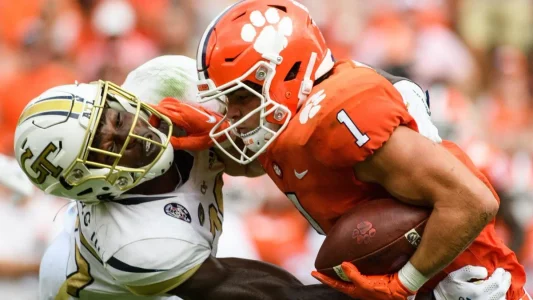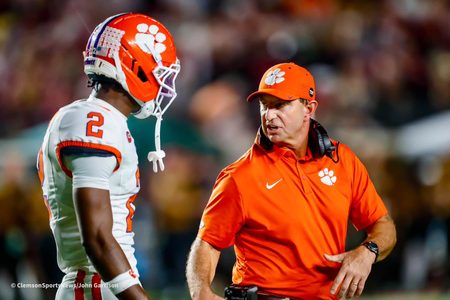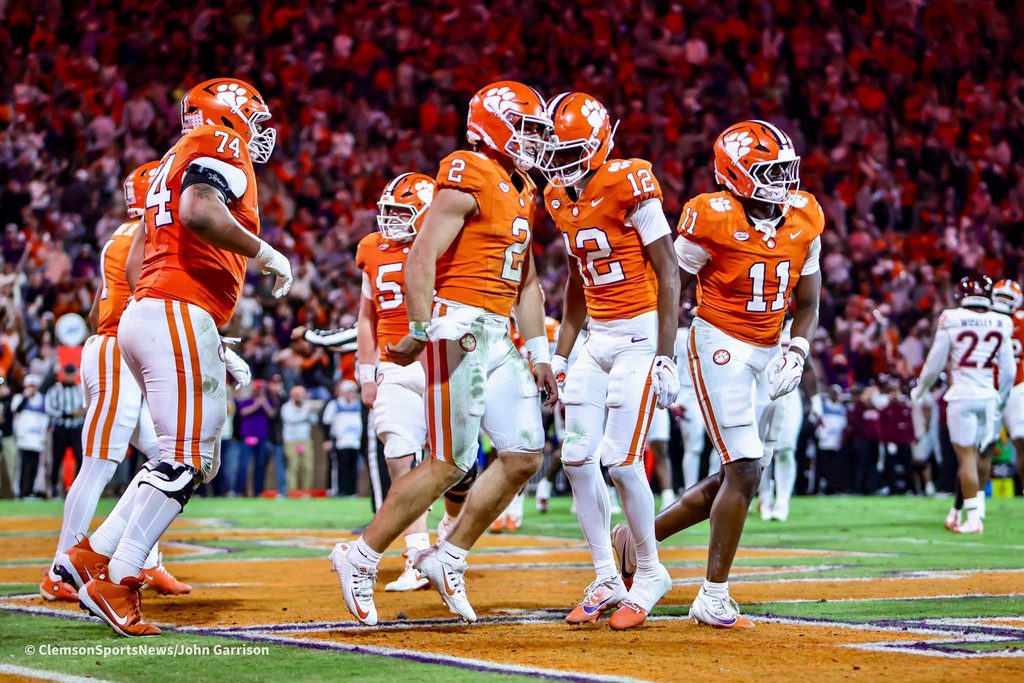
The freshman quarterback’s development is about more than passing yards and completion percentages. It’s about confidence, decision-making, leadership, toughness and learning how to win football games. And his performance against Syracuse may have provided the clearest indication yet of how far he has come.
CLEMSON SPORTS NEWS | 2026 FOOTBALL FEATURE
There is a difference between a young quarterback having talent and a young quarterback beginning to understand how to use that talent.
Clemson has seen plenty of talented quarterbacks come through its program. The expectations at the position are enormous, and the standard established over the years doesn’t leave much room for patience.
But sometimes the most important development in a young quarterback isn’t immediately reflected in the box score.
It’s how he responds to adversity. It’s how quickly he processes a defensive look. It’s whether he recognizes a mistake and corrects it the next time. It’s whether he understands when to take a chance, when to throw the football away and when to put his head down and pick up a critical first down.
That’s the story beginning to emerge with freshman quarterback Tait Reynolds.
From his early-season introduction to college football to his increasingly confident performances in recent weeks, Reynolds has been learning on the job. The Syracuse game offered another important example.
Clemson won 18-13, and while the offense certainly wasn’t perfect, Reynolds played an important role in getting the Tigers across the finish line.
His development deserves a closer look because the future of Clemson’s offense is increasingly tied to how quickly this young quarterback continues to mature.
Note: I’m using Tait Reynolds, the Clemson quarterback, rather than Cade Reynolds. The name appearing in Clemson’s game records and coaching comments is Tait Reynolds.
THE BEGINNING: LEARNING HOW FAST COLLEGE FOOTBALL REALLY MOVES
Nobody should underestimate the adjustment a true freshman quarterback faces when moving from high school football into the college game.
The speed is different. The defensive disguises are more complicated. The defensive linemen are bigger, the linebackers are faster, and mistakes that might have resulted in a five-yard loss in high school can become turnovers or drive-ending plays at the college level.
Reynolds was thrown into the action early in the season, including a difficult opening stretch in which Clemson was trying to find its offensive identity.
There were missed reads, questionable decisions and moments when the game appeared to move faster than he wanted.
Those are growing pains.
The important question was never whether Reynolds would make mistakes. Every young quarterback makes mistakes.
The important question was how he would respond.
Head coach Dabo Swinney made that point when discussing Reynolds’ development following Clemson’s September victory over North Carolina.
Swinney acknowledged that the freshman had been placed in a difficult situation early, but emphasized that he needed those live-game repetitions.
He also made it clear that Reynolds’ talent was something to be excited about, praising his arm strength, ability to throw from the pocket, ability to make throws on the move and rushing ability.
Swinney’s message was straightforward: Reynolds needed experience, and he was getting better.
That experience has become increasingly valuable as the season has progressed.
THE STATISTICAL PROGRESSION: GAME ONE THROUGH GAME NINE
The best way to understand Reynolds’ development is to look at the progression throughout the season.
His numbers show a quarterback who has experienced difficult afternoons, made adjustments and gradually become a more complete part of Clemson’s offense.
GAME 1 — LSU (September 5)
- Passing: 4-of-6
- Passing yards: 22
- Passing touchdowns: 0
- Interceptions: 0
- Rushing: 5 carries, minus-9 yards
Clemson’s season opener was a difficult introduction. Reynolds saw limited action against a nationally ranked opponent in a 51-10 defeat.
It was a brief appearance, but it provided his first taste of the speed and physicality of major college football.
GAME 2 — GEORGIA SOUTHERN (September 12)
- Passing: 16-of-27
- Passing yards: 178
- Passing touchdowns: 0
- Interceptions: 0
- Rushing: 14 carries, 38 yards
Reynolds showed improvement in his second appearance. He became more involved in the offense, demonstrated his mobility and protected the football.
He was beginning to settle into the college game.
GAME 3 — NORTH CAROLINA (September 19)
- Passing: 20-of-29
- Passing yards: 215
- Passing touchdowns: 1
- Interceptions: 1
- Rushing: 11 carries, 26 yards
This was a significant turning point.
Reynolds earned his first career start and responded with a comeback victory over North Carolina.
He completed nearly 69% of his passes and threw for 215 yards and a touchdown.
More importantly, Clemson’s offense found another gear in the second half.
After struggling early, Reynolds helped lead four scoring drives in the final five possessions, excluding kneel-downs.
His performance demonstrated that he could respond to adversity rather than allowing a difficult first half to dictate the remainder of the game.
GAME 4 — CALIFORNIA (September 25)
- Passing: 14-of-22
- Passing yards: 106
- Passing touchdowns: 0
- Interceptions: 1
- Rushing: 11 carries, 28 yards
This was a more challenging statistical performance.
Reynolds wasn’t nearly as productive through the air, but Clemson won 24-10.
It was another important experience for a freshman quarterback learning that winning doesn’t always require putting up enormous numbers.
GAME 5 — MIAMI (October 3)
- Passing: 29-of-44
- Passing yards: 295
- Passing touchdowns: 0
- Interceptions: 1
- Rushing: 14 carries, minus-22 yards
Despite Clemson’s 41-13 loss, this was Reynolds’ most productive passing performance to that point.
He attempted 44 passes and threw for 295 yards.
Miami presented significant challenges, and the negative rushing numbers reflected the pressure and difficulty Clemson experienced offensively.
It was a learning experience against a quality opponent.
GAME 6 — CHARLESTON SOUTHERN (October 17)
- Passing: 17-of-26
- Passing yards: 127
- Passing touchdowns: 0
- Interceptions: 0
- Rushing: 7 carries, 40 yards
Clemson won 37-0.
Reynolds played a more controlled game, protected the football and contributed with his legs.
This was another example of a quarterback learning to manage a game rather than feeling compelled to make every play himself.
GAME 7 — VIRGINIA TECH (October 24)
- Passing: 20-of-26
- Passing yards: 153
- Passing touchdowns: 0
- Interceptions: 0
- Rushing: 18 carries, 63 yards
- Rushing touchdowns: 1
Although Clemson lost 20-16, this performance demonstrated Reynolds’ increasing value as a dual-threat quarterback.
He completed more than 76% of his passes and led the team in rushing.
His first career rushing touchdown also demonstrated his ability to create opportunities when the passing game wasn’t producing enough points.
GAME 8 — FLORIDA STATE (October 31)
- Passing: 18-of-32
- Passing yards: 189
- Passing touchdowns: 2
- Interceptions: 0
- Rushing: 14 carries, 85 yards
- Rushing touchdowns: 1
THE BREAKTHROUGH PERFORMANCE
This was arguably Reynolds’ most complete performance of the season.
Clemson defeated Florida State 36-24 in Tallahassee, and Reynolds delivered a performance that showed just how dangerous he could become.
He threw for two touchdowns, didn’t throw an interception and added 85 rushing yards and another touchdown.
And then came the play everybody will remember.
His 79-yard touchdown run in the fourth quarter was a Clemson record for the longest rushing touchdown by a Clemson quarterback in the modern post-single-wing era.
That wasn’t simply a big play.
It was a demonstration of athleticism, confidence, vision and the ability to recognize an opportunity and make something happen.
It was also a moment when Reynolds looked increasingly comfortable being the quarterback responsible for leading Clemson.
GAME 9 — SYRACUSE (November 7)
- Passing: 17-of-28
- Passing yards: 161
- Passing touchdowns: 0
- Interceptions: 1
- Rushing: 15 carries, 61 yards
Clemson won 18-13.
This performance wasn’t statistically spectacular, and Reynolds would be the first to acknowledge that the offense needed to be better.
But there was something important about the way he finished the game.
With Clemson protecting a five-point lead late in the fourth quarter, Reynolds delivered two critical rushing plays that helped secure the victory.
The first came on third-and-eight with 2:52 remaining.
He took a quarterback draw, showed patience, found the running lane and picked up 10 yards for a first down.
Then, after the two-minute timeout, he made another important read and ran for 13 yards, allowing Clemson to run out the clock.
Those were winning plays.
And for a freshman quarterback, understanding when and how to make those decisions is a significant part of development.
Season statistics and game-by-game production through Syracuse. Clemson University Athletics+2
THE NUMBERS: WHAT REYNOLDS HAS ACCOMPLISHED THROUGH NINE GAMES
Through nine appearances, Reynolds has accumulated:
- Passing yards: 1,446
- Completions: 155
- Attempts: 240
- Completion percentage: 64.6%
- Passing touchdowns: 3
- Interceptions: 4
- Rushing yards: 310
- Rushing touchdowns: 2
His passing production is only part of the story.
Reynolds has accounted for 1,756 yards of total offense, combining his passing and rushing production.
He has also become an increasingly important component of Clemson’s running game.
Consider these developments:
- He has rushed for at least 60 yards in three consecutive games.
- He has rushed for at least 40 yards in four consecutive games.
- He has scored rushing touchdowns in consecutive games against Virginia Tech and Florida State.
- He rushed for 85 yards against Florida State.
- He has demonstrated the ability to convert important third downs with his legs.
The three-game stretch against Virginia Tech, Florida State and Syracuse is particularly interesting.
Reynolds has rushed for 209 yards over those three games.
That’s a significant contribution from the quarterback position.
And it changes how opposing defensive coordinators must prepare for Clemson.
WHAT DABO SWINNEY IS SEEING: THE DEVELOPMENT IS MORE THAN PHYSICAL TALENT
Perhaps the most encouraging part of Reynolds’ progression is what Swinney has been saying about him.
Following the North Carolina victory, Swinney praised Reynolds’ talent and his ability to make plays from different positions in the pocket.
But as the season progressed, Swinney began emphasizing something more important: confidence and decision-making.
Ahead of the Syracuse game, Swinney discussed how the game had started to slow down for his freshman quarterback.
He specifically pointed to improved confidence in the pocket, confidence moving around and confidence running the football.
He also acknowledged that Reynolds’ decision-making had improved after some of the turnovers earlier in the season.
That’s important.
Quarterback development isn’t simply about throwing harder or running faster.
It’s about processing information more quickly and making the correct decision more consistently.
After Syracuse, Swinney offered perhaps his strongest assessment of Reynolds’ progress.
Talking about the quarterback’s critical late-game decisions, Swinney said:
“We talked about how he missed some reads early in the season, but that is growth. That was a critical play by our quarterback.”
He also praised the maturity Reynolds demonstrated on the final drive.
“The last one was Tait making the right decision, and again, that just showed his growth and maturity.”
And Swinney added something that Clemson fans should find encouraging:
“This kid is going to keep getting better and better.”
Those aren’t simply compliments about athletic ability.
They’re observations about a quarterback who is learning the position and beginning to understand how to manage situations.
REYNOLDS’ OWN WORDS: ACCOUNTABILITY AND LEADERSHIP
One of the things that stands out about Reynolds is his willingness to take responsibility.
Following the Syracuse victory, he didn’t point fingers at receivers, offensive line injuries or missed opportunities.
He looked inward.
Discussing Clemson’s offensive struggles, Reynolds said:
“I think it all just comes back to the quarterback. I’ve got to command and lead out there and be better, right? So we’ll go on tape and see what it is.”
He continued with the same message:
“Ultimately, I’ll always take it. I’m the guy leading it out there, and we’ll go back on the tape and look at it and get better.”
That mentality matters.
A quarterback is expected to be the leader of the offense. When things go well, he receives much of the credit. When things go wrong, he must be willing to accept responsibility.
Reynolds appears to understand that responsibility.
He has also demonstrated a willingness to learn from mistakes.
Following the North Carolina victory, he acknowledged that there were still plenty of things to correct.
He talked about learning from those mistakes and recognizing how much better he and the offense could become.
That’s a healthy mindset for a young quarterback.
He isn’t suggesting that he has everything figured out. He’s recognizing that development is a process.
THE MEDIA AND FOOTBALL COMMUNITY ARE BEGINNING TO NOTICE
There has been increasing attention on Reynolds’ development, particularly following his performance against North Carolina and his record-setting rushing touchdown against Florida State.
The biggest discussion surrounding him isn’t necessarily his current passing production.
It’s his potential.
Observers have increasingly pointed to three characteristics:
1. His athletic ability.
Reynolds is not a traditional pocket-only quarterback. He can extend plays, escape pressure and create opportunities with his legs.
The 79-yard touchdown against Florida State put that ability on full display.
2. His arm talent.
Swinney has publicly praised his arm strength and ability to make throws both from the pocket and on the move.
That combination provides Clemson with an opportunity to develop a more versatile offensive attack.
3. His decision-making progression.
This might be the most important development.
The Syracuse game provided a particularly clear example of Reynolds making the correct reads in critical situations.
That’s the difference between a quarterback who simply has athletic ability and one who is learning to become a complete field general.
The outside conversation is beginning to shift from whether Reynolds can handle the starting position to how much better he can become with additional experience.
THE RUNNING GAME HAS CHANGED THE EQUATION FOR CLEMSON
There is another important component to Reynolds’ development.
His ability to run the football has created an additional dimension for Clemson’s offense.
When a quarterback can threaten defenses with designed runs, quarterback draws and read-option plays, defensive coordinators must account for another ball carrier.
That creates opportunities for the running backs.
It also creates opportunities for receivers because linebackers and defensive backs cannot always drop into coverage.
The 79-yard Florida State touchdown demonstrated the explosive potential.
But the Syracuse game demonstrated something arguably more important.
Reynolds showed patience, recognized the defensive alignment and made the correct decisions to pick up first downs.
Those are the kinds of plays that sustain winning drives.
Clemson doesn’t necessarily need Reynolds to run for 80 yards every Saturday.
It needs him to understand when the opportunity is there and when the smarter decision is to distribute the football.
That balance will be important as he continues to develop.
WHAT STILL NEEDS TO IMPROVE?
There is plenty to like about Reynolds’ progress, but it would be a mistake to suggest that everything is solved.
Clemson still needs more consistency from its passing offense.
Through nine games, Reynolds has thrown for three touchdowns and four interceptions.
Those numbers need to improve.
The Tigers need to generate more explosive passing plays, become more efficient in the red zone and convert a higher percentage of third downs.
There are several areas where Reynolds can continue improving.
READING DEFENSIVE COVERAGES
The next step is becoming more consistent at recognizing defensive alignments before the snap and understanding how those coverages change after the snap.
ANTICIPATION
College quarterbacks must learn to throw receivers open rather than waiting until they are completely uncovered.
That comes with experience, confidence and repetition.
PROTECTING THE FOOTBALL
Reynolds has made progress, but ball security must remain a priority.
Clemson cannot afford unnecessary turnovers, particularly against quality ACC opponents.
POCKET MANAGEMENT
His athleticism is a tremendous asset, but he must continue learning when to escape, when to stand in the pocket and when to get rid of the football.
RED-ZONE EXECUTION
Clemson needs more offensive touchdowns.
Reynolds and the entire offense must become more efficient when the field gets shorter.
These are not unusual challenges for a freshman quarterback.
They’re simply the next steps in his development.
THE NEXT THREE GAMES COULD BE IMPORTANT FOR HIS DEVELOPMENT
Georgia Tech, Duke and South Carolina represent three very different challenges.
But they also provide Reynolds with three more opportunities to demonstrate his progress.
GEORGIA TECH
Georgia Tech has struggled defensively, particularly against the run.
This is an opportunity for Reynolds to continue utilizing his mobility while improving his efficiency as a passer.
Clemson needs to establish the running game and give him opportunities to make plays downfield.
DUKE
This is an important ACC matchup.
Reynolds will need to demonstrate his ability to handle defensive adjustments, protect the football and execute in important conference situations.
SOUTH CAROLINA
There’s nothing ordinary about this rivalry game.
The atmosphere, intensity and pressure are different.
For a freshman quarterback, this could be one of the most valuable experiences of the season.
If Reynolds can continue developing and lead Clemson through these final games, the Tigers could enter the postseason with considerably more confidence in their offensive direction.
THE BIGGER PICTURE: CLEMSON MAY HAVE FOUND AN IMPORTANT PIECE OF ITS FUTURE
It’s easy to get caught up in the immediate results.
Clemson fans want wins. They want touchdowns. They want explosive offensive performances. They want to see the Tigers competing for championships.
Those expectations aren’t going away.
But there is also something important happening with this young quarterback.
Reynolds is gaining experience in real football situations. He’s learning from difficult losses, responding to mistakes and beginning to make critical decisions with greater confidence.
The Florida State game showed his explosive potential.
The Syracuse game showed his growing maturity.
Those are two different accomplishments, and both matter.
The next step is bringing those qualities together consistently.
If he can continue improving his passing accuracy, develop better anticipation, protect the football and use his running ability intelligently, Clemson could have a quarterback capable of giving this offense a different identity.
Swinney has made it clear that he believes in the young quarterback’s future.
And Reynolds appears determined to earn that confidence.
THE CSN BOTTOM LINE
Tait Reynolds isn’t a finished product.
He’s a freshman quarterback learning one of the most difficult positions in college football while playing in a program where expectations are enormous.
There have been mistakes. There have been growing pains. There have been frustrating offensive performances.
But there has also been progress.
From his early-season introduction against LSU to his first career start against North Carolina, his development has been visible.
From his 295-yard passing performance against Miami to his record-setting 79-yard touchdown run against Florida State, we’ve seen the physical tools.
And against Syracuse, we saw something else.
We saw a young quarterback make two critical late-game decisions, pick up first downs and help his team secure a victory on the road.
That’s growth.
That’s maturity.
And that’s what Clemson needs from its quarterback.
The best part of Tait Reynolds’ story may be that he’s still just getting started.
Clemson fans have every reason to be encouraged by what they’re seeing. The talent is there. The confidence is growing. And the experience is beginning to show.
The next chapter starts Saturday in Death Valley.
GO TIGERS!
Clemson Sports News | Your Home for Clemson Athletics