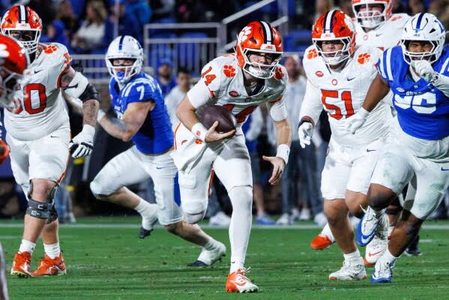
Five games into this season, I think Clemson’s offensive line might be the hardest position group on the entire football team to figure out.
There are moments when you look at this group and think you can see exactly what Matt Luke is building. They’re young, big, athletic and loaded with guys who were highly regarded coming out of high school. Then Clemson lines up against an LSU or a Miami and suddenly it looks like we are right back where we started.
So what is really going on up front?
Let’s start with the obvious: this is basically a rebuilt offensive line.
Clemson lost an enormous amount of experience following last season. Blake Miller, Tristan Leigh, Walker Parks and Ryan Linthicum departed after combining for more than 11,000 career offensive snaps and 161 starts. That isn’t replacing one veteran tackle or one center. That is ripping the backbone out of a position group and replacing it almost overnight.
Brayden Jacobs is now the guy at left tackle. Elyjah Thurmon has been working at left guard when healthy. Harris Sewell, Clemson’s most experienced returning lineman, moved into the center position. The right side has been a continuing experiment involving Collin Sadler, Ronan O’Connell, Easton Ware, Tucker Kattus and now true freshman Grant Wise. Clemson spent basically the entire preseason admitting it was still trying to identify its best fifth starter.
That matters.
But eventually Clemson has to stop using youth as the entire explanation, because there is plenty of talent in this room.
Brayden Jacobs is a 6-foot-7, 345-pound sophomore who flashed enormous upside last season. Grant Wise is a true freshman who was a four-star prospect, a state champion weightlifter and made 45 consecutive high school starts without allowing a sack or pressure according to his Clemson bio. He’s already gone from eight snaps against Georgia Southern to 38 against North Carolina, 12 at Cal and 30 against Miami.
Then there is Chance Barclay — that’s the freshman you’re thinking of — along with Carter Scruggs, Leo Delaney, Braden Wilmes and the rest of this young recruiting class. Matt Luke recruited these guys specifically because he wanted more size, athleticism and physicality in the room. Clemson believed during camp that several of them could eventually push into the two-deep.
So I’m starting to wonder whether Clemson needs to quit worrying quite so much about class designation and simply play the best five guys.
If Grant Wise keeps earning snaps, play him.
If Chance Barclay is physically ready to help, start finding out.
If Easton Ware gives Clemson something another player doesn’t, get him involved.
At some point this season has to become about identifying the offensive line Clemson wants to take into 2027, not merely surviving 2026.
ELYJAH THURMON IS ANOTHER HUGE PIECE OF THIS.
When Thurmon is available, Clemson believes he can be a major part of this line. The problem is availability. Injuries affected him significantly last season, and Clemson entered this year already understanding that keeping Thurmon and Sadler healthy would be important to maintaining continuity.
Offensive line may be the position where continuity matters more than almost anywhere else on a football team. Five guys have to see the same picture, communicate the same protection, understand combination blocks and know instinctively when one man is passing off a defender to another.
Constantly changing those five pieces is a problem.
And Clemson knows all about that problem. Matt Luke had to use seven different starting combinations in 13 games last season because of injuries.
Now look at what has happened this season.
LSU: ABSOLUTELY NOWHERE TO GO
The LSU game was alarming because we had spent an offseason hearing about the growth up front, and then Clemson went into Baton Rouge and looked overwhelmed.
Clemson finished with 40 net rushing yards on 26 attempts — 1.5 yards per carry — and allowed four sacks. The offense produced only 145 total yards.
That wasn’t simply “a young offensive line making a couple mistakes.”
That was domination.
LSU reset the line of scrimmage, Clemson struggled to create movement inside, and the quarterbacks never developed any comfort because the pocket kept getting compressed.
For anybody hoping to see proof that Clemson had finally fixed its longstanding ability to generate consistent push against elite defensive lines, LSU looked painfully familiar.
GEORGIA SOUTHERN: BETTER, BUT NOT DOMINANT
Clemson followed LSU with 150 rushing yards against Georgia Southern. That sounds better, and it was, but Clemson averaged only 3.8 yards per carry and didn’t score a rushing touchdown.
That was incremental progress, not some declaration that the problem was solved.
NORTH CAROLINA: NOW WE START SEEING SOMETHING
Then came North Carolina.
Clemson rushed for 186 yards on 36 attempts, 5.2 yards per carry, and Gideon Davidson went for 105.
Now we’re talking.
You could finally see movement. You could see Clemson creating lanes. You could see Davidson being allowed to reach the second level rather than having to dodge somebody in the backfield before he ever got started.
And importantly, Clemson was able to run when everybody in the stadium knew Clemson needed to run.
That was progress.
CAL: THE BEST THIS LINE HAS LOOKED
Then Clemson went across the country and absolutely ran the football.
257 rushing yards.
48 attempts.
5.4 yards per carry.
Gideon Davidson: 159 yards and two touchdowns on 22 carries.
That looked like a Clemson running game again.
That wasn’t gimmicks. That wasn’t one quarterback scramble inflating the statistics. Clemson’s running back carried it 22 times for 159 yards.
For the first time this season you could legitimately ask: Has this offensive line turned the corner?
Then Miami came to town.
And the answer suddenly became much less clear.
MIAMI: REGRESSION — BUT MAYBE NOT AS SIMPLE AS THE BOX SCORE MAKES IT LOOK
Miami held Clemson to 55 net rushing yards.
That number looks horrific.
But there is an important qualifier.
Clemson actually gained 93 yards rushing before losses were deducted, and Miami’s six sacks accounted for 35 yards of negative rushing yardage. Clemson’s running backs weren’t completely incapable of moving the football. Chris Johnson had 32 yards on five carries, Gideon Davidson had 25 on seven and Jarvis Green had 14 on three.
That’s 71 yards on 15 running-back carries — roughly 4.7 yards per carry.
That changes the conversation a little.
The bigger problem against Miami wasn’t necessarily that Clemson repeatedly handed the football to its backs and got stuffed.
Clemson barely tried.
Davidson got seven carries.
Johnson got five.
Green got three.
Meanwhile, Tait Reynolds attempted 44 passes.
So I think there is a legitimate question here:
Did Clemson abandon the traditional running game because it believed Miami’s defensive tackles made banging the ball between the tackles a losing proposition?
Miami entered the game with one of the best defenses in the ACC, and Clemson clearly knew what it was dealing with up front.
Maybe Clemson looked at those matchups and effectively said, our short passing game is going to become our running game.
That would explain Tyler Brown catching 10 passes. It would explain some of the quick throws. It would explain throwing 44 times while the running backs combined for only 15 carries.
But there’s another side to that decision.
When you abandon the run, you are also giving an elite pass rush permission to attack your young offensive line.
Now they aren’t reading run or pass.
They’re hunting your quarterback.
Miami finished with six sacks, nine tackles for loss and more than 20 pressures according to Clemson reporting after the game.
That’s the danger.
Maybe Clemson avoided Miami’s defensive tackles in the running game only to unleash Miami’s entire front in the passing game.
And eventually Clemson’s young offensive line couldn’t survive it.
That gets to what I believe is the real issue.
CLEMSON DOESN’T HAVE A “CAN’T RUN THE BALL” PROBLEM.
It has a consistency-against-elite-fronts problem.
Look at the progression:
LSU — 40 rushing yards, 1.5 per carry.
Georgia Southern — 150 yards, 3.8 per carry.
North Carolina — 186 yards, 5.2 per carry.
Cal — 257 yards, 5.4 per carry.
Miami — 55 net yards, although the backs averaged about 4.7 before sack yardage distorted the team total.
That is a fascinating graph.
The trajectory from LSU through Cal is almost exactly what you’d expect from a young line learning to play together.
Then Clemson encounters another elite defensive front and the whole thing falls apart.
That tells me the progress wasn’t imaginary.
It just isn’t mature yet.
Against average or good defensive fronts, Clemson is starting to move people.
Against great defensive fronts loaded with older, stronger, expensive, NFL-caliber defensive linemen, Clemson’s youth gets exposed.
There is an enormous difference between executing a combo block against a normal ACC defensive tackle and doing it against a 320-pound future NFL player who can defeat your guard one-on-one.
And right now Clemson’s offensive line isn’t consistently winning those matchups.
AND THAT BRINGS US TO MATT LUKE.
I don’t think Clemson’s current situation can simply be blamed on offensive-line coaching.
Remember the timeline.
Robbie Caldwell coached Clemson’s offensive line from 2011 through 2021. During that period Clemson won seven ACC titles, made four national championship games, won two national championships and produced 25 All-Conference offensive-line selections in Caldwell’s final seven seasons.
Caldwell moved into an administrative role after 2021.
Thomas Austin took over in 2022 and coached the position through 2023. Clemson produced individual success under Austin, including Jordan McFadden winning the Jacobs Blocking Trophy and Blake Miller earning Freshman All-America honors, but the overall offensive line never consistently developed into the physically dominant unit Clemson needed.
After 2023, Dabo made a change and hired Matt Luke.
And Matt Luke has a legitimate résumé.
He coached Georgia’s offensive line on the 2021 national championship team. He’s coached numerous NFL draft picks. He has more than two decades coaching offensive lines. In his first full Clemson season in 2024, Clemson improved significantly up front, with Blake Miller and Marcus Tate earning All-ACC recognition and Clemson producing six games with both 200 passing and 200 rushing yards.
So I’m not ready to say Matt Luke can’t coach offensive line.
Quite the opposite.
I think Clemson is finally recruiting offensive linemen that actually look like Matt Luke offensive linemen.
The problem is most of those kids are freshmen, redshirt freshmen and sophomores.
That’s where Clemson may simply have to endure some growing pains.
But here’s where the criticism is fair:
By October, Clemson needs to start identifying its five.
You cannot play musical chairs forever.
You need a left tackle.
You need a left guard.
You need your center.
You need a right guard.
You need a right tackle.
And barring injury, those five guys need to play together long enough to develop chemistry.
Brayden Jacobs looks like part of the future.
Elyjah Thurmon can be part of it if he can stay healthy.
Harris Sewell gives Clemson veteran leadership in the middle.
Grant Wise is forcing his way into the conversation.
Ronan O’Connell, Collin Sadler, Easton Ware and Tucker Kattus are battling for roles.
And I’d keep watching Chance Barclay and the rest of those freshmen because this program cannot be afraid to accelerate a talented young player’s timetable simply because he’s 18 years old.
If he’s better, play him.
THE OTHER QUESTION IS SCHEME.
Are Clemson’s offensive linemen actually being put in the best position to succeed?
At Cal, Clemson committed to running the football. Davidson got 22 carries. Clemson ran it 48 times.
Against Miami, Clemson’s running backs got 15 carries.
Those are fundamentally different offensive philosophies.
Maybe that was dictated by the opponent.
Maybe Miami loaded the box.
Maybe Clemson decided its best answer was screens, swings, quick throws and getting Reynolds on the perimeter.
But I’m not convinced Clemson can become the offense it wants to become by essentially conceding the physical running game whenever it sees an elite defensive front.
Because those are precisely the games where you’re going to need it.
If Clemson wants to beat LSU, Miami, Georgia, Notre Dame or whoever it sees in a playoff environment, eventually it has to be able to say:
We’re running the football. You know we’re running the football. Stop us.
That’s offensive-line football.
Clemson used to have that mentality.
And that is where I think this group still has to grow.
SO, ARE WE SEEING PROGRESS?
Yes.
I think the numbers say we are.
You don’t accidentally rush for 186 yards against North Carolina and 257 against Cal.
You don’t accidentally have a sophomore running back go for 159 yards behind you.
There has been development since the LSU disaster.
But the Miami game also showed Clemson is nowhere near a finished product.
The ceiling is beginning to show itself.
The floor is still way too low.
And that’s the issue.
Great offensive lines aren’t great one week and overwhelmed the next. Great offensive lines establish a baseline. Even when they face outstanding defensive fronts, they find a way to give the quarterback a pocket and produce enough movement to keep the running game alive.
Clemson isn’t there yet.
The bye week couldn’t come at a better time.
Matt Luke has some decisions to make.
Who are the five?
Does Grant Wise become a permanent part of that five?
Can Elyjah Thurmon get healthy and stay there?
Does Clemson need to accelerate Chance Barclay or another freshman?
Where exactly does Collin Sadler fit?
What does Clemson believe its identity in the running game actually is?
And maybe most importantly:
When Clemson lines up against another big-time defensive front later this season, will we see the line that pushed Cal around for 257 yards — or the line that couldn’t handle LSU and Miami?
That’s what I’m watching.
Because Tait Reynolds can continue developing.
Gideon Davidson can be special.
Bryant Wesco can make plays outside.
But none of it reaches its ceiling until Clemson can consistently control the five guys standing directly across from its offensive line.
So what do you guys see?
Are we watching a young, talented offensive line taking the normal bumps and bruises that eventually turn into a really good group?
Or after LSU and Miami, are you concerned Clemson still hasn’t solved the same problem that has followed this offense for the last several years?
Is it personnel? Coaching? Scheme? Youth? Or simply the reality that Clemson has faced two elite defensive fronts and isn’t physically mature enough yet to handle them?