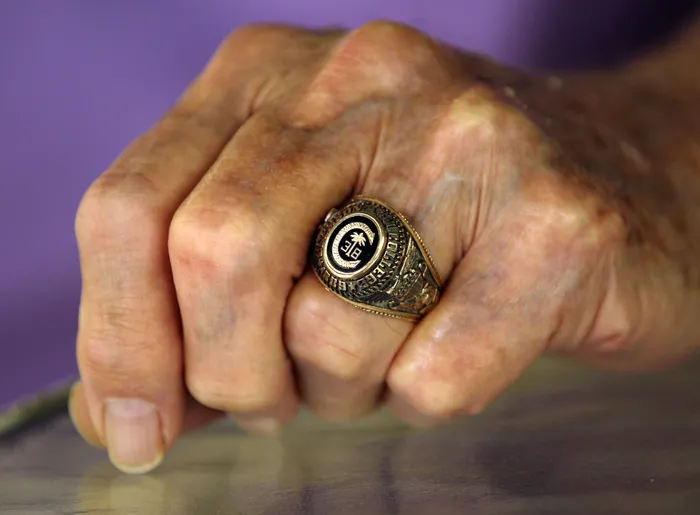
He survived the Bataan Death March, three years of unimaginable suffering, and the horrors of Japanese prison camps. But what ultimately saved this Clemson Tiger’s life was a gold Clemson class ring, two extraordinary friends, and a brotherhood that refused to surrender.
By Gary McDaniel | Clemson Sports News
There are legends at Clemson University whose names are forever associated with touchdowns, national championships, and unforgettable Saturday afternoons inside Memorial Stadium. Their accomplishments are celebrated by generations of Tiger fans, their names etched into the history of one of college football’s most recognizable institutions.
And then there are Clemson legends whose greatest victories had absolutely nothing to do with football. Their battles were fought thousands of miles from Death Valley, on foreign soil, under circumstances so horrifying that most of us could never begin to comprehend what they endured.
One of those men was Beverly N. “Ben” Skardon, Clemson Class of 1938, a decorated American soldier, survivor of the infamous Bataan Death March, prisoner of war, beloved Clemson professor, and eventually an honorary Brigadier General in the United States Army.
He was a man who witnessed humanity at its absolute worst and somehow spent the remainder of his remarkable 104 years demonstrating humanity at its very best.
And perhaps no story in Clemson University’s distinguished history better illustrates the true meaning of the Clemson Family than the story of Ben Skardon, two fellow Clemson graduates, and a little gold ring that became worth far more than its weight in precious metal.
This is not simply another story about a military hero. It is a story about friendship, sacrifice, survival, and the sacred responsibility of remembering those who never made it home.
It is also a story that remains alive today through Clemson’s military traditions, the efforts of local Clemson historian and businessman Trent Allen, the annual Clemson 8 Challenge, and a remembrance involving 485 American flags that this writer was fortunate enough to witness and document years ago.
To truly understand this story, we must travel back nearly nine decades, to a Clemson University that looked much different from the campus we know today.
A Clemson Cadet Before He Became an American Hero
Ben Skardon graduated from Clemson College in 1938, during an era when Clemson was still an all-male military institution. Young men attending Clemson weren’t simply students pursuing college degrees. They were cadets, expected to embrace discipline, personal responsibility, leadership, and a commitment to something larger than themselves.
Military training was part of everyday life. Uniforms, formations, drills, and the responsibilities associated with the Corps of Cadets helped shape generations of Clemson graduates who would eventually answer their nation’s call to service.
For Skardon, that call would come sooner than anyone could have imagined.
After graduating, Skardon entered the United States Army, beginning a military career that would place him in the Philippines as the world descended into the greatest global conflict in human history.
When Japanese forces attacked Pearl Harbor on December 7, 1941, the United States was thrust into World War II. Within hours, American military forces throughout the Pacific were facing attacks of their own.
Skardon was serving in the Philippines, where American and Filipino soldiers found themselves confronted by an overwhelming Japanese invasion.
He commanded Filipino troops and fought alongside American and Philippine forces attempting to defend the islands. The situation deteriorated rapidly as supplies dwindled, disease spread, and Japanese forces relentlessly pressed their advantage.
The defenders of the Bataan Peninsula fought with extraordinary determination despite hunger, exhaustion, inadequate ammunition, and little hope of reinforcements.
For his courage and military service, Skardon would receive numerous decorations, including two Silver Stars, Bronze Stars, and the Purple Heart.
But the greatest test of his life was still ahead.
April 9, 1942: The Beginning of a Nightmare
On April 9, 1942, American and Filipino forces on the Bataan Peninsula surrendered to the Imperial Japanese Army.
Approximately 75,000 American and Filipino military personnel were taken prisoner. What followed would become one of the most notorious atrocities of World War II.
The Bataan Death March.
Prisoners already weakened by weeks of fighting, starvation, tropical diseases, and dehydration were forced to march approximately 65 to 70 miles through the oppressive Philippine heat.
Men who fell behind risked being beaten, bayoneted, or killed. Prisoners who could no longer walk were often abandoned or murdered. Water and food were desperately scarce. Disease and exhaustion claimed countless lives.
Thousands never survived the journey.
Imagine being thousands of miles from home, starving, sick, exhausted, and surrounded by an enemy that demonstrated almost no regard for human life.
Imagine knowing that simply stumbling or collapsing could result in your execution.
For Ben Skardon, that was no imagination. That was reality.
He survived the march, but survival brought no immediate relief. Instead, he was transported into the Japanese prisoner-of-war system, where the suffering would continue for more than three years.
Skardon endured imprisonment at Cabanatuan and other locations, witnessing starvation, disease, brutal treatment, and the deaths of countless fellow prisoners. He would also survive the sinking of two Japanese transport vessels commonly remembered as “hell ships,” ships used to move Allied prisoners under appalling conditions.
He had survived the battlefield. He had survived Bataan. But inside the prison camps, his own body was beginning to betray him.
And that is where the story of the Clemson ring begins.
A Gold Clemson Ring and Two Friends Who Refused to Let Him Die
Of all the extraordinary stories in Clemson University’s history, this may be the one that best defines what it means to be a Clemson Tiger.
During his imprisonment, Skardon became desperately ill. Malaria, beriberi, severe intestinal illness, malnutrition, and an infection affecting his eyes left him almost completely helpless.
His body deteriorated to the point that he could barely care for himself.
Two fellow Clemson graduates, Henry Leitner of the Class of 1937 and Otis Morgan of the Class of 1938, were imprisoned alongside him.
These men had shared the Clemson experience before the war. They understood the same traditions, wore the same school colors, and carried the same lifelong connection to a small military college in South Carolina.
Now, thousands of miles away from home, that brotherhood would become a matter of life and death.
Leitner and Morgan cared for Skardon when he could no longer care for himself. They washed him, fed him, tended to his fever, and carried him when he was too weak to walk.
But their friend was dying, and their options were disappearing.
Somehow, throughout the ordeal of capture and imprisonment, Skardon had managed to conceal his gold Clemson class ring from his Japanese captors.
It was one of his most precious possessions, representing his education, his accomplishments, his years as a cadet, and the university he loved.
But the ring would soon take on a meaning that no jeweler could ever place a value upon.
When Skardon’s condition became critical, Morgan arranged to trade that Clemson ring for food. Accounts of the exchange describe a small chicken and canned ham obtained from Japanese guards.
Morgan and Leitner prepared what nourishment they could, including soup from the chicken, and carefully fed it to their critically ill friend.
The food helped sustain him.
The care kept him alive.
And the Clemson ring, once a symbol of achievement and pride, became the means by which two Clemson men helped save the life of a third.
Skardon never forgot what Henry Leitner and Otis Morgan did for him. For the remainder of his life, he credited those two men with saving him from almost certain death.
Think about that for a moment.
A young man walks across a stage in Clemson, South Carolina, receives a ring representing his college experience, and years later, halfway around the world, that very ring becomes the difference between life and death.
There are moments when the phrase “Clemson Family” can seem like something we say because it sounds good.
For Ben Skardon, Henry Leitner, and Otis Morgan, it was something far greater.
It was survival.
Liberation, a Distinguished Career, and a Return Home
Skardon’s captivity finally ended in August 1945, when Soviet troops liberated the prison camp in Manchuria where he was being held.
After more than three years of imprisonment, a journey through some of the darkest chapters of World War II, and repeated brushes with death, Ben Skardon was free.
He eventually returned to the United States and resumed his military career, serving his country during the Korean War era as well. His professional life reflected the same perseverance and commitment that had carried him through captivity.
Among his military distinctions were two Silver Stars, multiple Bronze Stars, and the Purple Heart. He retired from the United States Army in 1962 with the rank of Colonel.
Yet his service to Clemson was far from complete.
Following his military retirement, Skardon returned to the university that had helped shape his early adulthood. He joined Clemson’s English faculty in 1964, becoming an educator and mentor to another generation of students.
For years, students attended his classes, learned from his instruction, and interacted with a professor whose personal history included experiences that most people would encounter only in history books.
He was more than a decorated veteran and a survivor. He was a teacher who understood perseverance, compassion, leadership, and the importance of human dignity better than almost anyone.
Skardon eventually retired from teaching and was recognized as a professor emeritus.
But even retirement could not diminish his commitment to keeping the memory of his fellow soldiers alive.
As the years passed, the story of his Clemson ring became a treasured part of university tradition. Skardon shared his experiences with students, alumni, military personnel, and audiences across the country.
Clemson honored his legacy through the Colonel Beverly N. “Ben” Skardon Clemson Ring Endowment, which supports the university’s ring ceremony tradition.
Every time that story is told to another generation of Clemson students, it serves as a powerful reminder that their rings represent more than a university affiliation.
They represent a lifelong bond and the extraordinary responsibilities that come with it.
Eight Miles for the Men Who Never Came Home
For many survivors of war, the memories are too painful to revisit. For Ben Skardon, remembrance became a personal mission.
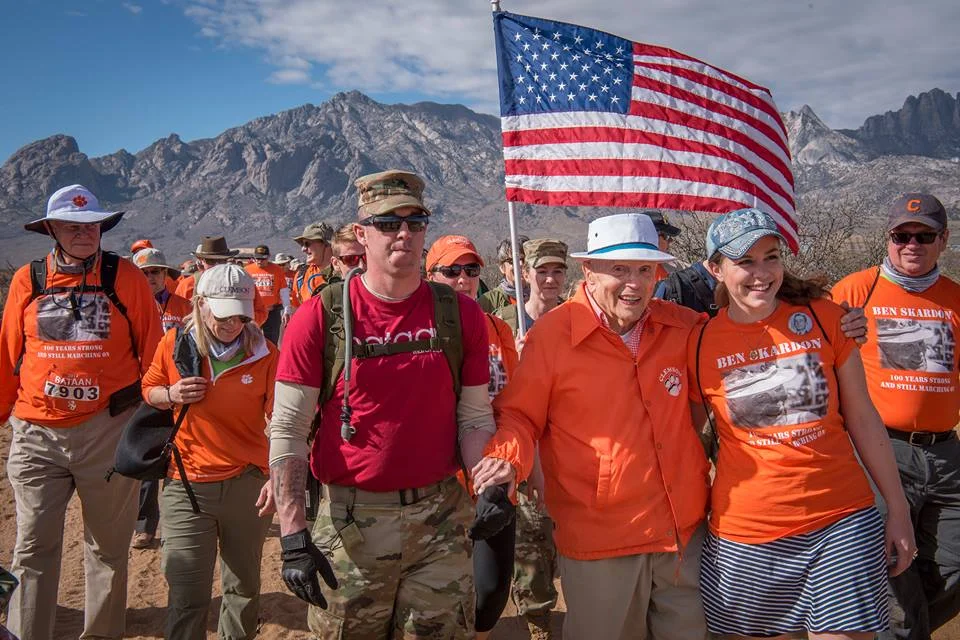
Beginning when he was nearly 90 years old, Skardon traveled to White Sands Missile Range in New Mexico to participate in the annual Bataan Memorial Death March, an event honoring the Americans and Filipinos who suffered during the original march.
He wasn’t there to win a race.
He wasn’t there to establish an impressive athletic record.
He was there because he believed the men who died alongside him deserved to be remembered.
Year after year, Skardon walked approximately eight to eight and a half miles as part of the memorial event, accompanied by friends, family members, military personnel, and a devoted group known as Ben’s Brigade.
He returned 13 times, making his final participation at the age of 101.
Just imagine the scene: a man more than a century old, wearing Clemson orange, moving deliberately across the New Mexico desert, retracing a symbolic portion of a journey that had nearly taken his life decades earlier.
Each step represented something much larger than physical endurance.
Each step honored the prisoners who died from starvation, disease, exhaustion, and brutality.
Each step honored friends like Henry Leitner and Otis Morgan.
And each step reminded those around him that freedom carries an enormous cost.
Skardon became an inspiration to countless veterans, active-duty military personnel, ROTC cadets, and ordinary Americans.
The same man who had once been forced to march under threat of death was now choosing to walk in remembrance of those who no longer could.
And Clemson University would find a way to carry that mission forward.
The Clemson 8 Challenge: Turning One Man’s Pilgrimage Into a Lasting Tradition
Today, the Clemson 8 Challenge represents one of the most meaningful ways the Clemson community continues to honor Skardon and the other Clemson graduates who endured the Bataan Death March.
The event was established through the work of Clemson students, veterans, alumni, and community supporters determined to ensure that Skardon’s annual pilgrimage would not disappear with his passing.
Among the Clemson community members whose efforts have helped preserve the university’s military heritage is longtime Clemson businessman, graduate, and local historian Trent Allen.
Allen’s connection to Clemson runs far deeper than operating a business in town. Through his longstanding relationships with the Clemson community, ROTC, military veterans, and the university’s historical traditions, he has devoted considerable time and energy to remembering the men and women who served.
He also developed a personal relationship with Skardon, a connection built around their mutual respect for Clemson’s military history and the importance of preserving it.
The Clemson 8 Challenge reflects that same spirit of remembrance.
The number eight honors the approximate distance Skardon walked during his yearly appearances at the Bataan Memorial Death March in New Mexico.
The event offers participants an opportunity to walk, run, or complete other physical challenges in recognition of the sacrifice of those who endured Bataan. Its programming has included an eight-mile challenge, an eight-kilometer option, and virtual participation, allowing people far beyond Clemson to share in the tribute.
But the event is about far more than finishing a course.
The challenge raises money for Clemson’s military-affiliated student organizations and helps support students and cadets who participate in the Bataan Memorial Death March in New Mexico.
It creates a direct connection between Clemson’s military past and the young men and women preparing to serve in the future.
And it brings together veterans, families, university students, graduates, and community members around a common purpose.
The first five challenges raised more than $126,000 for scholarships and support. By the 2027 event cycle, the total from the first six challenges had grown to more than $139,000.
What began as a way to preserve a remarkable veteran’s personal pilgrimage has become an enduring expression of Clemson’s commitment to remembering those who sacrificed for their country.
Through this annual challenge, Skardon’s footsteps continue long after his own journey ended.
485 Souls: A Clemson Evening I Will Never Forget
This story also brings me back to an experience that remains one of the most meaningful moments I’ve had covering Clemson University.
Years ago, while working as a Clemson journalist for 247Sports and CBS Sports, I wrote an article titled “485 Flags for 485 Heroes: Clemson Honors Its Own.”
That story documented a heartfelt effort by my longtime friend and Clemson businessman Trent Allen and his wife to honor the Clemson men whose names were recorded on the university’s Scroll of Honor.
The idea was beautifully simple.
While watching ceremonies at Arlington National Cemetery, where thousands of American flags are placed to honor the nation’s fallen military personnel, Trent’s wife suggested doing something similar at Clemson’s Scroll of Honor.
Why couldn’t Clemson honor its own fallen heroes with individual American flags?
From that simple suggestion, something extraordinary began to take shape.
Trent and his wife began searching for enough American flags to honor the 485 Clemson military dead recognized at the Scroll of Honor at that time.
They searched stores, contacted suppliers, made calls, and worked to find exactly what was needed.
Eventually, they located a supplier with precisely 485 flags available.
Whether coincidence or something more meaningful, that detail seemed especially fitting.
Trent contacted me and invited me to come to the Scroll of Honor to witness what they were preparing to do.
I made my way toward the memorial as the evening sunlight began fading behind Memorial Stadium.
A small gathering had formed, consisting of Clemson alumni, veterans, students, and local residents. They weren’t there for publicity, applause, or recognition.
They were there to honor 485 Clemson men who had given everything in service to this nation.
As darkness approached, the volunteers began placing American flags around the memorial.
One flag for each name.
One flag for each life.
One flag for each family that had experienced the pain of losing someone who never returned home.
The atmosphere was quiet, respectful, and deeply moving.
And among those gathered that evening was Colonel Ben Skardon himself.
This American hero, a survivor of one of the most horrifying experiences in military history, was there to participate in honoring the Clemson men who had made the ultimate sacrifice.
Skardon helped lead the procession and distribute the flags to the volunteers.
Imagine standing there, surrounded by those little American flags, watching a man who had survived Bataan personally helping honor those whose military service had ended in death.
That is something you simply don’t forget.
I remember writing about that evening and encouraging Clemson fans to stop by the Scroll of Honor during Military Appreciation Day rather than simply walking past it on their way to Memorial Stadium.
Because those names weren’t decorations.
They represented real people.
Sons. Brothers. Husbands. Fathers. Friends.
Clemson men who once walked the same campus, attended classes, celebrated traditions, and dreamed about their futures.
Men whose lives were interrupted by the call of duty and who never had the opportunity to return home.
I referred to them as 485 souls.
And to this day, the meaning behind that description remains just as powerful.
The number reflected those honored at the memorial at the time of that original article; Clemson’s continuing work to document its war dead ensures that their individual stories remain central to its military heritage.
That evening also reinforced something I’ve come to appreciate about people like Trent Allen.
Preserving history doesn’t always require a museum, an enormous financial contribution, or an elaborate ceremony.
Sometimes it simply requires someone to care enough to act.
Sometimes it takes a husband and wife deciding that 485 forgotten sacrifices deserve 485 American flags.
And sometimes the greatest tributes begin with someone asking why something meaningful isn’t already being done.
From Colonel to General: A Final Honor for an Extraordinary American
As Ben Skardon approached the end of his remarkable life, recognition of his extraordinary military service continued.
Shortly before his death in November 2021, Skardon received word that his honorary promotion from Colonel to Brigadier General had been approved.
It was a fitting tribute to a soldier whose service extended far beyond his military decorations and whose impact had touched countless lives.
On November 15, 2021, Ben Skardon passed away at the age of 104.
He had outlived empires, witnessed the transformation of American society, seen Clemson evolve from a small military college into a major public research university, and inspired generations who came after him.
He had survived the Bataan Death March, endured years of imprisonment, and returned home to dedicate much of his life to teaching and remembrance.
He had been a soldier, prisoner, survivor, husband, father, professor, mentor, and friend.
And through it all, he remained a Clemson Tiger.
His final honorary rank was Brigadier General, but titles alone could never adequately measure the stature of this extraordinary man.
His greatest honors were found in the friendships he cherished, the lives he influenced, and the memories he preserved for future generations.
What Every Clemson Fan Should Remember
When Clemson celebrates Military Appreciation Day, the festivities inside Memorial Stadium are always something special.
The patriotic displays, American flags, military flyovers, recognition of veterans, and thousands of fans showing their appreciation make for an unforgettable experience.
But the real meaning of the day exists beyond the stadium.
It exists at the Scroll of Honor.
It exists in the stories of the Clemson cadets who traded classrooms for battlefields.
It exists in the sacrifice of Henry Leitner and Otis Morgan, who refused to abandon their dying friend in a Japanese prison camp.
It exists in that little gold Clemson ring.
It exists in the memories of 485 souls honored by 485 flags on a quiet Clemson evening.
And it exists in the footsteps of Ben Skardon, whose annual walks in New Mexico helped inspire a Clemson tradition that continues to introduce his story to new generations.
People like Trent Allen and the many Clemson alumni, veterans, ROTC supporters, and community volunteers who work to preserve this history deserve recognition as well. Their commitment ensures that these aren’t simply stories tucked away in archives, waiting for someone to discover them.
They are living traditions.
They are lessons passed from one generation to the next.
They are reminders that Clemson’s greatest accomplishments cannot always be measured in championships, academic rankings, or the size of its graduating classes.
Sometimes a university’s greatness is revealed in the character of the people it produces.
And there may be no finer example of that character than Ben Skardon.
One Ring. Three Tigers. A Brotherhood for Eternity.
There is something almost impossible to comprehend about the journey of that Clemson class ring.
It began as a symbol of one young man’s graduation from a military college in South Carolina.
It traveled across the Pacific Ocean into a world at war.
It survived the surrender of American forces, the brutality of the Bataan Death March, and the degradation of imprisonment.
And finally, when its owner was lying near death, it was surrendered not as a symbol of defeat but as an extraordinary act of love and loyalty.
One Clemson man gave up his most treasured possession.
Two Clemson brothers used it to help save his life.
And a legend was born.
Today, Clemson students continue receiving their own rings, many without realizing the full weight of the history they carry on their fingers.
They may someday look back at that ring and remember graduation, friendships, football weekends, or the classrooms where their futures began to take shape.
But if they truly understand the story of Ben Skardon, they will know that a Clemson ring can represent something far greater.
It can represent an unbreakable promise to the people who share its meaning.
The promise that when circumstances become unbearable, when everything seems lost, and when one of our own needs us most, we do not walk away.
We stand together.
We carry one another.
And when necessary, we sacrifice something precious to save someone we love.
That is the Clemson Family at its finest.
That is what Ben Skardon, Henry Leitner, and Otis Morgan showed the world.
And that is why, long after every football season has ended and every championship trophy has collected dust, the story of a Clemson Tiger, his two friends, and a little gold ring will remain among the greatest stories this university has ever produced.
The next time you walk past Clemson’s Scroll of Honor, stop for a moment.
Read a name. Remember a life. Think about what was sacrificed so that the rest of us could enjoy the freedoms we sometimes take for granted.
And remember a remarkable man named Ben Skardon.
He survived the march. He survived the war. He lost his ring, but he never lost his Clemson Family.
And his legacy will march on forever.
Lest we forget.
GO TIGERS.
Editor’s historical note: This feature incorporates memories and reporting from Gary McDaniel’s earlier 247Sports/CBS Sports article, “485 Flags for 485 Heroes: Clemson Honors Its Own,” including his firsthand account of Trent Allen, his wife, and General Skardon participating in a flag tribute at the Scroll of Honor. Military and biographical details have been cross-checked against Clemson University, U.S. Army accounts, and historical records.