

By Clemson Sports News
CLEMSON, S.C. — Two practices into Clemson’s 2026 fall camp, there are always players who flash. A freshman makes a difficult catch. A young defensive back gets his hands on a football. Somebody looks noticeably bigger or faster than expected.
Then there are players who make you start asking a different question.
What exactly does Clemson have in Tayveon Wilson?
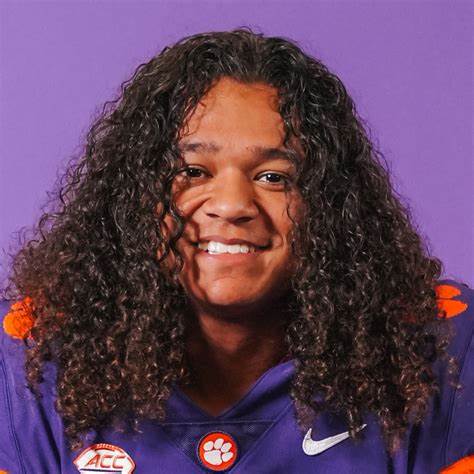
First, a clarification: Wilson is no longer simply a Clemson commitment. He signed with the Tigers, enrolled this summer and is now a true freshman wearing No. 18. Officially listed at 6-foot-1 and 210 pounds, Wilson arrived from Huntington, West Virginia, as one of the more unusual athletes Clemson has signed in recent memory. And through the opening days of camp, the athletic ability that made Clemson pursue him so aggressively is already beginning to show itself.
Wilson has stood out as a pass catcher during the limited portions of practice available for observation. Through the first two days, he has looked natural tracking the football, adjusting to throws and attacking the ball at its highest point rather than waiting for it to arrive. One camp report specifically identified Wilson as one of the freshmen who had distinguished himself on consecutive days, describing him as a smooth pass catcher with an ability to go up and high-point the football.
That shouldn’t be particularly surprising when you dig into his background.
Wilson wasn’t a traditional high school tight end who spent four years attached to the formation blocking defensive ends. He was essentially whatever Huntington High School needed him to be. He played receiver. He carried the football. He played quarterback. He played defense. He returned kicks and even earned all-state recognition as a punter.
His career numbers almost look like they belong to several different players: 1,407 passing yards, 950 rushing yards and 1,103 receiving yards, with 17 passing touchdowns, 17 rushing scores and 14 receiving touchdowns. As a senior, when Huntington needed him at quarterback, Wilson produced roughly 2,150 yards of offense while also playing safety and recording 30 tackles, two interceptions and a pick-six. He was ultimately named the Gatorade Player of the Year in West Virginia.
And football might not even provide the best evidence of just how unusual an athlete Clemson signed.
Wilson played baseball, basketball and competed in track. He earned all-state recognition as a baseball player, hit .435 with 22 stolen bases during summer baseball in 2024, was part of a state championship 4×100-meter relay team and earned all-state recognition in the 110-meter hurdles. Earlier in his high school career, he had already clocked an 11.23 in the 100 meters. He was also an all-tournament basketball player.
So, is the “freak athlete” label justified?
Athletically, yes.
Not because Wilson is a 6-foot-6, 260-pound tight end running like a receiver. That’s not what he is. The intrigue comes from his combination of acceleration, body control, ball skills, change of direction and the spatial awareness that usually comes from playing several different sports and several different football positions. Wilson has spent years learning how to compete for balls in the air, navigate space, run after the catch and make plays without being confined to one position.
That’s precisely why Clemson recruited him differently.
When Wilson committed in November 2024, Clemson had identified him as its priority at the position. Penn State, Virginia Tech and West Virginia were among the programs pursuing him, but Clemson recruited Wilson specifically with an H-back/tight end projection in mind. Wilson repeatedly visited Clemson, developed a strong relationship with tight ends coach Kyle Richardson and ultimately shut down his recruitment early.
Can Wilson actually play this year?
Here is where expectations need to remain reasonable.
Clemson has considerably more experience ahead of him. Olsen Patt-Henry, Christian Bentancur and Logan Brooking entered camp positioned to command the majority of the meaningful tight end work, while veteran Charlie Johnson also provides experience. Clemson’s official roster lists Patt-Henry at 245 pounds, Bentancur at 250 and Brooking at 240. Wilson is currently listed at 210.
That 30-to-40-pound difference matters.
Chad Morris’ offense asks a lot from tight ends. If Wilson is going to line up attached to the formation and consistently handle ACC defensive ends and linebackers in the running game, he has physical development ahead of him. Highlight-reel catches are one thing. Executing an assignment against a 250-pound edge defender on third-and-two is another.
For that reason, projecting Wilson as Clemson’s No. 1 or No. 2 traditional tight end this fall would be premature.
But cracking the three-deep? That’s becoming a much more interesting conversation.
And more importantly, Clemson doesn’t necessarily have to use Wilson like a traditional tight end.
That might ultimately be the key.
Put him in the slot. Motion him across the formation. Use him as an H-back. Release him into the flat. Match him against a linebacker. Run him vertically against a safety. Put him in a bunch formation and force the defense to determine whether it is dealing with a tight end, receiver or back.
At 210 pounds with legitimate receiver skills, Wilson could potentially provide Chad Morris with a chess piece rather than simply another tight end.
That doesn’t mean he will suddenly receive 30 or 40 catches as a freshman. Clemson has too many established weapons for that prediction to make sense right now. But the path toward situational playing time is easier to envision than it was before camp began.
There is another avenue, too: special teams. Players with Wilson’s running ability, toughness and multi-sport athleticism frequently force their way onto the travel roster through special teams before establishing themselves offensively.
The Bigger Picture
Perhaps the most interesting aspect of Wilson is that Clemson may not even know yet what his ceiling looks like.
He’s only beginning the process of becoming a college tight end.
Clemson didn’t recruit a finished product. It recruited an athlete who had played quarterback, receiver, running back and defensive back while simultaneously competing in three other sports. Now Richardson and Morris get to take those tools and build a position around them.
And sometimes those are the players whose recruiting rankings become largely irrelevant once they arrive on campus.
Wilson wasn’t regarded as one of the nation’s elite five-star tight ends. He was generally evaluated as a three-star athlete and was ranked as the top prospect in West Virginia by both Rivals and 247Sports. Clemson, however, saw enough that it made him its priority tight end target.
Two days of fall camp certainly aren’t enough to declare Clemson has found its next great tight end.
They’re enough to start watching closely.
The receiving ability appears real. The explosiveness isn’t manufactured. The multi-sport athletic résumé speaks for itself. The major hurdle will be whether Wilson can become physically ready enough—and dependable enough as a blocker and assignment player—to earn the coaches’ trust this quickly.
If he does?
Clemson may have a difficult time keeping No. 18 off the field.
And even if 2026 becomes primarily a developmental season, the early glimpse of Tayveon Wilson offers a pretty compelling hint at what Clemson could eventually have: not necessarily a conventional tight end, but an offensive mismatch with the athletic ability to become something much more dangerous.

























































One Comment
Punter??