By Clemson Sports News Staff
BERKELEY, Calif. — A week ago, there was still a legitimate question hanging over Clemson’s rapidly improving secondary.
Was this real?
Or was it simply the product of the competition?
After Clemson’s defensive backs were torched in the season opener at LSU, the numbers improved dramatically against Georgia Southern and then improved again against North Carolina. Ashton Hampton was playing some of the best football of his Clemson career. Elliot Washington II was settling into his role opposite him. The safeties were limiting explosive plays, quarterbacks were becoming less efficient, and the football was beginning to find Clemson hands instead of opposing receivers.
But Georgia Southern and North Carolina were not California.
Friday night provided a much different measuring stick.
And Clemson’s secondary passed the test.
In Clemson’s 24-10 victory over Cal at California Memorial Stadium, the Tigers faced one of the ACC’s most productive passing attacks and completely suffocated it.
California entered Friday averaging 321.7 passing yards per game, fourth-best in the ACC, while quarterback Jaron-Keawe Sagapolutele arrived in the matchup completing 66.7 percent of his passes with 866 yards and seven touchdowns through three games. He had thrown for a career-high 413 yards just six days earlier against Wagner.
Against Clemson?
16-of-29.
119 yards.
0 touchdowns.
2 interceptions.
It was the lowest passing-yardage total of Sagapolutele’s 17 career starts.
That is no longer something Clemson can dismiss as a favorable matchup.
That is a defensive secondary playing winning football.
Elliot Washington II Was the Headliner
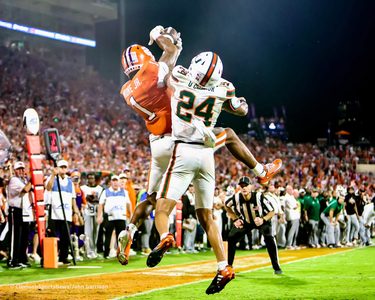
Washington produced the splash plays Friday.
The veteran corner intercepted Sagapolutele twice, giving Clemson possession on two Cal passing mistakes and making himself one of the defining players of the night. FOX listed Washington among the game’s top performers specifically for those two interceptions.
It continued what has quietly become an excellent start to Washington’s Clemson career.
He had already delivered the game-clinching interception against North Carolina a week earlier, picking off Billy Edwards Jr. with 37 seconds remaining to finish Clemson’s 28-20 comeback victory.
Now he has gone from making the final play against UNC to becoming the ballhawk Clemson needed against Cal.
That matters.
Washington’s arrival from Penn State was supposed to give Clemson another experienced, physical corner capable of playing aggressively opposite Hampton. Through the first few weeks, Clemson was still figuring out exactly what the new-look secondary would become.
Washington may have answered part of that question Friday.
Clemson now has two corners that quarterbacks cannot casually challenge.
Ashton Hampton’s Night Was About Erasing Space
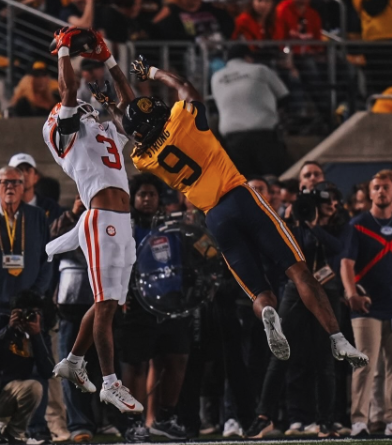
Hampton did not need two interceptions to affect this game.
His impact was visible in how difficult Cal found it to consistently create separation outside.
Multiple times Sagapolutele looked toward Hampton’s side and either had to move elsewhere or throw into extremely tight coverage. During Cal’s fourth-quarter attempts to rally, Hampton again provided lockdown coverage on a critical third-down situation.
That has become increasingly normal.
Hampton opened the season at LSU with an interception on the second play from scrimmage. Despite Clemson’s overall defensive struggles that night, he finished with two tackles, a half tackle for loss and that interception.
Against Georgia Southern, Hampton followed with three pass breakups and two tackles, repeatedly disrupting throws at the catch point.
Against North Carolina, he added another breakup while Clemson held the Tar Heels to just 135 passing yards.
Entering the Cal game, Hampton had already accumulated four pass breakups and an interception through three games, while becoming Clemson’s most reliable outside coverage defender.
Friday night was less about filling the box score and more about performing the fundamental job of an elite cornerback:
Make the quarterback stop throwing your way.
The Statistical Progression Is Impossible to Ignore
This is where Clemson’s defensive-back story becomes particularly interesting.
Look at the progression from Week 1 forward.
| Opponent | Comp.-Att. | Comp. % | Passing Yards | Yards/Attempt | TD-INT |
|---|---|---|---|---|---|
| LSU | 22-36 | 61.1% | 335 | 9.3 | 2-1 |
| Georgia Southern | 27-48 | 56.3% | 244 | 5.1 | 1-0 |
| North Carolina | 13-30 | 43.3% | 135 | 4.5 | 1-1 |
| Cal — Sagapolutele | 16-29 | 55.2% | 119 | 4.1 | 0-2 |
The direction is remarkable.
At LSU, Clemson allowed 335 passing yards and 9.3 yards per attempt.
Against Georgia Southern, that dropped to 244 yards and 5.1 per attempt.
Against North Carolina, Clemson surrendered only 135 yards and 4.5 per attempt.
Then came the real test.
Sagapolutele — a quarterback who entered averaging nearly 289 passing yards per game — managed only 119 yards at 4.1 yards per attempt with no touchdown passes and two interceptions.
Even using Cal’s total team passing figure rather than Sagapolutele’s individual number, Clemson allowed only 145 passing yards Friday.
So the team passing-yardage progression reads:
335 → 244 → 135 → 145.
Since LSU, Clemson has allowed an average of only 174.7 team passing yards per game.
That represents roughly a 48 percent reduction from the 335 yards surrendered in Baton Rouge.
That is not a small correction.
That is a transformation.
Quarterback Efficiency Has Collapsed Against Clemson
Passing yards tell only part of the story.
Quarterback efficiency tells considerably more.
Against LSU, Clemson allowed a passer-efficiency rating of approximately 152.1.
Georgia Southern dropped to 105.8.
North Carolina fell to 85.5.
Sagapolutele’s performance Friday works out to approximately 75.8.
That means Clemson has gone from allowing an extremely efficient quarterback performance in Week 1 to forcing progressively poorer ones.
Over the three games since LSU, the primary opposing quarterbacks have combined to complete:
56 of 107 passes
52.3 percent
498 yards
4.65 yards per attempt
2 touchdowns
3 interceptions
Their combined passer-efficiency rating is approximately 92.0.
That is shutdown territory.
Especially considering Clemson just added Cal to that sample.
This Was the Game That Changed the Conversation
Georgia Southern was encouraging.
North Carolina made it interesting.
California made it convincing.
There could always be an argument following the previous two games that Clemson’s improvement was partially related to the opposing passing attacks.
That argument becomes much harder after Friday.
Cal entered the evening ranked 14th nationally in passing offense at 321.7 yards per game. Sagapolutele had thrown seven touchdown passes in three games and had just completed 27 of 33 passes for 413 yards and three touchdowns against Wagner.
Clemson took that same quarterback and made him look uncomfortable for four quarters.
He completed only 55.2 percent of his passes.
He averaged just 4.1 yards per attempt.
He did not throw a touchdown.
He threw two interceptions.
And Cal failed to score an offensive touchdown.
The Golden Bears’ only touchdown came from their defense on Kamar Mothudi’s 35-yard fumble return. According to the ACC’s postgame report, it was the first time Cal had gone without an offensive touchdown at home since 2018.
That is a statement.
Hampton and Washington Are Giving Clemson Something It Needed
For defensive coordinator Tom Allen, the importance extends beyond two talented corners playing well.
Having Hampton and Washington capable of surviving on islands changes the defense.
It gives Clemson more freedom to disguise pressure.
It allows linebackers to attack instead of constantly worrying about underneath coverage.
It allows safeties Corey Myrick and Jerome Carter III to disguise their responsibilities.
It allows Clemson to challenge receivers rather than simply conceding easy completions.
Most importantly, it forces quarterbacks to hold the football.
And that gives Clemson’s pass rush additional time to arrive.
This is how coverage and pressure begin feeding each other.
Earlier in the season, Clemson occasionally looked like a defense hoping the pass rush would rescue the secondary.
Now the secondary is helping create opportunities for the pass rush.
That is a fundamentally different defense.
The Ball Is Starting to Find Clemson
There is another important evolution occurring.
Clemson is no longer merely defending passes.
The Tigers are taking them away.
Hampton intercepted LSU.
Washington intercepted North Carolina.
Washington intercepted Cal twice.
That gives Clemson corners four interceptions through the first four games, with Hampton and Washington responsible for all four.
And Washington has now produced three interceptions in Clemson’s last two games alone.
That is the difference between coverage that is merely competent and coverage that changes football games.
Against North Carolina, Washington ended the game.
Against California, he helped Clemson control it.
From Question Mark to Strength
Four weeks ago, cornerback was one of the biggest questions surrounding Clemson’s defense.
Avieon Terrell was gone.
The secondary had new pieces.
The Tigers were replacing experience.
Then LSU threw for 335 yards.
The concern was legitimate.
Four games later?
The entire conversation has changed.
Ashton Hampton looks like an established No. 1 corner.
Elliot Washington II looks increasingly comfortable and increasingly dangerous.
The safeties are keeping plays in front of them.
Explosive passes are disappearing.
Completion percentages are falling.
Yards per attempt are collapsing.
Interceptions are increasing.
And now Clemson has done it against a quarterback and passing attack capable of exposing a secondary that is not legitimate.
California was supposed to answer the question.
It did.
This is no longer simply an improving Clemson secondary.
It is becoming one of the strengths of the football team.
And Ashton Hampton and Elliot Washington II are standing right in the middle of it.