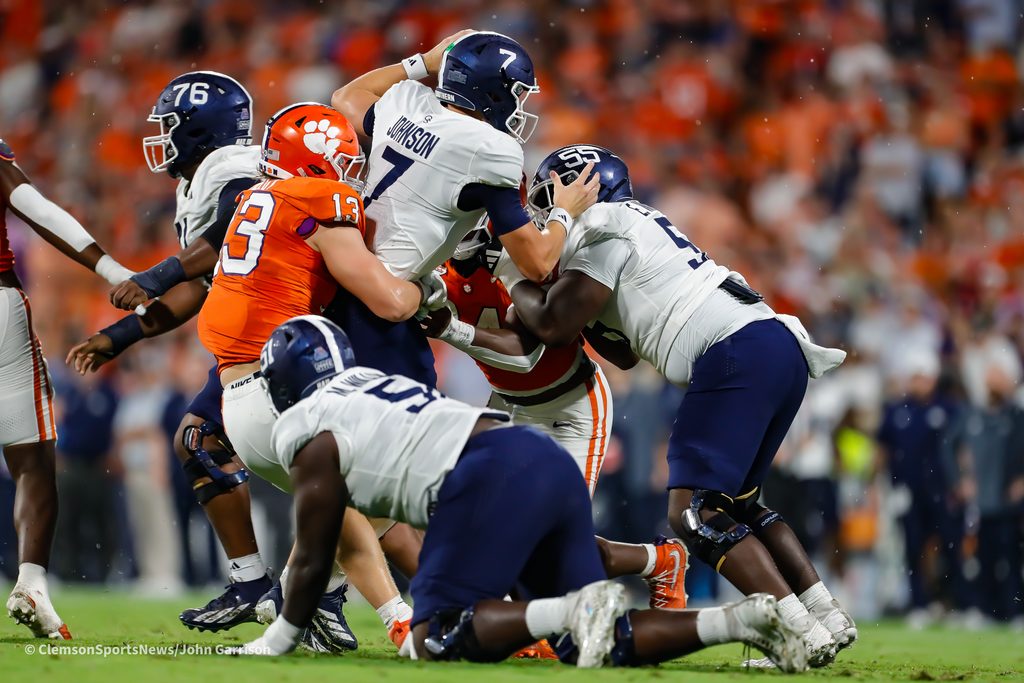
From 309 rushing yards allowed at LSU to just 22 against Georgia Southern, Tom Allen’s defense looked like an entirely different unit Saturday night. The question now is whether Clemson found its defensive identity — or simply took the first step toward it.
CLEMSON, S.C. — Seven days can change a lot in college football.
A week earlier in Baton Rouge, Clemson’s defense had been pushed around, run through and ultimately worn down during one of the most alarming defensive performances of the Dabo Swinney era.
Saturday night in Death Valley, the Tigers pushed back.
Hard.
Georgia Southern walked into Memorial Stadium with an experienced quarterback and an offense that had produced 514 yards in its opener. It walked out having scored seven points, rushed for only 22 yards, converted just 4-of-17 third downs and failed on both of its fourth-down attempts.
The Eagles punted 10 times.
Eight of their possessions officially ended as three-and-outs.
And when Georgia Southern drove all the way to Clemson’s 3-yard line in the final two minutes, with the outcome essentially decided, the Tigers still refused to allow them into the end zone.
Clemson won 22-7, and while the offensive questions coming out of Saturday night remain plentiful, there was very little ambiguity about what happened when Tom Allen’s defense was on the field.
This was a response.
A Tale of Two Saturdays
You almost have to put the numbers beside each other to appreciate how dramatically Clemson flipped the script.
Against LSU, Clemson surrendered 644 total yards, including a staggering 309 rushing yards. LSU accumulated 38 first downs and converted 11-of-16 third downs, repeatedly extending drives while Clemson struggled to set the edge, fit the run correctly and get off the field.
Against Georgia Southern?
266 total yards.
22 rushing yards.
14 first downs.
4-of-17 on third down.
0-for-2 on fourth down.
LSU averaged more than five yards per rushing attempt. Georgia Southern averaged only 1.2 yards per carry on 18 attempts.
That’s a 287-yard difference in rushing production in seven days.
Obviously, Georgia Southern isn’t LSU. Nobody should pretend those offenses present the same personnel, size or athletic challenge.
But Clemson didn’t need Georgia Southern to be LSU.
Clemson needed to show that what happened at LSU was correctable.
It needed to set an edge.
It needed defensive tackles holding their ground.
It needed linebackers attacking gaps instead of getting swallowed at the second level.
It needed safeties making tackles because the scheme dictated it — not because running backs were reaching them untouched.
And it needed to get off the field on third down.
For one night, Clemson checked almost every box.
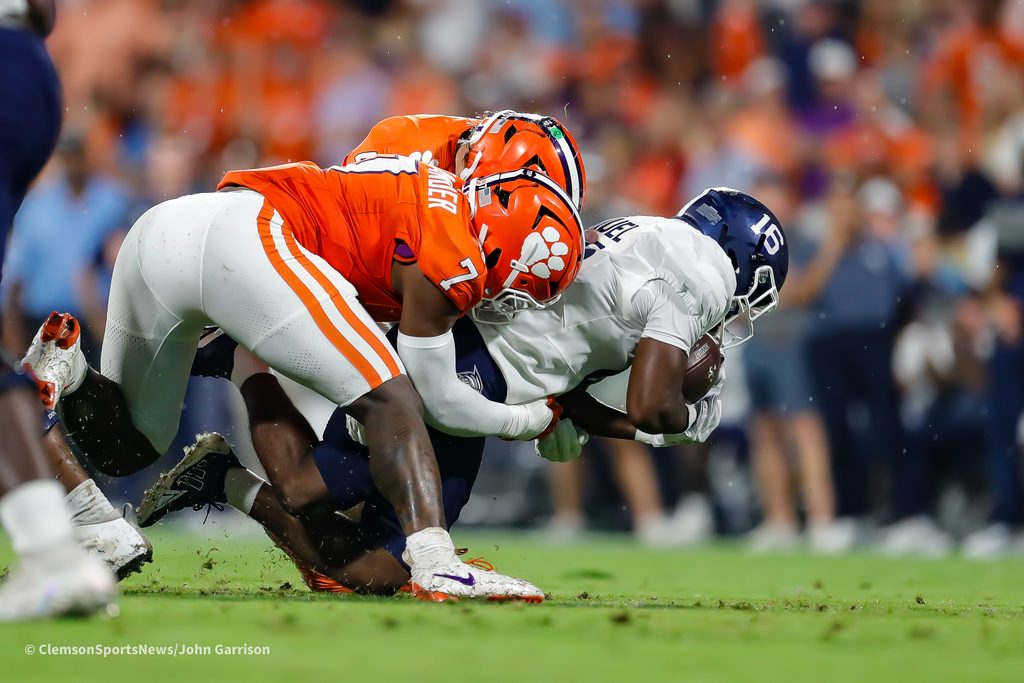
Tom Allen Turned Up the Heat
One of the most noticeable changes was Allen’s willingness to manufacture pressure.
Against LSU, Clemson didn’t record a sack.
Georgia Southern quarterback Max Johnson saw something very different.
Allen mixed his fronts and showed a willingness to bring five- and six-man pressures, forcing Johnson to make decisions quickly and frequently turning Georgia Southern’s passing game into a collection of short throws designed simply to get the football out. Clemson finished with three sacks for 27 yards in losses.
The biggest beneficiary was Will Heldt.
Heldt was exactly what Clemson needed its veteran edge defender to be.
He finished with two sacks and three tackles for loss, registering his first multi-sack game as a Clemson Tiger. His first sack came on Georgia Southern’s opening possession and helped Clemson immediately force a three-and-out.
That was significant.
Against LSU, Clemson spent most of the night reacting.
Against Georgia Southern, Clemson attacked.
Heldt was setting the edge against the run, winning pass-rush reps and forcing Georgia Southern to account for where No. 13 was lining up.
Afterward, Heldt credited Clemson’s preparation and his ability to anticipate the types of pass sets he would see from Georgia Southern’s offensive tackles. More importantly, he pointed toward execution.
That was the word Clemson needed after Baton Rouge.
Not scheme.
Not talent.
Execution.
And Saturday night, Clemson executed.
The Linebackers Played Downhill Again
The rushing total tells much of this story.
You don’t hold an FBS opponent to 22 rushing yards with one player.
The defensive front controlled the point of attack, but Clemson’s linebackers were much cleaner behind them.
Sammy Brown was part of a group of Tigers around the football throughout the night. Brown finished among Clemson’s leading tacklers with five total stops, as did safety Corey Myrick, Jerome Carter III and defensive back Corian Gipson.
The importance of Brown’s performance wasn’t necessarily found in a gaudy tackle total.
In fact, the relatively modest tackle numbers among Clemson’s linebackers and safeties were a good thing.
At LSU, Clemson’s safeties were piling up tackles because LSU runners were constantly reaching the third level. Jerome Carter III and Corey Myrick finished the opener with double-digit tackle totals because Clemson simply couldn’t stop LSU before the football reached them.
Against Georgia Southern, those emergency tackles largely disappeared.
That meant Brown and the linebackers could play downhill.
It meant defensive linemen were keeping blockers from climbing freely into the second level.
It meant Clemson was winning earlier in the down.
Instead of making a tackle eight or nine yards from the line of scrimmage, Clemson was repeatedly creating second-and-long and third-and-long.
That changes everything Allen can call.
And once Georgia Southern became one-dimensional, Allen could come after Johnson.

Clemson’s Secondary Quietly Smothered the Passing Game
Look at Max Johnson’s raw number and 244 passing yards might initially appear respectable.
Look deeper.
Johnson needed 47 attempts to get those 244 yards.
He completed 27 passes — a 57.4-percent completion rate — averaging only about 5.2 yards per attempt.
And outside of the 42-yard touchdown to Ashton Hollins, Georgia Southern consistently had trouble producing explosive plays down the field.
That’s where Clemson’s secondary deserves considerable credit.
Ashton Hampton, Elliott Washington II, Corey Myrick, Jerome Carter III, Corian Gipson and Ronan Hanafin spent most of the evening making Johnson work for everything.
Georgia Southern receiver Josh Dallas caught nine passes — for only 41 yards.
Tight end Rylan Helms caught five — for 23 yards.
Amare Taylor was targeted five times and caught one pass for two yards.
Alex Greene was targeted three times and did not record a reception.
That’s winning football in the secondary.
Let the opponent complete a three-yard pass.
Tackle it.
Line up again.
Don’t surrender the 25-yard catch behind the coverage.
Don’t miss the first tackle and turn four yards into 30.
Force the offense to string together 10, 11 or 12 good plays.
Georgia Southern couldn’t consistently do it.
Hampton finished with two tackles and continued to discourage quarterbacks from living on his side of the field. Washington recorded three solo stops. Gipson was active around the football, while Myrick, Carter and Hanafin gave Clemson a physical presence at safety. Hanafin also registered Clemson’s other sack outside Heldt’s two.
It looked much closer to what Allen wants his defense to become.
The One Scoring Drive — and the Play Clemson Will Want Back
The defense wasn’t flawless.
Georgia Southern’s only touchdown came late in the second quarter on its best sequence of the night.
Starting at its own 25, the Eagles went 75 yards in six plays.
The drive began badly for Georgia Southern when Heldt dropped running back Jalen Samuel for a two-yard loss.
Then Johnson found Josh Ware for 22 yards.
After consecutive incompletions, Georgia Southern converted third-and-10 with another 13-yard completion to Ware.
Then came the play Clemson will want back.
Johnson connected with Ashton Hollins for 42 yards down the right sideline for the Eagles’ only touchdown of the night. A defensive illegal-use-of-hands penalty was declined because Hollins had already scored.
It was Georgia Southern’s one explosive scoring strike.
And it illustrates the next step for Clemson’s defense.
Dominant defenses don’t simply eliminate the run. They eliminate the cheap one.
One busted assignment, one lost leverage point, one receiver getting behind the defense can undo 20 excellent snaps.
Georgia Southern found that play once.
They never found another touchdown.
Eight Three-and-Outs — and Ten Punts
This may have been the most encouraging statistic of all.
Clemson forced eight official three-and-outs, and Georgia Southern punted 10 times overall.
That is defensive control.
In the first quarter, Georgia Southern managed one rushing yard, 15 passing yards and zero first downs.
By halftime, six Georgia Southern possessions had already ended in three-and-outs.
Then came the third quarter.
Georgia Southern possessed the football for more than nine minutes in the period, but produced only 47 yards and punted three times.
Clemson’s offense wasn’t giving the defense much margin for error. The Tigers weren’t stacking touchdowns and allowing Allen to unleash the pass rush with a 30-point advantage.
The score was 16-7.
Every possession mattered.
Yet the defense continued handing the football back to the offense.
That is precisely what Clemson could not do at LSU.
The Goal-Line Stand Said Something
Then came the ending.
Georgia Southern’s final possession won’t look great in the yardage column.
The Eagles drove 72 yards in 11 plays, reaching Clemson’s 1-yard line before the Tigers slammed the door.
And considering the circumstances, that finish might have been one of the most important moments of the night for Clemson’s defense.
The game was essentially over.
Clemson led 22-7.
There was less than two minutes remaining.
This would have been an easy place to concede a meaningless touchdown and walk off the field with a 22-14 win.
Instead, Clemson treated the goal line like the outcome was still undecided.
Johnson hit Helms for five yards to reach the Clemson 1.
Then Jahiem Lawson and Fletcher Cothran combined to drive Tyler Todd backward for a two-yard loss.
Third-and-goal from the 3: incomplete.
Fourth-and-goal from the 3: incomplete.
Ballgame.
That stand won’t radically alter Clemson’s national defensive rankings.
But it says something about mentality.
After giving up 51 points a week earlier, this defense wasn’t interested in giving away seven meaningless ones.
Make them earn it.
Defend every blade of grass.
Finish the game.
That is the mindset Allen has been attempting to install.
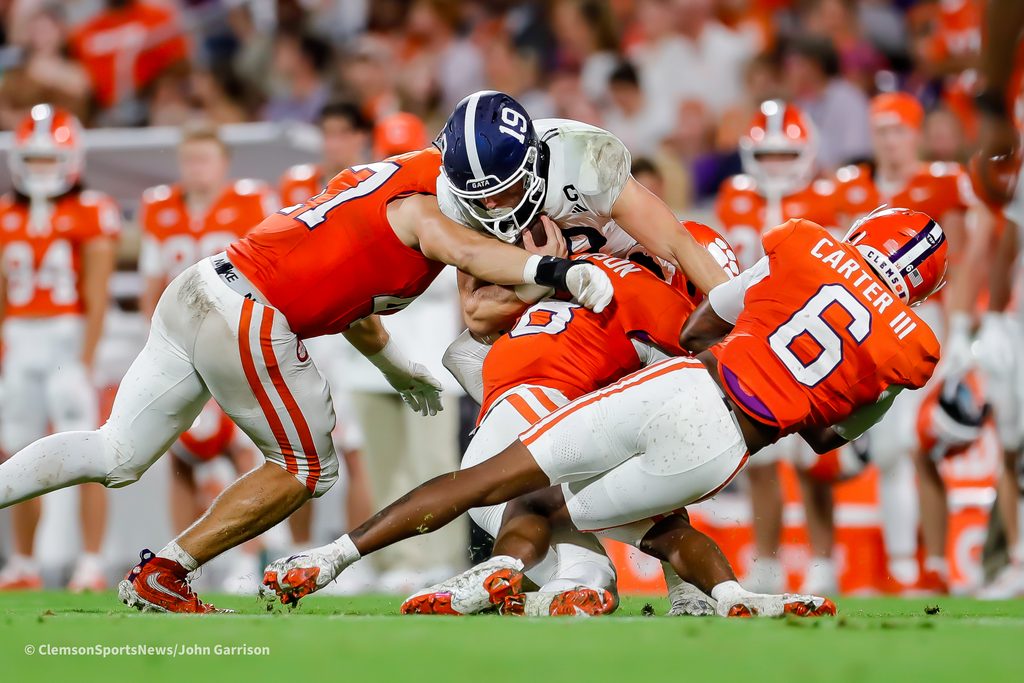
The Back End Looks Like a Strength
One of the legitimate positives emerging from the first two weeks is Clemson’s revamped secondary.
Even during the LSU disaster, Myrick and Carter showed flashes. Hampton intercepted Sam Leavitt on LSU’s second snap. Washington was productive.
Saturday night, that group got help from the front — and suddenly everything fit together.
That’s the relationship that was missing in Baton Rouge.
Coverage helps the rush.
The rush helps the coverage.
Run defense creates third-and-long.
Third-and-long opens Allen’s pressure package.
Pressure forces quarterbacks into quick throws.
Quick throws allow defensive backs to drive downhill and tackle.
Football becomes much easier when the defense controls the down-and-distance.
Against Georgia Southern, Clemson did.
Will Heldt Set the Tone
If there was one individual who embodied Clemson’s defensive response, it was Heldt.
Two sacks.
Three tackles for loss.
Edge integrity.
Pressure.
Leadership.
A week earlier, Clemson allowed LSU to repeatedly get outside its defensive structure.
Saturday, Heldt was one of the primary reasons that didn’t happen again.
He also understood what the performance meant — and what it didn’t.
Clemson improved.
Clemson did not suddenly solve everything.
As Heldt said afterward, the Tigers still have areas to correct, including run fits and mental errors.
That’s the right perspective.
Georgia Southern isn’t the measuring stick Clemson ultimately will be judged against.
But Clemson couldn’t get to North Carolina, Miami, Florida State or the rest of its ACC schedule without first fixing what LSU exposed.
Saturday was step one.
So Which Clemson Defense Is Real?
That’s now the question.
The defense that surrendered 51 points, 644 yards, 309 rushing yards and 38 first downs in Baton Rouge?
Or the defense that, seven nights later, allowed seven points, 266 yards, 22 rushing yards and 14 first downs?
Probably neither.
Not yet.
The truth is likely somewhere between the two extremes.
LSU exposed real problems that can’t simply be erased because Clemson physically overwhelmed Georgia Southern.
But Georgia Southern also provided evidence that those problems aren’t necessarily permanent.
Clemson tackled better.
Clemson set edges better.
Clemson fit the run better.
Clemson pressured the quarterback.
Clemson covered.
Clemson got off the field.
And when Georgia Southern stood three yards from the end zone with one last opportunity to score, Clemson told them no.
After what happened in Baton Rouge, that matters.
The Tigers aren’t going to erase LSU in one Saturday.
But against Georgia Southern, Tom Allen’s defense finally looked like a unit that had learned something from it.
One Saturday Clemson was gashed.
The next Saturday, Clemson grounded somebody else.
Now the challenge is making sure the second version is the one that shows up when ACC play begins.