For Clemson, Saturday night’s 22-7 victory over Georgia Southern was not the offensive breakout anyone was looking for. The Tigers managed just 347 yards, converted only 2-of-14 third downs and failed to score an offensive touchdown after the first quarter. Five Nolan Hauser field goals ultimately supplied most of the scoring. But buried inside an otherwise frustrating night may have been something considerably more important to Clemson’s future.
Tait Reynolds may have arrived.
Not as a finished quarterback. Not as some instant savior who suddenly fixes every problem on Clemson’s offense. But as a true freshman who was thrown into meaningful action much earlier than anticipated and showed enough arm talent, athleticism, toughness and improvisational ability to change the quarterback conversation completely.
Reynolds entered after Clemson’s third offensive series and essentially ran the offense for the remainder of the night. He finished 16-of-27 for 178 yards without an interception, added 38 rushing yards and directed five scoring possessions. Clemson head coach Dabo Swinney’s conclusion afterward was revealing: Reynolds had “made a move” in the quarterback competition.
And considering where Reynolds was only a few months ago, what happened Saturday should get Clemson fans’ attention.
This wasn’t supposed to become Tait Reynolds’ game
Christopher Vizzina started for the second consecutive week. He completed 4-of-7 passes for 19 yards, including Clemson’s only touchdown, a 10-yard strike to T.J. Moore. His third series ended with an interception.
Clemson had already planned to insert Reynolds on its fourth possession, so this was not technically a benching. But Vizzina took a hit and developed numbness in his left arm. Swinney said Clemson intended to put Vizzina back into the game later, but he could not feel the arm well enough to return. Suddenly the planned freshman cameo became Reynolds’ football game.
That distinction matters.
Reynolds didn’t enter with Clemson leading by 30 against an overmatched opponent. He entered a 7-0 game in the first quarter with an offense already under enormous scrutiny after Clemson’s 51-10 loss at LSU. Memorial Stadium was restless. The offense needed something. Reynolds had virtually no meaningful collegiate résumé from which to draw.
His college experience entering Saturday consisted of six passing attempts against LSU.
Yet he didn’t look overwhelmed for very long.
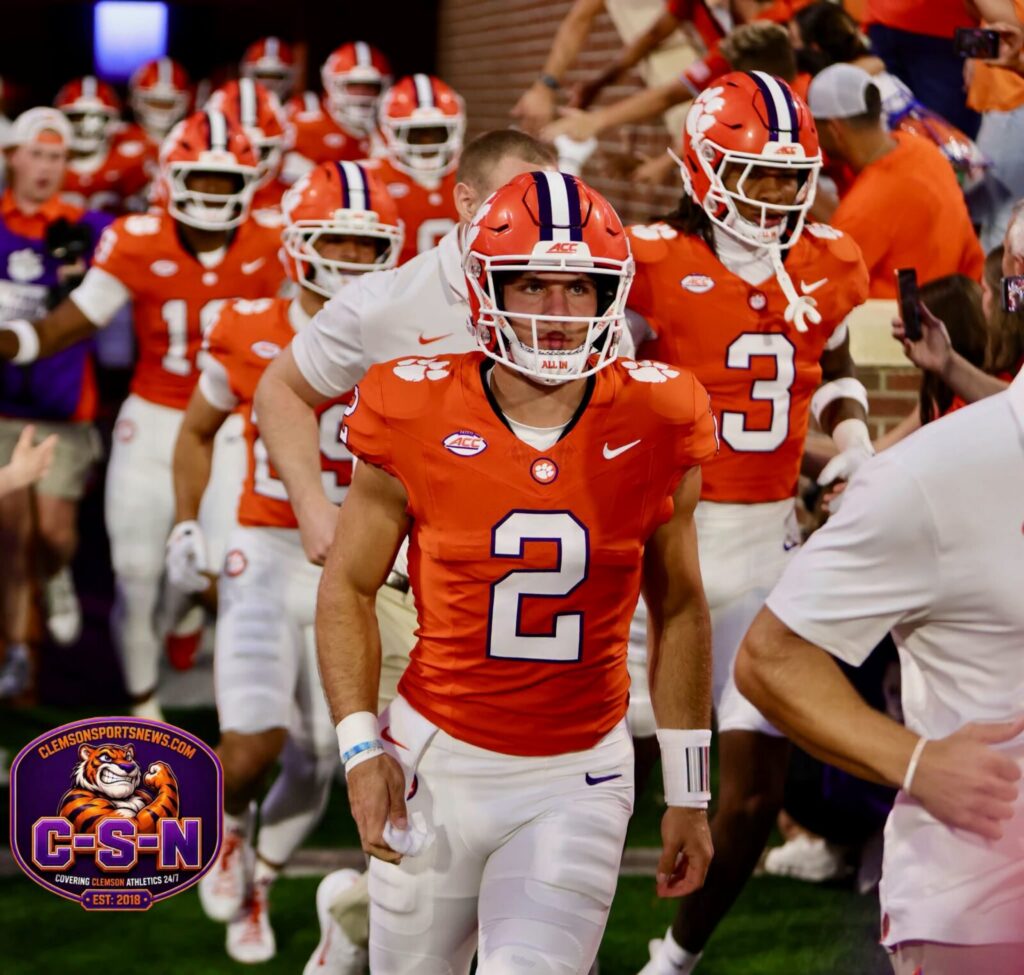
The first drive showed both sides of Tait Reynolds
His opening possession was almost the perfect miniature version of where Reynolds is right now as a quarterback.
Starting at Clemson’s 31, Reynolds immediately completed a 10-yard pass to Tyler Brown. Chris Johnson Jr. ripped off a 15-yard run, Georgia Southern added a personal foul and suddenly Clemson was attacking.
Reynolds then completed a nine-yard pass to T.J. Moore to reach the Georgia Southern 10.
Clemson had moved 62 yards in seven plays.
Then came the freshman mistake.
On third-and-one, Reynolds kept the football, gained enough for the first down and fumbled near the Georgia Southern 6. The Eagles recovered at the 7. Clemson went from potentially taking a 14-0 lead to coming away empty.
That’s the Reynolds evaluation in one possession.
The explosiveness is real. The athleticism is real. The offense feels different with his ability to threaten the defense as a runner. But the details — ball security, situational awareness and knowing when the play is over — have to improve.
What was more impressive was what happened after the mistake.
The freshman didn’t disappear.
The 45-yard throw showed what Clemson has been missing
Midway through the second quarter, Reynolds produced probably his most eye-opening passing play of the night.
On second-and-five from Clemson’s 43, Reynolds found T.J. Moore for 45 yards, taking Clemson all the way to the Georgia Southern 12. It was Clemson’s longest completion of the game and the sort of intermediate-to-explosive passing play this offense desperately needs more frequently.
The drive stalled and became another Hauser field goal, which is an important part of the criticism of Clemson’s offense. But the quarterback created the scoring opportunity.
Reynolds was not simply throwing bubble screens and five-yard hitches. Clemson gave him opportunities to push the football downfield. Some missed. Some weren’t particularly close. But there were flashes of a quarterback capable of stressing a defense vertically while simultaneously forcing linebackers to account for his legs.
That combination is what gives Reynolds such an intriguing ceiling.
A quarterback who can extend plays is useful.
A quarterback who can run for first downs is useful.
A quarterback who can do those things and deliver the ball down the field changes the geometry of a defense.
Reynolds has the physical ingredients to become that type of player.
The drive Clemson should study the hardest
For all the physical flashes, the sequence that may have told us the most about Reynolds came immediately before halftime.
Georgia Southern had just cut Clemson’s lead to 13-7 on a 42-yard touchdown pass. There were 3:03 remaining.
This was no longer simply a freshman getting experience. Clemson needed an answer.
Reynolds delivered one.
He completed an 11-yard pass to Bryant Wesco Jr., followed later by a 17-yarder to Wesco. Clemson then sabotaged itself with a holding penalty and a false start, eventually facing first-and-25.
Reynolds hit Christian Bentancur for nine.
After another penalty pushed Clemson backward again, the Tigers reached third-and-18 from their own 44 with 29 seconds remaining.
That’s the play worth circling.
Reynolds found Tyler Brown for 20 yards and a first down.
Two plays later, with only seconds remaining, Reynolds took off and ran for 16 yards to the Georgia Southern 20. He got the offense lined up, spiked the football and gave Hauser the opportunity to hit a 38-yarder as the half expired.
That possession matters more to me than several easier completions earlier in the game.
Why?
Because quarterbacking is not simply arm strength and completion percentage. It is functioning when circumstances become ugly.
Penalty.
Another penalty.
Long-yardage situation.
Clock running.
Defense knowing you have to throw.
Freshman quarterback.
And Reynolds kept the possession alive.
That’s where you begin seeing the competitive personality underneath the physical tools.
There is a difference between pass-rush pressure and football pressure
It’s important not to exaggerate what the available play-by-play tells us. The official log does not chart every hurry, pressure or pocket collapse the way a detailed film-grading service would, so it would be irresponsible to claim Reynolds was repeatedly completing throws with defenders hanging off him.
But we can evaluate situational pressure, and there was plenty of it.
The third-and-18 completion to Brown was one example. The two-minute situation immediately after Georgia Southern’s touchdown was another. There was also Reynolds converting a third-and-10 with his legs early in the third quarter, running for 13 yards to extend the possession.
Swinney’s postgame description was revealing. He specifically praised Reynolds’ ability to create “off-schedule plays” and said the freshman’s gifts were obvious. Swinney even added, “He’s going to be a problem.”
That is probably the central reason Reynolds has a chance to become Clemson’s quarterback sooner rather than later.
When the original play doesn’t work, Reynolds sometimes has a second answer.
Clemson hasn’t had nearly enough second answers offensively.
The statistics need context
Reynolds’ final line — 16-of-27, 178 yards, no touchdowns, no interceptions and 38 rushing yards — looks respectable rather than spectacular. But the first-half numbers are considerably more interesting.
He was 12-of-17 for 160 yards before halftime, while rushing nine times for another 32 yards.
That means the second half was far less impressive: Reynolds went just 4-of-10 for 18 passing yards after halftime. Clemson and Georgia Southern traded punts repeatedly, and the Tigers never solved their red-zone problems. Reynolds was sacked twice overall, and Clemson finished with only one touchdown on its five official red-zone opportunities.
That cannot simply be brushed aside because everyone is excited about the freshman.
If Clemson is going to hand Reynolds the offense, eventually field-goal drives have to become touchdown drives.
The next stage of his development is not proving he can make a spectacular play. We already saw that ability.
It’s proving he can make the routine play over and over again.
Swinney basically said the same thing after the game. There were moments where Reynolds looked gifted and moments where his freshman inexperience was obvious. That is exactly what Clemson should expect from an 19-year-old quarterback seeing his first extended meaningful action.

And here’s what makes this really intriguing: Reynolds hasn’t been living with the first-team offense
There is some nuance needed here.
Reynolds has received some first-team opportunities during Clemson’s quarterback competition, so it would be inaccurate to say he had never practiced with the ones. But Vizzina clearly received the heavier workload. In the final days before LSU, On3 reported that Vizzina had taken nearly every snap with Clemson’s first-team offense. Reynolds had risen to the clear No. 2 role but was still developing primarily from behind Vizzina.
Think about what that means.
Timing with T.J. Moore.
Timing with Bryant Wesco.
Understanding how the starting offensive line handles protections.
Communication with the center.
Recognizing defensive checks with Clemson’s actual starting personnel.
Executing the complete game plan at practice speed.
Those repetitions matter enormously for quarterbacks.
Now Reynolds has gone into a real game, played more than three quarters and given the staff legitimate evidence that he can operate the offense.
Clemson has not publicly announced how the quarterback repetitions will be divided this week, and Swinney answered “We’ll see” when asked whether Reynolds would start against North Carolina. But after Swinney himself said the freshman “made a move,” it would be surprising if Reynolds does not receive a substantially more significant opportunity with the starting unit — particularly while Vizzina’s arm is evaluated.
That could accelerate his development considerably.
His high school résumé explains why the ceiling is so fascinating
Reynolds wasn’t a quarterback who had been groomed from age six by private passing instructors to become the next five-star prodigy.
His development came quickly.
As a sophomore at Queen Creek High School in Arizona, Reynolds passed for 1,808 yards and 11 touchdowns while rushing for another 631 yards and 17 touchdowns.
Then came the explosion.
As a junior in 2024, Reynolds completed 156-of-252 passes — 61.9 percent — for 2,238 yards, 22 touchdowns and only five interceptions. He added a staggering 1,426 rushing yards at 10.4 yards per carry with 19 rushing touchdowns.
That’s 3,664 yards of offense and 41 touchdowns in one season.
Queen Creek improved by seven victories, finished 10-3 and advanced to Arizona’s 6A semifinals. Reynolds was named the Arizona Cardinals’ statewide Player/Offensive Player of the Year, earned state and region Player of the Year recognition and was an Arizona Republic first-team selection.
His senior season should have been the final development stage.
Instead, a hamstring injury cost him most of it.
That is an enormous part of this story.
When Reynolds talked after Saturday’s game about this being his most extensive playing time since his junior year of high school, he wasn’t exaggerating. His development as a quarterback essentially lost an entire competitive season.
And now Clemson is asking him to learn against Division I defenses.
The Elite 11 offered another clue
Before that senior-season injury, Reynolds competed at the Elite 11 Finals in the summer of 2025 against many of the nation’s best quarterback prospects.
He performed extremely well.
During the second night’s pro-day competition, Reynolds was reported to have been on target on 17 of 20 throws. Evaluators praised his physical build, arm talent and delivery, and Clemson’s official biography lists him among the top performers at the event.
ESPN ultimately rated him as a four-star prospect and one of the top quarterbacks in his class. Clemson lists him at 6-foot-2 and 215 pounds.
So Saturday did not create the athletic ability.
It confirmed that some of what evaluators saw in camp settings can translate when the jersey changes color and defenders are actually trying to hit him.
Don’t overlook the baseball background
There is another part of Reynolds’ athletic profile that matters.
He wasn’t merely a kid who also happened to play baseball. He was a legitimate high-level baseball prospect, ranked by some services among the nation’s top 100 players and selected to the USA Baseball Junior Team.
In the 2024 Arizona 6A state championship game, Reynolds delivered the walk-off hit in the 10th inning to win the title for Queen Creek.
That doesn’t tell us whether he can read Cover 3.
But it tells you something about the athlete and the competitor.
Baseball rewards rotational power, hand-eye coordination, throwing from changing platforms and remaining composed when a game comes down to one pitch or one at-bat.
Those traits don’t automatically produce great quarterbacks, but they’re certainly compatible with the kind of off-platform, off-schedule football Clemson saw Saturday night.
So what is the ceiling?
This is why Reynolds is so intriguing.
His ceiling is not “competent game manager.”
The combination of arm talent, a 215-pound frame, legitimate open-field running ability and improvisational instincts gives him the physical ceiling of a quarterback around whom an offensive coordinator can build an entire system.
Zone read becomes harder to defend.
Designed quarterback run becomes legitimate.
Boot action becomes more dangerous.
Broken pockets don’t automatically become dead plays.
Safeties creeping toward the line to account for the quarterback can create throwing windows behind them.
That is the upside.
But the floor remains volatile because Reynolds is still learning the position at this level.
Saturday showed areas that must improve: the red-zone fumble, holding the ball long enough to take sacks, inconsistent downfield accuracy, stalled possessions, Clemson’s awful third-down percentage and the major drop in passing production after halftime.
The difference between talented freshman and championship quarterback is everything that happens between those explosive plays.
Recognition.
Anticipation.
Protection calls.
Footwork.
Ball placement.
Knowing when to run.
Knowing when not to run.
Protecting the football.
Making third-and-six boring.
Those things come from repetitions.
And Reynolds has not had many of them.
That’s what makes the next month so interesting.
Has Clemson found its quarterback?
Maybe.
And that is a much more meaningful “maybe” than Clemson had 24 hours ago.
One game against Georgia Southern cannot establish that Reynolds is Clemson’s next great quarterback. Georgia Southern is not Miami, Florida State or South Carolina. Clemson scored only 22 points. The Tigers didn’t score a touchdown with Reynolds at quarterback. His second half was considerably less productive than his first.
Those facts matter.
But so do the circumstances.
This was a true freshman whose senior high school season was essentially wiped out by injury, whose college experience before Saturday amounted to a handful of snaps, and who had not been receiving the bulk of Clemson’s first-team practice work.
Then the game landed in his hands.
He made a costly mistake.
He recovered.
He hit an explosive pass.
He converted third-and-18.
He used his legs.
He managed a two-minute drive.
He helped Clemson win.
And afterward, Dabo Swinney — hardly someone who casually hands starting jobs to freshmen — acknowledged that Reynolds had moved the competition.
My conclusion is this:
Tait Reynolds has not done enough to be declared Clemson’s quarterback of the future. He has done enough to deserve the opportunity to prove that he is Clemson’s quarterback of the present.
If Vizzina cannot practice because of his arm, the decision may make itself.
If Vizzina is healthy, then Clemson has a genuine choice.
I would give Reynolds starter-level repetitions this week and find out how dramatically his command improves when he gets an entire week working with the first offense. There is no substitute for that opportunity now. Reynolds has earned it.
Clemson hosts North Carolina next Saturday. That’s a significant jump from Georgia Southern, and it provides exactly the next test Clemson needs.
Can Reynolds recognize more?
Can he eliminate the turnover?
Can he convert those field-goal possessions into touchdowns?
Can he produce for four quarters instead of flashing for two?
Can the explosive athlete become the quarterback?
Those are questions Clemson didn’t know it would be asking this early.
But Saturday night changed the equation.
For the first time, Clemson fans got more than recruiting rankings, practice reports, spring-game clips and stories about potential.
They got Tait Reynolds playing quarterback when the game mattered.
There were freshman mistakes everywhere.
There was also something Clemson badly needed to see:
possibility.
Welcome to Clemson, Tait Reynolds.
Now let’s find out how high the ceiling really is.