Three games into the 2026 season, Clemson’s pass defense is beginning to develop an identity, and the numbers are moving sharply in the right direction. The LSU game remains the obvious outlier. Since that night in Baton Rouge, opponents have gone from attacking Clemson vertically and efficiently to fighting for every completion. The most important change is not simply passing yards allowed; it is efficiency. Completion percentage is falling, yards per attempt are collapsing, quarterbacks are being pressured more frequently, and Clemson’s defensive backs are getting their hands on the football.
Here is the progression:
| Split | Comp-Att | Comp. % | No-completion % | Pass yards | Yds/Att | Yds/Comp | TD-INT | NCAA Pass Eff. Allowed |
|---|---|---|---|---|---|---|---|---|
| LSU | 22-36 | 61.1% | 38.9% | 335 | 9.3 | 15.2 | 2-1 | 152.1 |
| Georgia Southern | 27-48 | 56.3% | 43.8% | 244 | 5.1 | 9.0 | 1-0 | 105.8 |
| North Carolina | 13-30 | 43.3% | 56.7% | 135 | 4.5 | 10.4 | 1-1 | 85.5 |
| All 3 games | 62-114 | 54.4% | 45.6% | 714 | 6.3 | 11.5 | 4-2 | 115.1 |
| Last 2 games | 40-78 | 51.3% | 48.7% | 379 | 4.9 | 9.5 | 2-1 | 98.0 |
Those figures are calculated from the individual game books. LSU threw for 335 yards on 22-of-36 passing; Georgia Southern finished 27-of-48 for 244; and Billy Edwards Jr. was held to 13-of-30 for just 135 yards Saturday.
LSU Was Bad — But It Also Provides the Baseline
There is no reason to sugarcoat Baton Rouge. LSU averaged 9.3 yards every time it dropped back and threw the football, and when a pass was completed it averaged more than 15 yards. Clemson also failed to record a sack while LSU ran an exhausting 94 offensive plays and accumulated 644 total yards. That combination matters because Clemson’s secondary was being asked to cover while the defensive front provided almost no disruption and while LSU’s running game was forcing safeties to remain heavily involved against the run.
Even in that mess, there were hints that this secondary had some playmakers. Ashton Hampton intercepted Sam Leavitt on LSU’s second offensive snap. The gamebook also credited Champ Thompson with two pass breakups, Elliot Washington II with two, Jeremiah Alexander with one and Jerome Carter III with another. In other words, the coverage group was still challenging throws even while the overall defense was being overwhelmed.
That distinction becomes important when looking at what happened next.
Georgia Southern: The Yardage Was Misleading
At first glance, allowing 244 passing yards to Georgia Southern does not scream shutdown defense. But Max Johnson needed 48 attempts to get those 244 yards. Clemson held the Eagles to only 5.1 yards per attempt and 9.0 yards per completion, with Johnson and Weston Bryan combining to complete just 56.3% of their throws. Georgia Southern managed one passing touchdown, went only 4-of-17 on third down and was held to 266 total yards.
More importantly, Clemson started attacking the football. The gameday book credited the Tigers with seven pass breakups. Hampton had three by himself, while Washington, Corey Myrick, London Merritt and Sammy Brown each added one. Hampton’s three were a career high, and Clemson’s coverage was making quarterbacks work through much tighter throwing windows than LSU had encountered the previous week.
That game also marked the beginning of another development that directly benefits the secondary: the pass rush showed up. Clemson went from zero sacks against LSU to three against Georgia Southern. Will Heldt had two and Ronan Hanafin added another. Suddenly receivers were not being given unlimited time to uncover, and the back end could play more aggressively.
North Carolina: This Is Where the Numbers Become Eye-Opening
Saturday was Clemson’s best pass-defense performance of the season by a substantial margin. Billy Edwards Jr. entered the game having completed 31 of 48 passes in UNC’s first two games — 64.6% — for 476 yards. Clemson reduced him to 13-of-30, 43.3%, for 135 yards, one touchdown and one interception. He averaged only 4.5 yards per attempt.
Think about that difference. Edwards’ completion percentage against Clemson was more than 21 percentage points below what he had produced entering Death Valley. On 30 passing attempts, 17 resulted in something other than a completion. For the first time this season, Clemson’s opponent actually had a higher no-completion rate — 56.7% — than completion rate.
And it became even nastier after halftime. UNC was 7-of-15 for 83 yards through two quarters. That means Clemson held Edwards to 6-of-15 for only 52 passing yards in the entire second half, with no touchdown passes and Washington’s game-sealing interception. That is a 40% completion rate, 3.5 yards per attempt and 52 yards over 30 minutes of football.
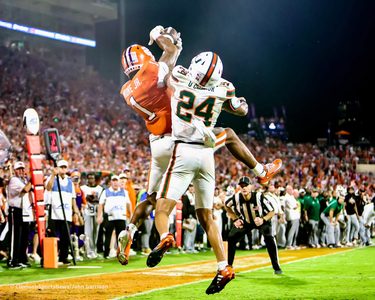
Washington’s interception will get the highlight, but one of the defining coverage snaps came just before it. With North Carolina needing one yard on fourth down late in the fourth quarter, Jerome Carter stayed glued to the route and Edwards’ throw fell incomplete, giving Clemson the ball back. That is exactly what shutdown secondary play looks like: leverage, tight windows and finishing possessions without allowing the quarterback an easy answer.
The Two-Game Sample Since LSU Is Extremely Encouraging
Now remove Baton Rouge and look only at Georgia Southern and North Carolina. Clemson has faced 78 passes and allowed only 40 completions for 379 yards.
That works out to 51.3% completions, 189.5 passing yards per game, 4.86 yards per attempt and 9.48 yards per completion. Opposing quarterbacks have thrown two touchdowns against one interception and generated a combined NCAA passing-efficiency rating of approximately 98.0.
Compared with LSU alone, Clemson’s yards allowed per pass attempt have fallen from 9.3 to 4.9 — a reduction of almost 48%. Yards per completion have dropped from 15.2 to 9.5. Completion percentage has fallen nearly 10 percentage points. And passing yardage has gone from LSU’s 335 to an average of 189.5 over the next two games.
That is not cosmetic improvement. That is a defense making the passing game dramatically less efficient.
The Pass Rush and Secondary Are Beginning to Feed Each Other
Perhaps the biggest reason this can continue is that Clemson is finally getting the front and back end of the defense working together. The Tigers recorded zero sacks against LSU. They have recorded six over the last two games, three against Georgia Southern and three against North Carolina. Heldt has produced two sacks in consecutive games, something Clemson had not had from one player in back-to-back contests since Jeremiah Trotter Jr. in 2022.
That changes everything for Hampton, Washington, Carter, Myrick, Corian Gipson and the rest of the coverage unit. Corners can challenge routes knowing quarterbacks cannot comfortably hold the football for four or five seconds. Safeties can drive downhill. Routes do not have as much time to develop. Quarterbacks begin throwing before receivers are completely uncovered, and those contested throws become PBUs, interceptions or incompletions.
Hampton looks increasingly comfortable as Clemson’s premier outside cover man. Washington has been around the football from the opener onward — two breakups against LSU, another against Georgia Southern and now the interception that ended UNC’s final possession. Clemson specifically brought Washington from Penn State to reunite him with defensive coordinator Tom Allen, and through the opening stretch he has supplied exactly the veteran presence Clemson needed opposite Hampton.
So, Are These Guys Becoming a Shutdown Secondary?
The evidence is beginning to say yes.
Three games remain a small sample, and LSU is still part of the résumé. Clemson will eventually face passing attacks capable of testing these numbers much more severely than Georgia Southern did, and one excellent afternoon against North Carolina does not settle the issue for an entire season.
But the trend is difficult to ignore.
Opposing completion percentage: 61.1 → 56.3 → 43.3.
Opponent yards per attempt: 9.3 → 5.1 → 4.5.
Opponent passer efficiency: 152.1 → 105.8 → 85.5.
Passing yards allowed: 335 → 244 → 135.
And over Clemson’s last six quarters, beginning with the second half against Georgia Southern and continuing through Saturday, the eye test has increasingly matched the numbers. Receivers are having fewer clean releases, throwing windows are getting smaller, Clemson is contesting the football, the rush is arriving sooner and the secondary is beginning to finish plays instead of merely being in position.
The LSU game showed Clemson exactly how far it had to go. Two weeks later, Hampton, Washington, Carter, Myrick and company are beginning to look less like a rebuilt secondary and more like a group quarterbacks may eventually decide they simply don’t want to challenge.