By Clemson Sports News
The Clemson Tigers have reached their bye week, and with the first portion of the 2026 season in the rearview mirror, it is time to hand out some grades. There have been encouraging developments, frustrating performances, unexpected standouts, and more than a few questions that remain unanswered as Clemson prepares to enter the second half of its schedule.
At 3-2, Clemson has certainly not lived up to all the expectations that surrounded this football team entering the season. Losses to LSU and Miami exposed some significant weaknesses, particularly along both lines of scrimmage, but the Tigers have also shown signs of improvement, especially with a freshman quarterback learning how to operate at this level.
The biggest question moving forward is whether Clemson can put everything together consistently enough to make a strong second-half run. There is talent on this roster, and there are certainly reasons for optimism, but there are also position groups that simply have not performed to the standard Clemson fans have come to expect.
With that in mind, Clemson Sports News takes a hard look at every phase of the football team, handing out grades based on performance, development, consistency, and expectations through the first five games.
The Overall Team Grades
OFFENSE
C+
DEFENSE
B+
SPECIAL TEAMS
A
OFFENSE — C+
The Clemson offense has been a work in progress from the opening kickoff, and while there have been some encouraging signs, there simply has not been enough consistency to warrant anything higher than a C-plus at the midway point.
To its credit, the offense has made strides in certain areas, particularly in establishing a running game when opportunities present themselves. There have also been flashes in the passing attack that suggest Clemson could become much more dangerous offensively as freshman quarterback Tait Reynolds continues to grow into his role.
The problem is that those flashes have not translated into sustained production against quality opponents. Clemson has struggled to generate consistency from one possession to the next, and much of that can be traced directly to the offensive line, particularly the right side.
Until Clemson identifies the right combination of players up front, the offense will continue to operate with limitations. There is enough talent at the skill positions to put points on the board, but the Tigers must find a way to protect their quarterback and establish some rhythm before expecting this unit to reach its full potential.
The C-plus reflects both the improvement we have witnessed and the significant amount of work that remains.
DEFENSE — B+
The Clemson defense has been the stronger of the two primary units, and there is a legitimate argument that this group could become something special if the Tigers can address their inconsistency against the run.
The secondary has been outstanding for much of the season, led by Ashton Hampton, who is rapidly establishing himself as one of the premier cornerbacks in college football. Hampton has the coverage ability, physicality, and confidence that make him a legitimate candidate to become the first cornerback selected when his NFL draft opportunity arrives.
Alongside Hampton, Elliot Washington II has emerged as a major playmaker, recording three interceptions through the first five games. Sammy Brown has continued to provide steady, high-level play at linebacker, giving Clemson a reliable presence in the middle of the defense.
The biggest concern remains the defensive front, where injuries, personnel changes, and inconsistent interior play have made stopping the run a challenge. Clemson has had difficulty finding a dependable rotation at defensive tackle, and opponents have been able to take advantage of that instability.
If the Tigers can become more physical and consistent up front, this defense has the potential to rank among the best in the country, especially against the pass.
SPECIAL TEAMS — A
If there is one phase of Clemson football that deserves widespread praise through the first portion of the season, it is special teams.
This group has been outstanding, providing consistency in the kicking game, strong contributions in coverage, and an explosive punt-return touchdown that demonstrated just how valuable special teams can be in changing the momentum of a football game.
With only one missed field goal through the first five games, the kicking operation has largely delivered when called upon. The return game has also created excitement, and Clemson has benefited from a level of execution that has not always been present in this phase in previous seasons.
Bryant Wesco Jr. even earned ACC Specialist of the Week recognition for his performance against California, further highlighting the impact of the Tigers’ return game.
Special teams can make a difference in close football games, and Clemson has a group capable of providing exactly that advantage during the second half of the season.
Offensive Position Grades
Quarterbacks
C+
There may not be a more fascinating storyline surrounding Clemson football right now than the development of true freshman quarterback Tait Reynolds.
Reynolds is growing up right in front of our eyes, and while the results have been inconsistent, his toughness and competitive personality have been impossible to overlook.
This young man has some Johnny Football in him, and I mean that in the best possible way. He has guts, confidence, and a willingness to put himself in harm’s way to make something happen. You simply cannot teach the kind of competitive fire that Reynolds brings to the football field.
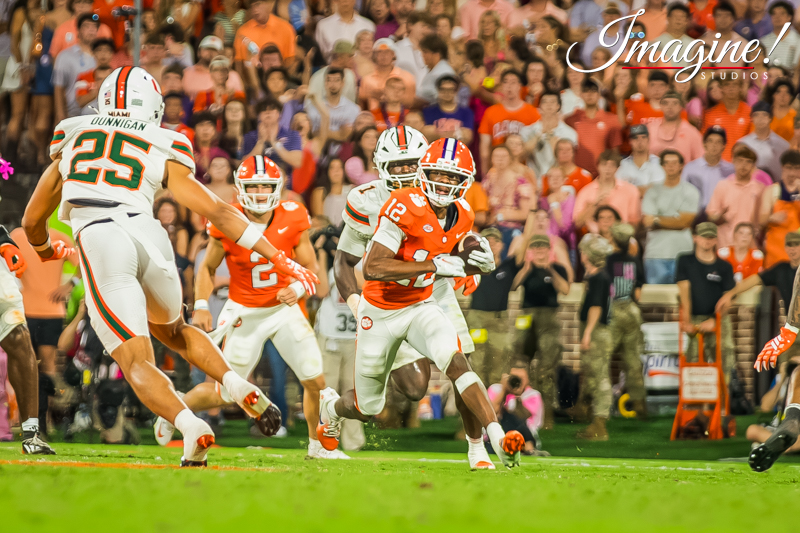
Against Miami, Reynolds completed 29 of 44 passes for 295 yards, demonstrating that he can move the football through the air even against elite competition. Those numbers are especially encouraging considering the amount of pressure he faced throughout the game.
There are still throws he needs to make, decisions he needs to improve, and situations where he must learn to trust the offense rather than trying to create everything himself. However, it is difficult not to be excited about what this young man could become.
The C-plus is a reflection of where he is today, not necessarily where he is headed. Clemson may have something very special developing at quarterback.
Running Backs
C
The running back room remains one of the more difficult position groups to evaluate because injuries and inconsistent offensive line play have made it challenging to establish a dependable rushing attack.
Jarvis Green has shown what he can provide when healthy, but nagging injuries have complicated his availability heading into the Charleston Southern matchup. The loss of David Eziomume for the season has also taken another option away from a backfield that could certainly use more depth and stability.
There have been moments when Clemson has successfully established its running game, but those performances have not come with enough consistency to inspire complete confidence.
Some of that responsibility belongs to the offensive line, where the lack of continuity has made it difficult for running backs to find predictable running lanes. However, this group must also produce more explosive plays and demonstrate that it can help carry the offense when the passing game struggles.
Until Clemson finds a dependable rotation and establishes a more consistent ground attack, a C is a fair assessment of the running backs.
Wide Receivers
C+
For a position group that entered the season with plenty of expectations, Clemson’s wide receivers have been somewhat disappointing through the first five games.
There have been individual bright spots, including Bryant Wesco Jr.’s outstanding performance against Miami, when he hauled in nine passes for 152 yards. Tyler Brown also delivered a productive game against the Hurricanes with 10 receptions for 76 yards.
Brown has flashed at other times throughout the season, while T.J. Moore has contributed without consistently becoming the game-changing presence many expected him to be.
The concern is that Clemson has not found a receiver who consistently takes control of a football game, forces defenses to adjust, and demands additional attention on every possession.
Freshman Gordon Sellars III has yet to make the kind of impact many hoped to see, and the Tigers have received limited meaningful production beyond their established primary targets.
Some of the inconsistency can be attributed to a freshman quarterback learning the offense and an offensive line struggling to provide adequate protection. Nevertheless, Clemson has recruited too much talent at wide receiver for this unit to remain merely average.
Someone needs to step forward during the second half of the season and become the reliable, explosive target this offense desperately needs.
Tight Ends
C+
Clemson’s tight ends have performed reasonably well when their numbers have been called, but the biggest issue with this position group is that the Tigers simply have not utilized them enough in the passing game.
There are opportunities to create mismatches with tight ends, particularly when defenses are concentrating on the outside receivers or applying pressure to a young quarterback. Clemson needs to make this position a more meaningful part of the offense.
One encouraging development has been the improvement of Olsen Patt-Henry as a blocker in the running game. His physicality and willingness to contribute at the point of attack have been noticeable, representing an improvement over some of what we have seen from the position in previous seasons.
The overall grade is not necessarily an indictment of the talent in the room. It reflects the lack of involvement and production that Clemson has generated from its tight ends.
There is more available here offensively, and it is time for the Tigers to take advantage of it.
Offensive Line
D
There is no way to sugarcoat this one. Clemson’s offensive line has been the biggest disappointment on the offensive side of the football, and the continued problems along the right side have become impossible to ignore.
The left side of the line had its own difficulties against LSU and Miami, two programs that feature outstanding defensive front talent. Those struggles are understandable to a degree, considering the level of competition.
The right side, however, has experienced problems against nearly everybody.
One particularly alarming figure from our breakdown of the Miami game was that 17 of the 20 quarterback pressures were attributed to the right side of Clemson’s offensive line. That is simply unacceptable, regardless of the opponent.
CSN film-review figure; not independently confirmed as an official pressure statistic.
At some point, Clemson must stop experimenting without finding answers and identify the best combination of players available.
Freshman Chance Barclay deserves an opportunity to demonstrate the athleticism and potential that made him such an attractive prospect coming out of high school. Whether Barclay ultimately proves to be the answer or someone else emerges, Clemson cannot continue allowing this level of pressure on its quarterback.
Reynolds has shown tremendous toughness, but toughness alone will not keep him healthy or allow this offense to grow.
The offensive line must improve dramatically if Clemson expects to take a meaningful step forward during the second half of the season.
Defensive Position Grades
Defensive Tackles / Interior Defensive Line
C−
The interior defensive line has been one of Clemson’s biggest question marks this season, and the inability to establish consistency up front has contributed directly to the Tigers’ occasional struggles against the run.
Amare Adams entered the season with enormous expectations. A former five-star prospect with tremendous physical tools, Adams has the ability to become a dominant player in the middle of Clemson’s defense.
However, the production simply has not matched the expectations or the investment made in keeping that talent in Clemson.
There have been flashes that remind everyone why Adams was considered such a special prospect, but flashes are not enough at this level. Clemson needs him to become a consistent, disruptive force who can control the line of scrimmage and make opposing offenses account for his presence.
Transfer Andy Burburija has also failed to make the kind of sustained impact many expected. He has provided occasional pressure and recorded a sack against Miami, but Clemson needs significantly more production and disruption from the interior rotation.
One move that deserves credit has been sliding Darien Mayo inside from defensive end. Mayo brings size and athleticism to the position, and the adjustment could help the Tigers improve their interior depth and versatility.
The possible return of Kourtney Kelly would also provide some much-needed reinforcement for a defensive tackle group that has been dealing with injuries and constant personnel changes.
The talent is certainly there, but talent alone does not stop the run. Clemson needs more physicality, better gap discipline, and greater consistency from this group before its grade can improve.
Defensive Ends
C+
Clemson’s defensive ends have shown more promise than the interior defensive line, but this group has also struggled to produce consistently enough to earn a higher grade.
Will Heldt has been the standout performer, demonstrating the size, athleticism, and pass-rushing ability that could eventually make him a first-round NFL draft selection.
Heldt looks the part of a future professional defensive end, and when he is playing at his best, he has the ability to disrupt an opponent’s entire offensive approach.
The problem is that Clemson needs more consistent production from the entire defensive end rotation, not just occasional big plays from its top performers.
There have been positive developments, including contributions from other members of the rotation, but the overall pass rush must become more dependable.
This is especially important because Clemson’s secondary has been providing strong coverage on the back end. When defensive backs are doing their jobs at such a high level, the defensive ends must take advantage by getting home and finishing plays.
There is enough talent here for a stronger second half, but this group must start turning potential into production.
Linebackers
B−
Clemson’s linebackers have been one of the steadier position groups on the defense, and there is plenty to like about the job being done by this unit.
Sammy Brown continues to demonstrate why he is considered one of the most talented linebackers in college football. His combination of athleticism, physicality, and football instincts makes him a difference-maker who can contribute in multiple ways.
Brown has remained a dependable presence, but one of the more encouraging developments has been the improvement of Jeremiah Alexander.
Alexander looks noticeably quicker this season, almost as though he has gained an extra step. He appears lighter on his feet, more comfortable moving laterally, and significantly more capable of dropping into coverage and defending players in the flat.
That added versatility has made him a much more complete linebacker and an important contributor to Clemson’s defense.
The linebacker room is doing many of the things it has been asked to do, although there is still room for improvement when it comes to cleaning up assignments and supporting the defensive line against the run.
A B-minus is appropriate for a group that has largely met expectations while showing encouraging individual development.
Cornerbacks
A+
If Clemson Sports News were handing out an award for the best position group on the entire football team, the cornerbacks would win it without much debate.
Ashton Hampton has been absolutely outstanding, playing the kind of lockdown coverage that has made him one of the most impressive defensive backs in college football.
In my opinion, Hampton has a legitimate argument to be considered the best CB1 in the country, and he certainly deserves consideration among the top cornerback prospects for his eventual NFL draft class.
He has the physical tools, the coverage instincts, and the confidence to challenge elite receivers, and his performances have been one of the biggest bright spots of Clemson’s season.
On the opposite side, Elliot Washington II has been equally impressive in his own way, producing three interceptions and establishing himself as one of the most productive defensive backs in the ACC.
Washington’s ability to find the football and capitalize on opportunities has made Clemson’s secondary incredibly difficult to attack. His two-interception
Between Hampton’s coverage ability and Washington’s knack for creating turnovers, Clemson has one of the best cornerback tandems anywhere in college football.
There is not much more you can ask from a position group than what these players have delivered through the first five games.
They have earned every bit of this A-plus.
Safeties
B+
Clemson’s safety group has quietly put together an impressive first half of the season, complementing the outstanding cornerback play and helping establish the Tigers as a potentially elite pass-defense unit.
There have been a few coverage breakdowns, and those mistakes cannot be ignored, but the overall communication and execution on the back end have been encouraging.
Corey Myrick has been particularly impressive with his ability to come downhill and provide support against the run.
Myrick has demonstrated the willingness to be physical, attack ball carriers, and make plays closer to the line of scrimmage. His eight-tackle performance against Miami demonstrated just how valuable he can be when Clemson needs help stopping opponents on the ground.
The safety group has also done a strong job communicating with the cornerbacks and maintaining coverage responsibilities throughout much of the season.
That chemistry is especially important when a defense is relying on its secondary to carry a significant portion of the workload.
There are still occasional mistakes that need to be addressed, but the overall performance has been very good.
When you combine the play of Clemson’s corners and safeties, there is a legitimate argument that the Tigers have one of the most talented pass defenses in America.
Whether they can finish the season among the nation’s best remains to be seen, but the foundation is certainly in place.
Complete Clemson Sports News Midseason Report Card
| Unit | Grade |
|---|---|
| Overall Offense | C+ |
| Overall Defense | B+ |
| Special Teams | A |
| Quarterbacks | C+ |
| Running Backs | C |
| Wide Receivers | C+ |
| Tight Ends | C+ |
| Offensive Line | D |
| Defensive Tackles / Interior Line | C− |
| Defensive Ends | C+ |
| Linebackers | B− |
| Cornerbacks | A+ |
| Safeties | B+ |
The Second Half: Can Clemson Put It All Together?
As Clemson prepares to return from its bye week and welcome Charleston Southern to Death Valley, there is plenty of work ahead for Dabo Swinney and his coaching staff.
The Tigers have some pieces that championship-caliber football teams need. They have a young quarterback with tremendous competitive instincts, a secondary capable of shutting down talented receivers, a reliable special teams unit, and enough individual talent on defense to create problems for opposing offenses.
What they do not have right now is consistency along the lines of scrimmage.
That, more than anything else, is the biggest concern surrounding this Clemson football team.
The offense cannot reach its potential if the quarterback is constantly running for his life, and the defense cannot become truly dominant if opponents can consistently find running lanes between the tackles.
Those problems have been exposed against quality competition, and simply hoping they disappear during the second half of the season is not an acceptable solution.
Clemson needs answers on the right side of the offensive line. The Tigers need more disruptive play from their defensive tackles, particularly from players who entered the season with high expectations. They need their wide receivers to produce more game-changing moments, and they need to continue developing Reynolds without forcing him to carry the entire offensive burden.
The encouraging part is that many of these problems appear correctable.
The bye week provided an opportunity to evaluate personnel, reassess combinations, and make adjustments before the Tigers begin the next stretch of their schedule.
There is still plenty of football remaining, and Clemson has enough talent to become a significantly better team than the one we have seen through five games.
However, improvement must begin at the line of scrimmage. Until that happens, the Tigers will continue to struggle against opponents with the size, speed, and physicality to challenge them up front.
The second half of the season will tell us whether Clemson is simply a talented football team searching for answers or a program capable of making the necessary adjustments to become a legitimate contender again.
For now, the grades reflect a football team with some outstanding individual performances, some promising young talent, and several areas that desperately need improvement.
The report card is in. Now it is time to see who makes the honor roll when the final grades are handed out in December.