By Clemson Sports News Staff
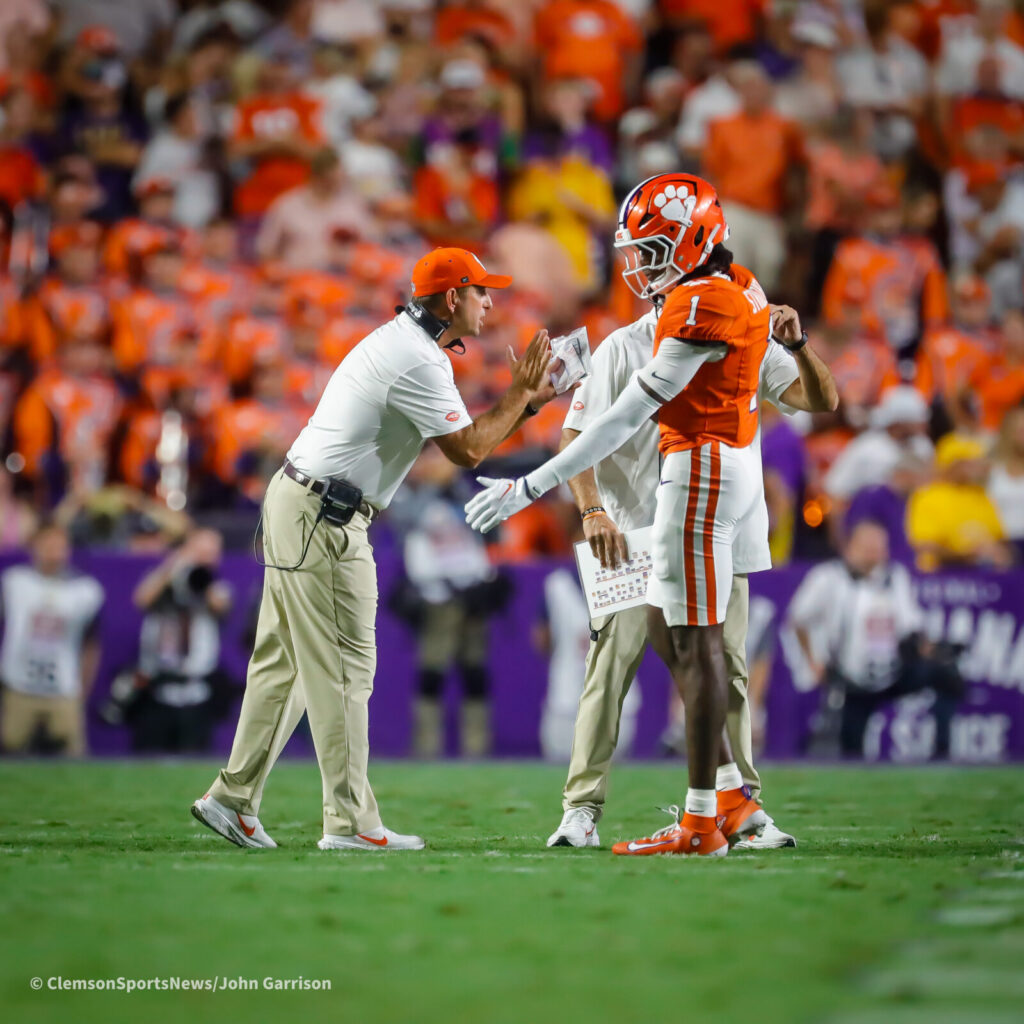
For years, Dabo Swinney has talked about the journey.
He has talked about getting on the bus, believing in the people sitting beside you, ignoring the noise outside the windows and trusting Clemson’s way to eventually get you where you want to go.
Well, after one Saturday night in Baton Rouge, there is suddenly a much more uncomfortable question surrounding Clemson football.
Are the wheels beginning to come off that bus, or can Dabo grab the steering wheel, get this thing back between the lanes and prove that Clemson football still has plenty of road ahead?
Because Clemson isn’t dealing with an ordinary 0-1 start.
The Tigers are dealing with the aftermath of a 51-10 demolition at LSU, the most lopsided loss of Swinney’s head-coaching career. Clemson was outgained 644-145, surrendered 309 rushing yards, produced only 40 of its own, finished with just eight first downs and converted only one of 13 third-down opportunities. LSU ran 94 offensive plays to Clemson’s 48 and controlled the football for more than 36 minutes.
Those aren’t numbers from a competitive game that got away late.
Those are numbers from a football team that was overwhelmed.
And that is precisely why what happened in Baton Rouge cannot simply be dismissed as Clemson losing a difficult road opener against a talented LSU team.
The concern is not that Clemson is 0-1.
The concern is how Clemson became 0-1.
This Didn’t Start Saturday Night
If Clemson were coming off another 11-win season, an ACC championship and a College Football Playoff run, Saturday could probably be tossed into the category of one horrific night.
But Clemson isn’t.
The Tigers finished 7-6 in 2025, including a 4-4 ACC record, and ended the season with a 22-10 loss to Penn State in the Pinstripe Bowl. Clemson averaged 27.2 points per game, finished just 3-4 at home and lost six games in a season for the first time since 2010.
That 2025 season itself had begun with LSU coming into Clemson and beating the Tigers 17-10. Then came losses to Georgia Tech and Syracuse in September, and a preseason team ranked No. 4 nationally quickly found itself trying to salvage its season instead of competing for a national championship.
So when Clemson traveled to Baton Rouge Saturday, this wasn’t simply another season opener.
It was supposed to be the first piece of evidence that 2025 had been corrected.
Instead, the opening night of 2026 looked frighteningly like the problems of 2025 had not disappeared at all. They had multiplied.
Clemson has now lost four consecutive season openers and five of its last six, although there is important context: the Tigers have repeatedly scheduled major opponents to begin seasons, including Georgia and LSU, and Clemson has opened against an AP-ranked opponent three consecutive years for the first time in school history. Still, championship programs eventually have to win some of those games.
At some point, strength of schedule stops being an explanation.
At some point, Clemson has to look like Clemson again.
Saturday Became an Avalanche
What made the LSU loss especially disturbing was that Clemson actually received exactly the kind of opening it needed.
On LSU’s second offensive play, Ashton Hampton intercepted Sam Leavitt and handed Clemson possession at the LSU 33-yard line.
It was the dream beginning.
Take the crowd out of the game. Punch LSU in the mouth. Put pressure on Lane Kiffin’s new team and give Christopher Vizzina an early lead.
Instead, Clemson couldn’t move the football and settled for Nolan Hauser’s 49-yard field goal.
3-0 Clemson.
It would be the Tigers’ only meaningful moment of control all night.
LSU responded with a field goal, followed with an 89-yard touchdown march, and then the game began sliding downhill at an increasingly frightening speed. Vizzina threw an interception to defensive end Jordan Ross, who returned it 30 yards for a touchdown.
Suddenly it was 17-3.
Leavitt then ripped Clemson with his legs, scoring twice on quarterback runs before halftime.
31-3 LSU.
At halftime, Clemson had been outgained 336-54 and had produced one first down compared with LSU’s 21.
The second half provided no miracle.
LSU continued scoring until it reached 51. Clemson didn’t reach the end zone until David Eziomume’s 11-yard run with a little more than three minutes remaining, long after the outcome had been decided.
It wasn’t one busted coverage.
It wasn’t three turnovers.
It wasn’t an officiating controversy.
It wasn’t one player having a bad night.
Clemson got beaten at quarterback. Clemson got beaten on the offensive line. Clemson got beaten on the defensive line. Clemson couldn’t run. Clemson couldn’t consistently protect. Clemson couldn’t get LSU off the field. Clemson couldn’t sustain possessions.
It was complete.
The Biggest Warning Sign Was Up Front
Of everything that happened, Clemson’s performance along both lines of scrimmage may be the most alarming.
Championship Clemson football was built there.
Go back to those great Swinney teams and Clemson might have featured Deshaun Watson or Trevor Lawrence, Sammy Watkins or Mike Williams, Travis Etienne or Wayne Gallman, but the identity of those teams was also found among men like Christian Wilkins, Dexter Lawrence, Clelin Ferrell, Austin Bryant and an offensive line that could survive championship football.
On Saturday night, LSU looked like the more physical football team.
And it wasn’t particularly close.
Clemson finished with 40 rushing yards on 26 attempts. Both quarterbacks were under pressure. Vizzina completed 10 of 16 passes for 83 yards with the pick-six, while freshman Tait Reynolds finished 4-of-6 for 22 yards after entering late in the first half.
Swinney acknowledged Sunday after reviewing the film that Clemson didn’t protect the quarterback well and didn’t play well up front. He also pointed to alignment mistakes, footwork problems and failures to finish blocks.
On defense, it was equally troubling.
LSU quarterback Sam Leavitt rushed for 113 yards. Running back Dilin Jones also went over 100. LSU repeatedly attacked Clemson’s edges, and when the Tigers failed to contain Leavitt, he turned broken situations into explosive runs.
Swinney called Clemson’s inability to hold the edge “very concerning.”
It should be.
Schemes can be adjusted. Plays can be changed. Quarterbacks can be switched.
But when a team is physically dominated on both sides of the football, the repair job becomes much larger.
The Quarterback Question Has Arrived Immediately
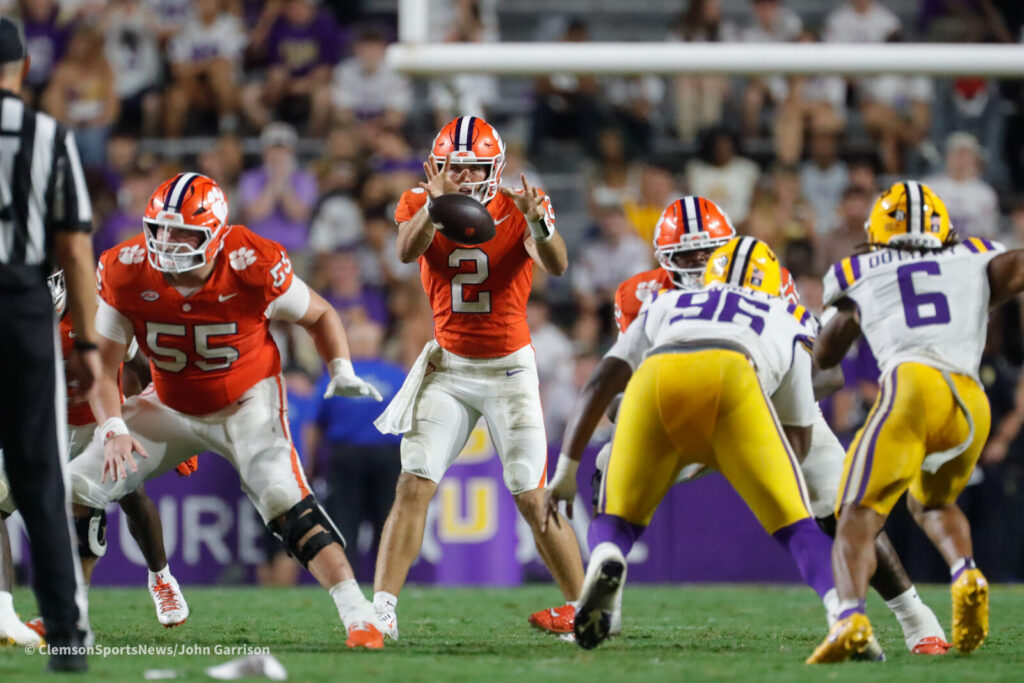
Clemson hoped to enter 2026 with Christopher Vizzina finally getting his opportunity.
Vizzina waited behind Cade Klubnik for three seasons. He remained committed to Clemson while the transfer portal changed college football around him. He had shown promise when given opportunities, including a 317-yard, three-touchdown performance in his previous start against SMU.
Dabo rewarded that patience by naming him the starter over talented freshman Tait Reynolds.
But Swinney also made it clear before LSU that the competition wasn’t necessarily finished.
Now it certainly isn’t.
Vizzina’s pick-six was damaging, but blaming the LSU disaster on him would be lazy. He was playing behind an offensive line that never allowed Clemson’s offense to become comfortable, and Clemson had virtually no rushing attack to take pressure off either quarterback.
Still, the position will be watched closely.
When Swinney was asked afterward whether Vizzina would start against Georgia Southern, his answer was simple: “I don’t know.”
That is a quarterback competition.
Maybe Vizzina responds and proves he is Clemson’s guy.
Maybe Reynolds’ mobility and upside ultimately win the position.
But Clemson can’t afford a month-long identity crisis at quarterback. Chad Morris and quarterbacks coach Tajh Boyd have to figure out which player gives this offense the best opportunity and then build around him.
And Then There Is Chad Morris
Morris’ return was one of Dabo’s biggest offseason moves.
After Clemson went 7-6 last season, Swinney turned back toward the man who helped transform Clemson’s offense more than a decade earlier. Morris’ original Clemson run from 2011-14 helped establish the offensive foundation for what eventually became a national powerhouse.
When announcing Morris’ return, Swinney even acknowledged the symmetry: the last time Clemson lost six or more games had been 2010, and his response then was also to hire Morris.
The obvious question was whether Clemson could recreate that magic in a sport that looks dramatically different in 2026.
Saturday offered an awful first answer.
145 yards. Eight first downs. Ten points. One third-down conversion.
Nobody should determine Chad Morris’ second Clemson tenure after one game against LSU in Baton Rouge.
But nobody should ignore it, either.
Clemson did not bring Morris back merely to improve a few statistics. Dabo brought him back because this offense needed an identity and because 2026 needed to feel different.
Against LSU, it looked worse.
Roster Turnover Is Real — But Clemson Knew It Was Coming
There is another piece of context Clemson fans should consider.
This is not the veteran roster Clemson carried into some previous seasons.
According to Clemson’s spring guide, the Tigers entered 2026 returning only eight starters — four on offense and four on defense — while losing 14 starters from their base units. Cade Klubnik, Antonio Williams, Bryant Wesco Jr., Blake Miller, Peter Woods, T.J. Parker, Avieon Terrell and others were among the significant departures.
Clemson also became more active in adding experienced transfers, particularly on defense, including additions in the defensive line, secondary and edge groups.
So this isn’t simply a matter of saying Dabo did nothing to address the roster.
He did.
But one decision will continue receiving scrutiny: Clemson elected not to pursue a transfer quarterback after Klubnik’s departure, with Swinney expressing confidence in Vizzina, Reynolds and the quarterbacks already inside the program.
That faith may eventually be rewarded.
After Saturday, however, the burden of proof has shifted.
This Is Now About Dabo
And that is where the conversation ultimately arrives.
Dabo Swinney has earned enormous equity at Clemson.
Two national championships.
Nine ACC championships.
A six-year College Football Playoff run.
Thirteen 10-win seasons.
He didn’t inherit Clemson as a national powerhouse. He built one.
That history cannot be erased because of one terrible Saturday night.
But history also doesn’t make the present irrelevant.
College football is ruthless about that.
The sport has changed. Roster management has changed. NIL has changed recruiting. The transfer portal has changed depth charts. Coaching staffs turn over faster. Players move faster. Championship windows open and close faster.
Swinney has remained convinced Clemson can adapt without surrendering what made Clemson different.
That is an admirable position when it works.
When Clemson is losing 51-10, however, principles aren’t what fans see on the scoreboard.
Results are.
And Dabo understands the responsibility belongs with him.
After reviewing the LSU film Sunday, Swinney said responsibility rested with Clemson’s coaches because preparing the team is their job.
That is exactly where it should rest.
Not because the players don’t have responsibility. They certainly do.
But Dabo built this roster. Dabo assembled this staff. Dabo chose this quarterback strategy. Dabo brought Morris back. Dabo has shaped Clemson’s approach to modern roster construction.
If this works, he deserves the credit.
If it doesn’t, the responsibility ultimately lands in the same office.
Georgia Southern Suddenly Matters — A Lot
Clemson returns to Memorial Stadium on September 12 to face Georgia Southern at 7:30 p.m. The Tigers then host North Carolina before traveling across the country for a Friday-night game at Cal. Miami arrives in Death Valley on October 3.
On paper, Georgia Southern shouldn’t be viewed as some grand referendum on Clemson football.
Emotionally, it absolutely is.
Clemson doesn’t merely need to win.
The Tigers need to look different.
They need to establish the line of scrimmage.
They need to run the football.
They need manageable third downs.
They need offensive rhythm.
They need defensive tackles for loss.
They need to tackle.
They need quarterback clarity.
They need urgency without panic.
Most importantly, they need confidence.
Because another sluggish performance — even in victory — will only make the noise louder heading into ACC play.
Are the Wheels Actually Coming Off?
Not yet.
One football game, even one as historically ugly as Saturday’s, cannot answer that question definitively.
Clemson is 0-1, not 0-5.
The ACC championship remains available. Clemson still has a talented roster. There are young players capable of improving rapidly. There are veteran coaches who have solved football problems before.
And Dabo certainly believes his team will respond.
On Sunday he said Clemson is better than it showed in Baton Rouge and predicted the Tigers will still have a “great season.”
Now comes the hard part.
Proving it.
Because Clemson fans have heard offseason optimism before. They’ve heard about great practices, tremendous chemistry, talented young players, development and how close the program is.
After 7-6 in 2025 and 51-10 to begin 2026, words aren’t going to settle this debate anymore.
Football will.
Dabo Has Been Here Before — But This Time Feels Different
There is an irony to the moment.
After Clemson went 6-7 in 2010, there were plenty of people questioning Swinney.
He responded by hiring Chad Morris.
The Tigers then went 10-4, won the ACC championship and began climbing toward one of the greatest stretches in modern college football history.
Fifteen years later, Clemson again came off a six-loss season.
Dabo again called Chad Morris.
Maybe history repeats itself.
Maybe Saturday night becomes one of those games everyone remembers months later as the moment Clemson was embarrassed badly enough to change.
Maybe Vizzina or Reynolds takes control of the quarterback position. Maybe the offensive line settles down. Maybe Tom Allen gets the defensive front repaired. Maybe Clemson reaches October looking entirely different from the team that staggered out of Baton Rouge.
That’s possible.
But there is another possibility Clemson fans have every right to consider.
Maybe Saturday wasn’t an aberration.
Maybe it was a warning.
Maybe the gap Clemson has spent several years trying to close against the nation’s elite has grown larger instead.
The next several weeks will begin giving us that answer.
The Bus Is Still Moving — But Dabo Better Grab the Wheel
Dabo Swinney once built Clemson by convincing everyone inside the program to believe before there was much external evidence that they should.
Eventually, Clemson proved him right.
That’s why Saturday night does not erase everything that came before it.
But legacy cannot drive the bus forever.
The 2026 Clemson Tigers have to.
Right now, that bus just got knocked violently toward the shoulder.
One wheel may have crossed the white line.
The warning lights are flashing.
Everybody outside the program is pointing and wondering whether this is finally the moment when the remarkable Clemson run under Dabo Swinney starts coming apart.
The answer isn’t known yet.
What is known is that Swinney is still sitting in the driver’s seat.
There are 11 regular-season games remaining.
There is still an ACC championship to chase.
There is still time to fix the offense, settle the quarterback position, rebuild confidence and restore the physical edge that once defined Clemson football.
But after 7-6 followed immediately by 51-10, Clemson no longer has the luxury of assuming everything eventually works itself out.
Dabo has to make it work.
And he has to make it work quickly.
Are the wheels coming off?
Maybe not.
But for the first time in a long time, Clemson fans can hear them rattling.
Now we’re going to find out whether one of the greatest coaches in college football history can grab the wheel, straighten out the bus and put Clemson football back between the lanes — or whether Saturday night in Baton Rouge was the first unmistakable sign that the road Clemson has traveled for nearly two decades is beginning to reach its end.