For most of the last decade and a half, there were certain places in college football that opposing teams simply did not want to visit. Tuscaloosa was one. Columbus was another. And for a long stretch, Clemson’s Memorial Stadium belonged firmly on that list.
Death Valley was not just a nickname. It had become a warning.
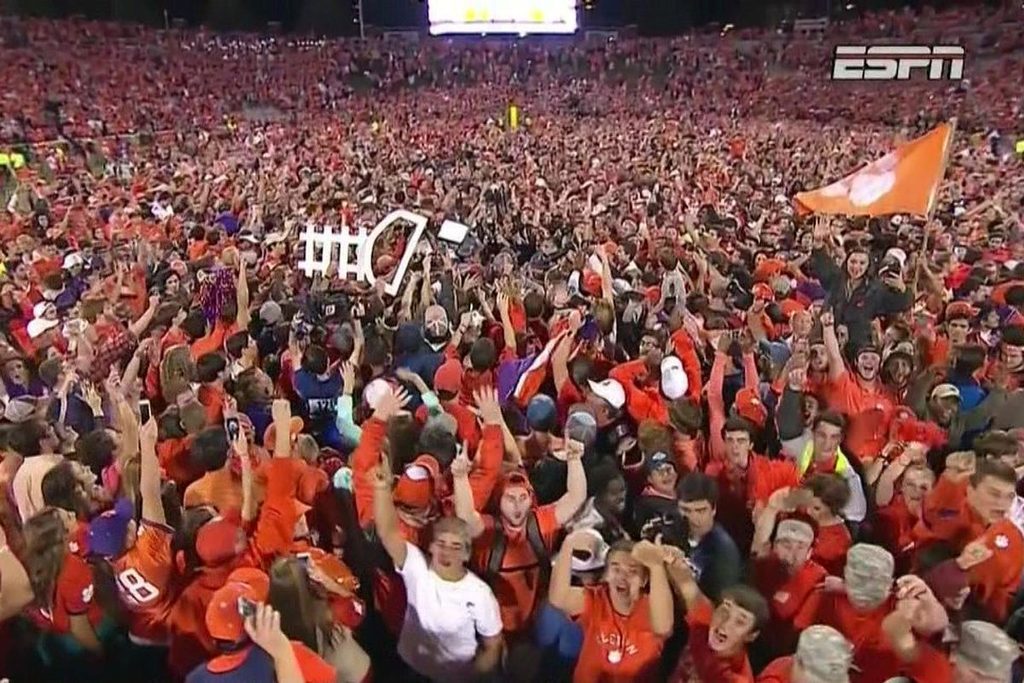
Opponents knew exactly what was waiting for them when the buses made the familiar ride around the stadium, when Clemson gathered at Howard’s Rock and when the Tigers came pouring down the Hill into a wall of orange. More than 80,000 people packed into Memorial Stadium, the noise trapped between those concrete decks, and a Clemson team that almost never lost at home combined to create one of the most intimidating environments in college football.
There was a point when Clemson did not simply have a home-field advantage. It had a home-field expectation. The Tigers expected to win there, the fans expected to win there, and visiting teams often arrived knowing that almost nobody else had been able to survive the experience.
That is why the question has become impossible to ignore now.
Where has the “death” gone in Death Valley?
The stadium is still there. The Hill is still there. Howard’s Rock is still there. Tiger Rag still pours through the speakers. Clemson fans still fill one of the largest stadiums in the country. Yet the aura surrounding the place has changed, and the numbers make that clear.
As No. 4 Miami prepares to come to Clemson for Saturday night’s 7:30 p.m. showdown on ABC, the game presents an opportunity that goes beyond one night and one opponent. It gives Clemson a chance to remind the rest of college football what Death Valley used to represent.
To understand what has changed, however, you first have to understand just how dominant Clemson once was at home.
A Fortress for Nearly a Decade
From 2011 through 2020, Clemson went an astonishing 66-3 in games played inside Memorial Stadium.
That is a winning percentage of 95.7 percent.
Over a full decade, Clemson lost three home football games.
Three.
The Tigers were 7-0 at home in 2011, 6-1 in both 2012 and 2013, then went unbeaten at home in 2014 and 2015. Clemson lost one home game in 2016 before running the table at Memorial Stadium in each of the next four seasons, including 2020.
That stretch coincided with Clemson’s rise from perennial contender to national power, but it also helped fuel that rise. The Tigers were not simply winning because they had great teams. The environment they created at home became part of the program’s identity.
Between 2014 and 2023, Clemson went 65-3 at Memorial Stadium. During that stretch, the Tigers established one of the most dominant home records in modern college football, including a 40-game home winning streak that stretched from 2016 until South Carolina snapped it in November 2022.
Forty straight home victories meant entire classes of Clemson players could spend almost their entire college careers without experiencing a home loss. Clemson’s 2022 senior class finished 25-1 in Memorial Stadium.
That kind of success changes the psychology of a building.
Clemson fans did not arrive wondering whether their team would win. They arrived expecting it. Opposing teams did not look at Memorial Stadium as just another difficult road trip. They knew the history. They knew how few teams had survived there. They knew the noise was coming, and they knew Clemson had developed a habit of turning close home games into victories.
That is what gave Death Valley its edge.
The Numbers Since 2020 Tell a Different Story
Since the beginning of the 2021 season, Clemson’s home record has fallen to 28-8 through the early portion of 2026.
That is still a good home record by the standards of most college football programs, but the comparison with the previous decade is striking.
Clemson won 95.7 percent of its home games from 2011 through 2020. Since 2021, that number has fallen to 77.8 percent.
The more recent trend is even harder to ignore.
From 2014 through 2023, Clemson lost three home games in 68 opportunities.
Since the beginning of the 2024 season, Clemson has already lost six times at Memorial Stadium.
That is the change people are feeling when they talk about Death Valley not quite feeling like Death Valley anymore. It is not nostalgia. It is measurable.
The fortress has become more vulnerable.
The symbolic crack in the wall came in November 2022 when South Carolina walked into Memorial Stadium and won 31-30, ending Clemson’s 40-game home winning streak. The following season, Florida State came to Clemson and won 31-24 in overtime.
Then the losses became more frequent.
Clemson went 5-2 at home in 2024, and in 2025 the decline became impossible to overlook. LSU came to Death Valley and won 17-10. Syracuse won there 34-21. SMU won 35-24. Duke won a 46-45 shootout.
Clemson finished the 2025 season just 3-4 at home, the program’s first losing home record since 1998.
For a generation of Clemson fans accustomed to dominance, that is almost difficult to process.
There was once a time when an opponent winning at Death Valley was national news because of how rarely it happened. Over the last few seasons, visiting teams have started proving that it can be done.
That changes the psychology on both sidelines.
This Is Not Simply a Fan Problem
It would be easy to look at the change in atmosphere and point the finger exclusively at Clemson fans, but that would oversimplify what is happening.
Clemson still draws enormous crowds. Even during the disappointing 2025 season, the Tigers averaged roughly 79,000 fans per home game, remaining among the national leaders in attendance and at the top of the ACC.
The stadium is not empty.
The fan base has not disappeared.
What has changed is the level of confidence and, at times, urgency inside the building.
There is a difference between attendance and atmosphere.
A stadium can have 79,000 people in the seats and still not feel the way it did when every third down carried the tension of a playoff race and every home game felt like Clemson was defending a national championship-caliber standard.
There have also been signs of declining engagement beyond the announced attendance figures. Ticket-scan data from recent seasons has shown a gap between announced attendance and the number of people actually entering the stadium, particularly as disappointing seasons have worn on.
Spring game crowds have also declined from the heights of Clemson’s championship era.
That does not mean Clemson fans stopped caring. It means sustained success created an extraordinary standard, and several years of frustration have taken some energy out of the relationship between the team and the crowd.
The truth is that home-field advantage has always been a partnership.
The fans need the team, and the team needs the fans.
How Death Valley Used to Feed on Itself
The great Clemson environments were rarely created by the crowd alone. They were created by a cycle that started on the field and quickly spread through the stadium.
Clemson would get an early sack. The crowd would erupt.
The visiting offense would come back to the line on third down and struggle to communicate. A false start would move the opponent backward.
Now third-and-6 had become third-and-11.
The crowd would get even louder.
The quarterback might have to burn a timeout. The defense would feed off the energy. A punt or turnover would follow. Clemson’s offense would take over, and suddenly the entire stadium felt as though the game was beginning to tilt downhill.
That was Death Valley at its best.
The crowd was not simply watching the game. It was affecting the game.
Clemson has produced an enormous number of opposing false starts at Memorial Stadium over the years, and there have been games when visiting teams committed five or six of them. That is not an abstract concept. Those are real yards and real downs created because offensive linemen and quarterbacks could not hear one another.
Five yards can turn a manageable third down into a difficult one. One timeout burned in the first half because of crowd noise can become a critical missing timeout late in the fourth quarter.
That is what an elite home-field advantage does.
It changes football games in small ways until those small ways become decisive.
Clemson Has Still Delivered Against Ranked Teams
For all of the concern about Death Valley losing some of its edge, Clemson’s record against ranked opponents at home remains one of the strongest reminders of what the stadium can still become.
Since 2015, Clemson has lost only three home games against ranked opponents.
During that span, some of the program’s most memorable victories have come under the lights or in adverse conditions at Memorial Stadium.
There was No. 6 Notre Dame in the rain in 2015, a game that became one of the defining moments of Clemson’s rise. There was No. 3 Louisville and Lamar Jackson in 2016, a night when Death Valley shook from beginning to end. Auburn, NC State, Texas A&M, Miami, Wake Forest, Syracuse, Notre Dame and North Carolina have all come into Memorial Stadium ranked during the years since and walked out with losses.
Those nights matter because they show that the formula has not disappeared completely.
It just needs to be rediscovered.
That brings us to Miami.
Saturday Night Is the Kind of Game Death Valley Was Built For
There could hardly be a better opportunity to restore some of the stadium’s old reputation.
Miami arrives ranked No. 4 in the country. The Hurricanes are unbeaten. Clemson is playing at night. The game is on ABC. There is a possibility of heavy rain and difficult weather, which could make the night even more chaotic.
This is exactly the type of environment that once made Clemson so dangerous.
The Tigers are also trying to earn their first home victory over a Top-5 opponent since the great championship-era teams of the previous decade.
The last one came in 2016 when Clemson defeated No. 3 Louisville 42-36 in one of the greatest games ever played in Memorial Stadium.
That night had everything.
Deshaun Watson. Lamar Jackson. Prime time. Two elite teams. A packed stadium. A fourth-quarter finish. And a crowd that seemed to grow louder with every snap.
Clemson does not have to recreate the 2016 team Saturday night.
But the people inside Memorial Stadium can recreate the environment.
Death Valley Has to Become Death Valley Again
This may be one of Clemson’s most important assignments of the night, and it belongs to the fans.
Show up early.
Be in the seats before the opening kick.
If the rain comes, stay through it.
When Miami breaks the huddle, make the Hurricanes communicate through noise. Make quarterback Darian Mensah shout protections. Make the offensive linemen look toward the center because they cannot hear the cadence. Force Miami to use hand signals. Make the Hurricanes burn a timeout.
Create a false start.
Turn third-and-6 into third-and-11.
That is not cheerleading. That is football.
Clemson fans have done it before, and Memorial Stadium has a long history of creating exactly those kinds of problems for visiting offenses.
But Clemson’s defense has a responsibility in this, too.
The fastest way to bring Death Valley back to life is to give the crowd something to explode about early.
Imagine Miami receiving the opening kickoff and Clemson forcing a three-and-out. Suddenly the building changes.
Now imagine a sack on the second possession.
Or a turnover.
Or a goal-line stand.
The volume climbs. The confidence returns. Miami begins feeling pressure not only from the Clemson defense but from the stadium surrounding it.
Belief spreads quickly inside Memorial Stadium.
So does doubt.
Clemson’s job Saturday night is to make sure the visiting sideline begins feeling the latter.
The Greatest Thing Clemson Lost Was Certainty
The biggest difference between Death Valley during Clemson’s championship years and Death Valley today may not be the decibel level.
It may be certainty.
For years, Clemson fans believed their team would find a way to win.
The players believed it.
More importantly, opponents often seemed to believe it, too.
When a team has won 40 consecutive home games and 65 of 68 over a decade, visiting players begin looking for evidence that something is about to go wrong. A missed field goal, a turnover, a bad third-down penalty or a blown coverage begins to feel inevitable because history says Clemson always finds a way inside that stadium.
That psychological edge is difficult to quantify, but it is very real.
When opponents begin winning regularly, it disappears.
Miami can come into Clemson now knowing that South Carolina has won there. Florida State has won there. LSU has won there. Syracuse has won there. SMU has won there. Duke has won there.
That is very different from walking into a stadium where almost nobody had won for years.
If Clemson wants the reputation back, it has to rebuild it one Saturday at a time.
The Crowd Cannot Do It Alone — But Clemson Cannot Do It Without Them
There is no button Clemson can push that immediately turns Memorial Stadium back into the version of Death Valley that terrorized opponents during the championship years.
Reputations are built through repetition.
The team has to start winning the big games at home again.
The defense has to create havoc.
The offense has to give the crowd opportunities to celebrate instead of reasons to sit on its hands.
The fans, meanwhile, have to remember that home-field advantage does not begin in the fourth quarter of a close game.
It begins before kickoff.
It begins when Miami walks out for warmups.
It begins when the Hurricanes break the huddle on their first possession.
It begins on third-and-4 in the first quarter when the visiting quarterback is still trying to settle into the game.
Clemson needs 81,000 people to become participants again.
Saturday night is not about pretending the last several seasons never happened. They happened, and the home record proves it.
It is about deciding what comes next.
There was a time when teams walked through that east end zone, looked around at the wall of orange, heard the roar rolling through the stadium and understood they were not simply playing Clemson.
They were playing Clemson in Death Valley.
There was a difference.
Over the last few seasons, that difference has become smaller.
Against No. 4 Miami on Saturday night, Clemson has a chance to start making it enormous again.
So where is the death in Death Valley?
Maybe the better question is whether the Tigers and 81,000 Clemson fans are ready to put it back there.